100% satisfaction guarantee Immediately available after payment Both online and in PDF No strings attached 4.2 TrustPilot
logo-home
Exam (elaborations)

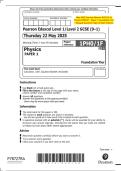
May 2025 Pearson Edexcel: GCSE (9–1) Physics IPHO/IF – Paper 1: Foundation Tier – Merged Question Paper & Mark Scheme.

Rating
-
Sold
-
Pages
69
Grade
A+
Uploaded on
04-10-2025
Written in
2025/2026

May 2025 Pearson Edexcel: GCSE (9–1) Physics IPHO/IF – Paper 1: Foundation Tier – Merged Question Paper & Mark Scheme. Answer ALL questions. Write your answers in the spaces provided. Some questions must be answered with a cross in one of the four boxes . If you change your mind about an answer, put a line through the box and then mark your new answer with a cross . 1 (a) Figure 1 shows a ray of light incident on a mirror. mirror (i) Draw the reflected ray on Figure 1. Figure 1 (1) (ii) On Figure 1, label the angle of incidence with the letter i and the angle of reflection with the letter r. 2 (2) ■■■■ DO NOT WRITE IN THIS AREA DO NOT WRITE IN THIS AREA DO NOT WRITE IN THIS AREA (b) A lens has a focal length of 17cm. Calculate the power of the lens in dioptres. Use the equation power (in dioptres) = 1 focal length (in metres) (3) power =...........................dioptres (c) Which of these is the best reason for explaining why a leaf appears green in daylight? (1) ■■■■ A the leaf absorbs green light only B the leaf absorbs yellow and blue light only C the leaf reflects green light only D the leaf reflects yellow and blue light only (Total for Question 1 = 7 marks) 3 Turn over DO NOT WRITE IN THIS AREA DO NOT WRITE IN THIS AREA DO NOT WRITE IN THIS AREA DO NOT WRITE IN THIS AREA DO NOT WRITE IN THIS AREA BLANK PAGE 4 ■ ■ ■ ■ infrared gamma ultraviolet radio waves 2 (a) Draw one straight line from each electromagnetic radiation to its correct description. (3) electromagnetic radiation (b) Different colours of light have different frequencies. Which of these colours has the highest frequency? A blue B green C red D yellow ■■■■ description (1) 5 Turn over the most dangerous radiation may damage eyes, so sunglasses worn as protection the least dangerous radiation used in night vision cameras DO NOT WRITE IN THIS AREA DO NOT WRITE IN THIS AREA DO NOT WRITE IN THIS AREA ray of light coming in glass block ray of light going out (c) Figure 2 is a diagram of a glass block being used to investigate the refraction of light. (Source: © ajizai/) Figure 2 The angle of incidence was varied and the angle of refraction was measured each time. Figure 3 shows the results in a table. angle of incidence in degrees angle of refraction in degrees 20 13 30 20 40 25 50 31 60 35 70 39 80 41 Figure 3 6 ■■■■ DO NOT WRITE IN THIS AREA DO NOT WRITE IN THIS AREA DO NOT WRITE IN THIS AREA Figure 4 shows a graph of these results. 45 40 35 30 angle ofrefraction 25 in degrees 20 15 10 5 0 angle of incidence in degrees Figure 4 (i) The two shaded rows in Figure 3 are not plotted on the graph in Figure 4. Plot these missing results on the graph in Figure 4. (ii) Draw a curve of best fit through the points on the graph in Figure 4. (iii) Using Figure 4, describe the relationship between the angle of refraction and the angle of incidence. (2) (1) (2) . . . . . . . . . . . . . . . . . . . . . . . . . . . . . . . . . . . . . . . . . . . . . . . . . . . . . . . . . . . . . . . . . . . . . . . . . . . . . . . . . . . . . . . . . . . . . . . . . . . . . . . . . . . . . . . . . . . . . . . . . . . . . . . . . . . . . . . . . . . . . . . . . . . . . . . . . . . . . . . . . . . . . . . . . . . . . . . . . . . . . . . . . . . . . . . . . . . . . . . . . . . . . . . . . . . . . . . . . . . . . . . . . . . . . . . . . . . . . . . . . . . . . . . . . . . . . . .. . . . . .. . . . . .. . . . . . . . . . . . . . . . . . . . . . . . . . . . . . . . . . . . . . . . . . . . . . . . . . . . . . . . . . . . . . . . . . . . . . . . . . . . . . . . . . . . . . . . . . . . . . . . . . . . . . . . . . . . . . . . . . . . . . . . . . . . . . . . . . . . . . . . . . . . . . . . . . . . . . . . . . . . . . . . . . . . . . . . . . . . . . . . . . . . . . . . . . . . . . . . . . . . . . . . . . . . . . . . . . . . . . . . . . . . . . . . . . . . . . . . . . . . . . . . . . . . . . . . . . . . . . . . . . . . . . . .. . . . . .. . . . . .. . . . . . . . . . . . . . . . . . . . . . . . . . . . . . . . . . . . . . . . . . . . . . . . . . . . . . . . . . . . . . . . . . . . . . . . . . . . . . . . . . . . . . . . . . . . . . . . . . . . . . . . . . . . . . . . . . . . . . . . . . . . . . . . . . . . . . . . . . . . . . . . . . . . . . . . . . . . . . . . . . . . . . . . . . . . . . . . . . . . . . . . . . . . . . . . . . . . . . . . . . . . . . . . . . . . . . . . . . . . . . . . . . . . . . . . . . . . . . . . . . . . . . . . . . . . . . . . . . . . . . . .. . . . . .. . . . . .. . . . . . . . . . . . . . . . . . . . . . . . . . . . . . . . . . . . . . . . . . . . . . . . . . . . . . . . . . . . . . . . . . . . . . . . . . . . . . . . . . . . . . . . . . . . . . . . . . . . . . . . . . . . . . . . . . . . . . . . . . . . . . . . . . . . . . . . . . . . . . . . . . . . . . . . . . . . . . . . . . . . . . . . . . . . . . . . . . . . . . . . . . . . . . . . . . . . . . . . . . . . . . . . . . . . . . . . . . . . . . . . . . . . . . . . . . . . . . . . . . . . . . . . . . . . . . . . . . . . . . . .. . . . . .. . . . . .. . . . . . . . . (Total for Question 2 = 9 marks) ■■■■ 7 Turn over DO NOT WRITE IN THIS AREA DO NOT WRITE IN THIS AREA DO NOT WRITE IN THIS AREA 3 Figure 5 shows a velocity / time graph for a car moving on a test track. 30 25 S R 20 velocity in m / s 15 10 Q 5 0 T P 25 30 35 time in s Figure 5 (a) (i) Use this graph to describe the velocity of the car in stages TS, SR and RQ. TS (3) . . . . . . . . . . . . . . . . . . . . . . . . . . . . . . . . . . . . . . . . . . . . . . . . . . . . . . . . . . . . . . . . . . . . . . . . . . . . . . . . . . . . . . . . . . . . . . . . . . . . . . . . . . . . . . . . . . . . . . . . . . . . . . . . . . . . . . . . . . . . . . . . . . . . . . . . . . . . . . . . . . . . . . . . . . . . . . . . . . . . . . . . . . . . . . . . . . . . . . . . . . . . . . . . . . . . . . . . . . . . . . . . . . . . . . . . . . . . . . . . . . . . . . . . . . . . . . .. . . . . .. . . . . .. . . . . . . . . . . . . . . . . . . . . . . . . . . . . . . . . . . . . . . . . . . . . . . . . . . . . . . . . . . . . . . . . . . . . . . . . . . . . . . . . . . . . . . . . . . . . . . . . . . . . . . . . . . . . . . . . . . . . . . . . . . . . . . . . . . . . . . . . . . . . . . . . . . . . . . . . . . . . . . . . . . . . . . . . . . . . . . . . . . . . . . . . . . . . . . . . . . . . . . . . . . . . . . . . . . . . . . . . . . . . . . . . . . . . . . . . . . . . . . . . . . . . . . . . . . . . . . . . . . . . . . .. . . . . .. . . . . .. . . . . . . . . SR . . . . . . . . . . . . . . . . . . . . . . . . . . . . . . . . . . . . . . . . . . . . . . . . . . . . . . . . . . . . . . . . . . . . . . . . . . . . . . . . . . . . . . . . . . . . . . . . . . . . . . . . . . . . . . . . . . . . . . . . . . . . . . . . . . . . . . . . . . . . . . . . . . . . . . . . . . . . . . . . . . . . . . . . . . . . . . . . . . . . . . . . . . . . . . . . . . . . . . . . . . . . . . . . . . . . . . . . . . . . . . . . . . . . . . . . . . . . . . . . . . . . . . . . . . . . . . .. . . . . .. . . . . .. . . . . . . . . . . . . . . . . . . . . . . . . . . . . . . . . . . . . . . . . . . . . . . . . . . . . . . . . . . . . . . . . . . . . . . . . . . . . . . . . . . . . . . . . . . . . . . . . . . . . . . . . . . . . . . . . . . . . . . . . . . . . . . . . . . . . . . . . . . . . . . . . . . . . . . . . . . . . . . . . . . . . . . . . . . . . . . . . . . . . . . . . . . . . . . . . . . . . . . . . . . . . . . . . . . . . . . . . . . . . . . . . . . . . . . . . . . . . . . . . . . . . . . . . . . . . . . . . . . . . . . .. . . . . .. . . . . .. . . . . . . . . RQ . . . . . . . . . . . . . . . . . . . . . . . . . . . . . . . . . . . . . . . . . . . . . . . . . . . . . . . . . . . . . . . . . . . . . . . . . . . . . . . . . . . . . . . . . . . . . . . . . . . . . . . . . . . . . . . . . . . . . . . . . . . . . . . . . . . . . . . . . . . . . . . . . . . . . . . . . . . . . . . . . . . . . . . . . . . . . . . . . . . . . . . . . . . . . . . . . . . . . . . . . . . . . . . . . . . . . . . . . . . . . . . . . . . . . . . . . . . . . . . . . . . . . . . . . . . . . . .. . . . . .. . . . . .. . . . . . . . . . . . . . . . . . . . . . . . . . . . . . . . . . . . . . . . . . . . . . . . . . . . . . . . . . . . . . . . . . . . . . . . . . . . . . . . . . . . . . . . . . . . . . . . . . . . . . . . . . . . . . . . . . . . . . . . . . . . . . . . . . . . . . . . . . . . . . . . . . . . . . . . . . . . . . . . . . . . . . . . . . . . . . . . . . . . . . . . . . . . . . . . . . . . . . . . . . . . . . . . . . . . . . . . . . . . . . . . . . . . . . . . . . . . . . . . . . . . . . . . . . . . . . . . . . . . . . . .. . . . . .. . . . . .. . . . . . . . . (ii) State how the motion of the car is different in RQ compared with QP.

Show more Read less
Institution
May 2025 Pearson Edexcel: GCSE Physics IPHO/
Course
May 2025 Pearson Edexcel: GCSE Physics IPHO/


Whoops! We can’t load your doc right now. Try again or contact support.

Written for

Institution
May 2025 Pearson Edexcel: GCSE Physics IPHO/
Course
May 2025 Pearson Edexcel: GCSE Physics IPHO/

Document information

Uploaded on
October 4, 2025
Number of pages
69
Written in
2025/2026
Type
Exam (elaborations)
Contains
Questions & answers

Subjects

Content preview

Please check the examination details below before entering your candidate information
Candidate surname Other names


Centre Number Candidate Number May 2025 Pearson Edexcel: GCSE (9–1)
Physics IPHO/IF – Paper 1: Foundation Tier
– Merged Question Paper & Mark Scheme.


Pearson Edexcel Level 1/Level 2 GCSE (9–1)
Thursday 22 May 2025
Morning (Time: 1 hour 45 minutes) Paper
reference 1PH0/1F
Physics 🟐 🟐


PAPER 1

Foundation Tier
You must have: Total Marks
Calculator, ruler, Equation Booklet (enclosed)


Instructions

•• Use black ink or ball-point pen.
Fill in the boxes at the top of this page with your name,
centre number and candidate number.
•• Answer all questions.
Answer the questions in the spaces provided
– there may be more space than you need.

Information

•• The total mark for this paper is 100.
The marks for each question are shown in brackets

• Instructure
– use this as a guide as to how much time to spend on each question.
questions marked with an asterisk (*), marks will be awarded for your ability to
your answer logically, showing how the points that you make are related
or follow on from each other where appropriate.

Advice
• Read each question carefully before you start to answer it.
• Try to answer every question.
• your answers if you have time at the end.
Check


Turn over


P78727RA
©2025 Pearson Education Ltd.
Y:1/1/1/1/1/1/1/1/1/1/1/1/1/

, Answer ALL questions. Write your answers in the spaces provided.

Some questions must be answered with a cross in one of the four boxes . If you change your


DO NOT WRITE IN THIS AREA
mind about an answer, put a line through the box and then mark your new answer with
a cross .
1 (a) Figure 1 shows a ray of light incident on a mirror.


mirror


Figure 1
(i) Draw the reflected ray on Figure 1.


DO NOT WRITE IN THIS AREA
(1)

(ii) On Figure 1, label the angle of incidence with the letter i and the angle of
reflection with the letter r.
(2)


DO NOT WRITE IN THIS AREA


2
■■■■

, (b) A lens has a focal length of 17 cm.
Calculate the power of the lens in dioptres.
DO NOT WRITE IN THIS AREA


Use the equation

1
power (in dioptres) =
focal length (in metres)
(3)


power =........................... dioptres
DO NOT WRITE IN THIS AREA


(c) Which of these is the best reason for explaining why a leaf appears green
in daylight?
(1)

A the leaf absorbs green light only

B the leaf absorbs yellow and blue light only

C the leaf reflects green light only

D the leaf reflects yellow and blue light only

(Total for Question 1 = 7 marks)
DO NOT WRITE IN THIS AREA


3
■■■■ Turn over

, DO NOT WRITE IN THIS AREA DO NOT WRITE IN THIS AREA


■■■■
BLANK PAGE


4

Get to know the seller

Seller avatar
Reputation scores are based on the amount of documents a seller has sold for a fee and the reviews they have received for those documents. There are three levels: Bronze, Silver and Gold. The better the reputation, the more your can rely on the quality of the sellers work.
ScholarsDove Arizona State University
View profile
Follow You need to be logged in order to follow users or courses
Sold
46
Member since
3 months
Number of followers
0
Documents
678
Last sold
16 hours ago

4.8

4 reviews

5
3
4
1
3
0
2
0
1
0

Recently viewed by you

Why students choose Stuvia

Created by fellow students, verified by reviews

Quality you can trust: written by students who passed their tests and reviewed by others who've used these notes.

Didn't get what you expected? Choose another document

No worries! You can instantly pick a different document that better fits what you're looking for.

Pay as you like, start learning right away

No subscription, no commitments. Pay the way you're used to via credit card and download your PDF document instantly.

Student with book image

“Bought, downloaded, and aced it. It really can be that simple.”

Alisha Student

Frequently asked questions