TMN3706
ASSIGNMENT 10 2025
DUE: OCTOBER 2025 (MEMO)
, TMN3706 ASSIGNMENT 10 2025
DUE OCTOBER 2025
QUESTION 1
1.1 Inclusive concepts
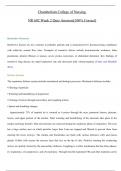
Inclusive concepts ensure that learners see themselves and others reflected in History.
They promote diversity, representation and social justice. Examples:
Race and ethnicity - recognising different cultural and racial groups in historical
narratives.
Gender - including the roles of both men and women in past events.
Class - showing how economic differences shaped people’s lives.
Disability - acknowledging the experiences of people with disabilities across history.
Culture and language - valuing oral traditions, indigenous knowledge and local
heritage.
Teaching the history of slavery should include the perspectives of enslaved people, not
only the colonisers.
1.2 Organisational concepts
Organisational concepts help teachers and learners arrange historical content
meaningfully. Examples:
Chronology - placing events in order to understand sequence.
Periodisation - dividing history into distinct periods (e.g., “colonial era”).
Change and continuity – exploring what has transformed and what has remained the
same.
ASSIGNMENT 10 2025
DUE: OCTOBER 2025 (MEMO)
, TMN3706 ASSIGNMENT 10 2025
DUE OCTOBER 2025
QUESTION 1
1.1 Inclusive concepts
Inclusive concepts ensure that learners see themselves and others reflected in History.
They promote diversity, representation and social justice. Examples:
Race and ethnicity - recognising different cultural and racial groups in historical
narratives.
Gender - including the roles of both men and women in past events.
Class - showing how economic differences shaped people’s lives.
Disability - acknowledging the experiences of people with disabilities across history.
Culture and language - valuing oral traditions, indigenous knowledge and local
heritage.
Teaching the history of slavery should include the perspectives of enslaved people, not
only the colonisers.
1.2 Organisational concepts
Organisational concepts help teachers and learners arrange historical content
meaningfully. Examples:
Chronology - placing events in order to understand sequence.
Periodisation - dividing history into distinct periods (e.g., “colonial era”).
Change and continuity – exploring what has transformed and what has remained the
same.