AQA - Topic 3: Attachment
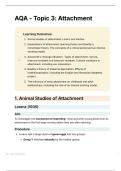
Learning Outcomes:
1. Animal studies of attachment: Lorenz and Harlow.
2. Explanations of attachment: learning theory and Bowlby's
monotropic theory. The concepts of a critical period and an internal
working model.
💡 3. Ainsworth's 'Strange Situation'. Types of attachment: secure,
insecure-avoidant and insecure-resistant. Cultural variations in
attachment, including van IJzendoorn.
4. Bowlby's theory of maternal deprivation. Effects of
institutionalisation, including the English and Romanian Adoptees
project.
5. The influence of early attachment on childhood and adult
relationships, including the role of an internal working model.
1. Animal Studies of Attachment
Lorenz (1935)
Aim
To investigate the mechanism of imprinting—how and when young birds form an
attachment to the first large moving object they see after hatching.
Procedure
1. Lorenz split a large clutch of goose eggs into two groups:
Group 1: Hatched naturally by the mother goose.
AQA - Topic 3: Attachment 1
, Group 2: Hatched in an incubator, where Lorenz was the first moving
object they saw.
2. He marked the goslings to identify which group they belonged to.
3. All goslings were placed under an upturned box, then released, and their
following behaviour was recorded.
Findings
Group 1 (naturally hatched): Followed their mother goose.
Group 2 (incubator-hatched): Followed Lorenz instead.
When released from the box, each group followed their respective
attachment figure, showing the bond was exclusive and irreversible.
Imprinting had to occur within a critical period (4–25 hours) after hatching.
Lorenz also observed that goslings imprinted on humans would later try to
mate with humans, suggesting imprinting affects later sexual behaviour.
Conclusion
Imprinting is a form of attachment seen in certain birds (especially
nidifugous species – those that leave the nest soon after birth).
It happens automatically during a critical period and appears to be
biologically programmed.
Imprinting has long-term consequences, influencing future social and sexual
behaviour.
Evaluation
Strengths Weaknesses
1. Biological basis of imprinting 1. Extrapolation to humans
- The irreversible natureof imprinting - Geese are very different from human
suggests it is innate and automatic, not infants—their attachment behaviour may not
learned. This supports the view that be generalisable. This limits the validity of
attachment has an evolutionary function applying findings to human attachment.
(survival).
2. Lack of emotional attachment
AQA - Topic 3: Attachment 2
, Strengths Weaknesses
2.Influence on Bowlby's theory - Some psychologists argue that Lorenz's
- Lorenz's idea of acritical period birds showed following behaviour, but not
influenced Bowlby's concept of asensitive necessarily emotional attachment like
period in human attachment. humans experience.
3.Long-term impact observed
- Lorenz found that imprinting affected
mating behaviour, supporting Bowlby's
continuity hypothesis— that early
attachments influence later relationships.
Harlow (1959)
Aim
To investigate whether attachment in infant monkeys is based on food provision
(learning theory) or contact comfort.
Procedure
Participants: 16 infant Rhesus monkeys
Materials: Two types of surrogate mothers were created:
Wire mother (cold, harsh surface)
Towelling mother (soft cloth-covered)
Four conditions (4 monkeys each):
1. Wire mother with milk + towelling mother with no milk
2. Wire mother with no milk + towelling mother with milk
3. Wire mother with milk only
4. Towelling mother with milk only
What was measured:
Time spent with each mother
AQA - Topic 3: Attachment 3
, Feeding behaviour
Response to stress (when frightened by a loud noise)
Exploration behaviour in a larger cage (to test secure base behaviour)
Findings
Monkeys spent more time with the towelling mother, regardless of which one
fed them.
When scared, they clung to the towelling mother if available.
Monkeys raised with only a wire mother showed signs of stress (e.g.,
diarrhoea).
In larger cages, monkeys with a towelling mother explored more confidently
and returned to her often, suggesting the use of a secure base.
Conclusion
Attachment is not formed purely for food (as learning theory suggests), but
instead due to the need for emotional comfort.
Contact comfort provides emotional security, which encourages exploration
and lowers stress.
Evaluation
Strengths Weaknesses
1. Challenged learning theory 1. Low generalisability to humans
- The study provided empirical evidence - Although Rhesus monkeys are similar to
against the behaviourist view that food is humans in many ways, human attachments
the primary basis for attachment, are more complex, involving language,
supporting Bowlby's evolutionary theory culture, and social norms. Results may not
instead. fully apply.
2. Real-world applications 2. Unethical
- Findings helped improve childcare - Monkeys were subjected to long-term
practices and institutional care, especially emotional harm, including maternal
for infants in hospitals or orphanages (e.g., separation and distress. Some monkeys
prioritising emotional warmth). grew up to be socially dysfunctional. This
AQA - Topic 3: Attachment 4
Learning Outcomes:
1. Animal studies of attachment: Lorenz and Harlow.
2. Explanations of attachment: learning theory and Bowlby's
monotropic theory. The concepts of a critical period and an internal
working model.
💡 3. Ainsworth's 'Strange Situation'. Types of attachment: secure,
insecure-avoidant and insecure-resistant. Cultural variations in
attachment, including van IJzendoorn.
4. Bowlby's theory of maternal deprivation. Effects of
institutionalisation, including the English and Romanian Adoptees
project.
5. The influence of early attachment on childhood and adult
relationships, including the role of an internal working model.
1. Animal Studies of Attachment
Lorenz (1935)
Aim
To investigate the mechanism of imprinting—how and when young birds form an
attachment to the first large moving object they see after hatching.
Procedure
1. Lorenz split a large clutch of goose eggs into two groups:
Group 1: Hatched naturally by the mother goose.
AQA - Topic 3: Attachment 1
, Group 2: Hatched in an incubator, where Lorenz was the first moving
object they saw.
2. He marked the goslings to identify which group they belonged to.
3. All goslings were placed under an upturned box, then released, and their
following behaviour was recorded.
Findings
Group 1 (naturally hatched): Followed their mother goose.
Group 2 (incubator-hatched): Followed Lorenz instead.
When released from the box, each group followed their respective
attachment figure, showing the bond was exclusive and irreversible.
Imprinting had to occur within a critical period (4–25 hours) after hatching.
Lorenz also observed that goslings imprinted on humans would later try to
mate with humans, suggesting imprinting affects later sexual behaviour.
Conclusion
Imprinting is a form of attachment seen in certain birds (especially
nidifugous species – those that leave the nest soon after birth).
It happens automatically during a critical period and appears to be
biologically programmed.
Imprinting has long-term consequences, influencing future social and sexual
behaviour.
Evaluation
Strengths Weaknesses
1. Biological basis of imprinting 1. Extrapolation to humans
- The irreversible natureof imprinting - Geese are very different from human
suggests it is innate and automatic, not infants—their attachment behaviour may not
learned. This supports the view that be generalisable. This limits the validity of
attachment has an evolutionary function applying findings to human attachment.
(survival).
2. Lack of emotional attachment
AQA - Topic 3: Attachment 2
, Strengths Weaknesses
2.Influence on Bowlby's theory - Some psychologists argue that Lorenz's
- Lorenz's idea of acritical period birds showed following behaviour, but not
influenced Bowlby's concept of asensitive necessarily emotional attachment like
period in human attachment. humans experience.
3.Long-term impact observed
- Lorenz found that imprinting affected
mating behaviour, supporting Bowlby's
continuity hypothesis— that early
attachments influence later relationships.
Harlow (1959)
Aim
To investigate whether attachment in infant monkeys is based on food provision
(learning theory) or contact comfort.
Procedure
Participants: 16 infant Rhesus monkeys
Materials: Two types of surrogate mothers were created:
Wire mother (cold, harsh surface)
Towelling mother (soft cloth-covered)
Four conditions (4 monkeys each):
1. Wire mother with milk + towelling mother with no milk
2. Wire mother with no milk + towelling mother with milk
3. Wire mother with milk only
4. Towelling mother with milk only
What was measured:
Time spent with each mother
AQA - Topic 3: Attachment 3
, Feeding behaviour
Response to stress (when frightened by a loud noise)
Exploration behaviour in a larger cage (to test secure base behaviour)
Findings
Monkeys spent more time with the towelling mother, regardless of which one
fed them.
When scared, they clung to the towelling mother if available.
Monkeys raised with only a wire mother showed signs of stress (e.g.,
diarrhoea).
In larger cages, monkeys with a towelling mother explored more confidently
and returned to her often, suggesting the use of a secure base.
Conclusion
Attachment is not formed purely for food (as learning theory suggests), but
instead due to the need for emotional comfort.
Contact comfort provides emotional security, which encourages exploration
and lowers stress.
Evaluation
Strengths Weaknesses
1. Challenged learning theory 1. Low generalisability to humans
- The study provided empirical evidence - Although Rhesus monkeys are similar to
against the behaviourist view that food is humans in many ways, human attachments
the primary basis for attachment, are more complex, involving language,
supporting Bowlby's evolutionary theory culture, and social norms. Results may not
instead. fully apply.
2. Real-world applications 2. Unethical
- Findings helped improve childcare - Monkeys were subjected to long-term
practices and institutional care, especially emotional harm, including maternal
for infants in hospitals or orphanages (e.g., separation and distress. Some monkeys
prioritising emotional warmth). grew up to be socially dysfunctional. This
AQA - Topic 3: Attachment 4