
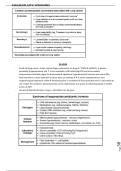
PARANEOPLASTIC SYNDROMES
SIADH
- Small cell lung cancer, stroke, hemorrhage, pneumonia, or drugs ↑ADH SIADH ↓ plasma
osmolality (hyponatremia) and ↑ urine osmolality >100 mOsm/kg H2O and urine sodium
concentrationinitially vague Sxuntreated significant hyponatremia seizures and comaRx:
fluid restriction is most important in those who can tolerate it if severe symptomatic or non-
responsive give hypertonic saline Demeclocycline is considered if fluid restriction and ↑ salt intake do
not resolve the condition. Demeclocycline can be nephrotoxic as it works at collecting tubule to inhibit
action of ADH.
- No role of thiazide diuretics. Loops + salt tablets can be given
38
Page
, DIGITAL CLUBBING
- Digital clubbing—bulbous enlargement and broadening of fingertips due to CT proliferation at nail bed
and distal phalanx
- Dx: when angle between nail fold and nail plate is > 180⁰ (Lovibond angle)
- Can occur itself or in association with hypertrophic osteoarthropathy (i.e. painful joint enlargement,
periostosis of long bones, and synovial effusions)
- May be hereditary, but is most often due to pulmonary or cardiovascular diseases
- Most common causes: lung malignancies, cystic fibrosis, and right to left cardiac shunt
- Pathogenesis: circulatory disruption from tumors, chronic lung inflammationmegakaryocytes skip
normal route of fragmentation by pulmonary circulation megakaryocytes enter systemic circulation
become entrapped in distal fingertips due to large sizesecrete PDGF and VEGF CT hypertrophy,
capillary permeability and vascularityclubbing
- COPD (causing hypoxemia) alone in the absence of occult malignancy DOES NOT cause clubbing. COPD+
clubbing search for occult malignancy.
39
HYPERTROPHIC OSTEOARTHROPATHY (HOA)
- Digital clubbing+ sudden-onset arthropathy, commonly affecting wrists and hand joints
Page
, - Hypertrophic pulmonary osteoarthropathy (HPOA)—subset of HOA due to underlying lung disease.
Usually due to adenocarcinoma
- CXR is appropriate initial study for underlying cause
MEDIASTINAL GERM CELL TUMORS
- Primary mediastinal germ cell tumors—common in young male pts, locally invasive
- Beta-hCG elevated in both seminomatous and non-seminomatous
NON-SEMINOMATOUS GERM CELL TUMORS
- Large mediastinal mass+ ↑ AFP (unlike seminomatous) and ↑beta-hCG (like seminomatous) vitually
diagnostic
- C/f: cough, chest discomfort, dyspnea on exertion
- Confirm with biopsy
- Perform testicular USG to rule out small primary tumor as management and prognosis differ in both
cases
- Almost all germ cell tumors in mediastinum are primary rather than metastatic
SEMINOMATOUS GERM CELL TUMORS
- Mediastinal mass + ↑ beta-hCG
Benign teratomas—from 3 germ layers—may also present as mediastinal mass—but do not produce tumor
markers
PANCOAST TUMOR/SUPERIOR PULMONARY SULCUS TUMOR
- Pt can also develop ↑ sympathetic activity ↑flushing and sweating on contralateral side of face
during exercise (Harlequin sign)
- Most pancoast tumors are non-small cell lung cancers
- Initial evaluation: chest imaging-CXR CT/MRI
40
- CT/MRI brain is also part of later evaluation cox of ↑ risk of brain mets
Page
, ASPERGILLOSIS
- For treatment: itraconazole or bronchial artery embolization can also be used
- Other conditions like TB should be ruled out.
- Can also occur in bronchogenic cysts and bullae
41
Page
SIADH
- Small cell lung cancer, stroke, hemorrhage, pneumonia, or drugs ↑ADH SIADH ↓ plasma
osmolality (hyponatremia) and ↑ urine osmolality >100 mOsm/kg H2O and urine sodium
concentrationinitially vague Sxuntreated significant hyponatremia seizures and comaRx:
fluid restriction is most important in those who can tolerate it if severe symptomatic or non-
responsive give hypertonic saline Demeclocycline is considered if fluid restriction and ↑ salt intake do
not resolve the condition. Demeclocycline can be nephrotoxic as it works at collecting tubule to inhibit
action of ADH.
- No role of thiazide diuretics. Loops + salt tablets can be given
38
Page
, DIGITAL CLUBBING
- Digital clubbing—bulbous enlargement and broadening of fingertips due to CT proliferation at nail bed
and distal phalanx
- Dx: when angle between nail fold and nail plate is > 180⁰ (Lovibond angle)
- Can occur itself or in association with hypertrophic osteoarthropathy (i.e. painful joint enlargement,
periostosis of long bones, and synovial effusions)
- May be hereditary, but is most often due to pulmonary or cardiovascular diseases
- Most common causes: lung malignancies, cystic fibrosis, and right to left cardiac shunt
- Pathogenesis: circulatory disruption from tumors, chronic lung inflammationmegakaryocytes skip
normal route of fragmentation by pulmonary circulation megakaryocytes enter systemic circulation
become entrapped in distal fingertips due to large sizesecrete PDGF and VEGF CT hypertrophy,
capillary permeability and vascularityclubbing
- COPD (causing hypoxemia) alone in the absence of occult malignancy DOES NOT cause clubbing. COPD+
clubbing search for occult malignancy.
39
HYPERTROPHIC OSTEOARTHROPATHY (HOA)
- Digital clubbing+ sudden-onset arthropathy, commonly affecting wrists and hand joints
Page
, - Hypertrophic pulmonary osteoarthropathy (HPOA)—subset of HOA due to underlying lung disease.
Usually due to adenocarcinoma
- CXR is appropriate initial study for underlying cause
MEDIASTINAL GERM CELL TUMORS
- Primary mediastinal germ cell tumors—common in young male pts, locally invasive
- Beta-hCG elevated in both seminomatous and non-seminomatous
NON-SEMINOMATOUS GERM CELL TUMORS
- Large mediastinal mass+ ↑ AFP (unlike seminomatous) and ↑beta-hCG (like seminomatous) vitually
diagnostic
- C/f: cough, chest discomfort, dyspnea on exertion
- Confirm with biopsy
- Perform testicular USG to rule out small primary tumor as management and prognosis differ in both
cases
- Almost all germ cell tumors in mediastinum are primary rather than metastatic
SEMINOMATOUS GERM CELL TUMORS
- Mediastinal mass + ↑ beta-hCG
Benign teratomas—from 3 germ layers—may also present as mediastinal mass—but do not produce tumor
markers
PANCOAST TUMOR/SUPERIOR PULMONARY SULCUS TUMOR
- Pt can also develop ↑ sympathetic activity ↑flushing and sweating on contralateral side of face
during exercise (Harlequin sign)
- Most pancoast tumors are non-small cell lung cancers
- Initial evaluation: chest imaging-CXR CT/MRI
40
- CT/MRI brain is also part of later evaluation cox of ↑ risk of brain mets
Page
, ASPERGILLOSIS
- For treatment: itraconazole or bronchial artery embolization can also be used
- Other conditions like TB should be ruled out.
- Can also occur in bronchogenic cysts and bullae
41
Page


