

TEAS Nursing School Entrance Exam
Study online at https://quizlet.com/_e2l6un
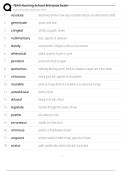
1. resolute determined (think of new years resolutions that you are determined to fufill)
2. germinate sprout, seed, bud
3. congeal solidify, coagulate, harden
4. rudimentary basic, opposite of advanced
5. dandy someone who is elegant in dress or has manners
6. whimsical playful, opposite of grim or grave
7. penitent person who tends to regret
8. querulous habitually whining person, tends to complain or argue over minor details
9. virtuouso having great skill, opposite of incompetent
10. mutable prone to change (think of a mutation or an abnormal change)
11. antediluvial before a flood
12. diluvial having to do with a flood
13. legislate mandate throught the creation of laws
14. prattle talk aimlessly or idly
15. erroneous mistake (err-think error)
16. ominous predicts or foreshadows disaster
17. unguent ointment used to soothe or heal, opposite of irritant
18. orator public speaker who needs to be able to articulate
, TEAS Nursing School Entrance Exam
Study online at https://quizlet.com/_e2l6un
19. exculpate clear from blame
20. ravenous extremely hungry
21. supplicant humble begger has humility
22. maven expert, has expertise
23. insidious something that spreads harmfully in a subtle or stealthy manner
24. cede yield, give up, transfer title to someone else
25. eschew forbid, shun, abatain from, avoid it
26. proscribe forbid or prohibit as harmful
27. percent increase (change/original number) x 100%
formula
28. circumfrence of a 2 x pie x radius OR diameter x pie
circle formula
29. commensal rela- form of a symbiotic relationship, two organisms live in close association with each
tionship other. One benefits while the other is neither harms or benefites. +/0 relationship
30. polysome cluster of ribosomes
31. notochord a semi-rigid rod in the dorsal part of all chordates, this remains as a semi-rigid
chord, although in highrt chordates it is seen only in the embryo and as a vestigial
organ.
-a flexible material made out of similar material to cartilage. If a species has
notochord it is by definition it is a chordate. Ex: fish, birds, mammals
, TEAS Nursing School Entrance Exam
Study online at https://quizlet.com/_e2l6un
32. enzymes proteins, typically work best at pH7.2
33. electron trans- directly produces the pH gradient by pumping protons out of the mitochondrial
port chain matrix. the proton gradient is used to make ATP.
34. closed circuit has continuity and allows current to flow in it
35. as you go from electrons are added one at a time, the electrons of the outermost shell experience
left to right an increasing amount of nuclear attraction becoming closer and more tightly
across a period, bound to the nucleus.
what happens to
electrons
36. voltage drop happens as current passes through a resistance, represents an energy loss, this
energy is usually dissipated in the form of heat.
37. what tempera- 212F, 100C, 373K
ture does water
at sea level boil
38. logy lethargic, lacking in energy or vitality, mental and physical slowness
39. gametes sex cells (sperm and egg), humans have 23 chromosomes in each sex cell (made
of 22 autosomes), 1n, haploid because they have half as many as regular human
cells. In a regular cell (not sex cell) there is a total of 46 chromosomes in each cell
or a set of 23.
40. regular cells 2n, or diploid a set of 23 chromosomes or 46 chromosomes
, TEAS Nursing School Entrance Exam
Study online at https://quizlet.com/_e2l6un
41. sexual reproduc- a sperm which is haploid (n) with 23 chromosomes combines with an egg which
tion simplified is also haploid (n) with 23 chromosomes to form a zygote (2n) which creates 46
chromosomes or diploid then it forms an embryo which turns into a fetus.
42. autosomes In a diploid or 2n human cell there are 46 chromosomes. 2 sex cells (one from
mom, one from dad) join with 44 autosomes (23 from mom 23 from dad). Mom
and dad have identical cells called autosomes. *These are essentially chromo-
somes that both mom and dad posess that are not determinants of the zygotes
gender (the sex cells do this).
Mom has 22 autosomes, and dad has 22 that each will donate.
In addition to the 22 chromsomes that mom and dad will both donate, 1 more
chromosome has to be added to make 23 chromosomes in total This is the sex
chromsome which determines the sex of the baby. These sex cells are not identical
like autosomes because there is either an X chromsome or a Y chromsome that
can be donated. Mom can donate only an X chromosome. Dad can donate either
an X or a Y chromosome.
43. sporophytes and sporophyte is just another name for a plant. some sporophytes produce oversized
how they repro- ovaries which presents itself as a fruit. There is a remains of a flower on one end
duce simplified of it. If you cut into the ovary there are fertilized ovules or seeds. Inside of the seed
is an embryo or fertilized egg. When we plant a seed we should be able to grow a
sporophyte through mitosis. Many sporophytes produce a flower which is diploid
(2n). Through meiosis sporophytes (2n) produce spores which are haploid (n).
One cell in the sporangia undergoes meiosis. At the end we get 4 haploid cells
or two diploid cells. A bunch of haploid cells create a gametophyte. Some of
these gametophytes differentiate into gametes. When a grain of pollen reaches
the entrance of an ovary, it releases the sperm that fertilizes the egg and creates
Study online at https://quizlet.com/_e2l6un
1. resolute determined (think of new years resolutions that you are determined to fufill)
2. germinate sprout, seed, bud
3. congeal solidify, coagulate, harden
4. rudimentary basic, opposite of advanced
5. dandy someone who is elegant in dress or has manners
6. whimsical playful, opposite of grim or grave
7. penitent person who tends to regret
8. querulous habitually whining person, tends to complain or argue over minor details
9. virtuouso having great skill, opposite of incompetent
10. mutable prone to change (think of a mutation or an abnormal change)
11. antediluvial before a flood
12. diluvial having to do with a flood
13. legislate mandate throught the creation of laws
14. prattle talk aimlessly or idly
15. erroneous mistake (err-think error)
16. ominous predicts or foreshadows disaster
17. unguent ointment used to soothe or heal, opposite of irritant
18. orator public speaker who needs to be able to articulate
, TEAS Nursing School Entrance Exam
Study online at https://quizlet.com/_e2l6un
19. exculpate clear from blame
20. ravenous extremely hungry
21. supplicant humble begger has humility
22. maven expert, has expertise
23. insidious something that spreads harmfully in a subtle or stealthy manner
24. cede yield, give up, transfer title to someone else
25. eschew forbid, shun, abatain from, avoid it
26. proscribe forbid or prohibit as harmful
27. percent increase (change/original number) x 100%
formula
28. circumfrence of a 2 x pie x radius OR diameter x pie
circle formula
29. commensal rela- form of a symbiotic relationship, two organisms live in close association with each
tionship other. One benefits while the other is neither harms or benefites. +/0 relationship
30. polysome cluster of ribosomes
31. notochord a semi-rigid rod in the dorsal part of all chordates, this remains as a semi-rigid
chord, although in highrt chordates it is seen only in the embryo and as a vestigial
organ.
-a flexible material made out of similar material to cartilage. If a species has
notochord it is by definition it is a chordate. Ex: fish, birds, mammals
, TEAS Nursing School Entrance Exam
Study online at https://quizlet.com/_e2l6un
32. enzymes proteins, typically work best at pH7.2
33. electron trans- directly produces the pH gradient by pumping protons out of the mitochondrial
port chain matrix. the proton gradient is used to make ATP.
34. closed circuit has continuity and allows current to flow in it
35. as you go from electrons are added one at a time, the electrons of the outermost shell experience
left to right an increasing amount of nuclear attraction becoming closer and more tightly
across a period, bound to the nucleus.
what happens to
electrons
36. voltage drop happens as current passes through a resistance, represents an energy loss, this
energy is usually dissipated in the form of heat.
37. what tempera- 212F, 100C, 373K
ture does water
at sea level boil
38. logy lethargic, lacking in energy or vitality, mental and physical slowness
39. gametes sex cells (sperm and egg), humans have 23 chromosomes in each sex cell (made
of 22 autosomes), 1n, haploid because they have half as many as regular human
cells. In a regular cell (not sex cell) there is a total of 46 chromosomes in each cell
or a set of 23.
40. regular cells 2n, or diploid a set of 23 chromosomes or 46 chromosomes
, TEAS Nursing School Entrance Exam
Study online at https://quizlet.com/_e2l6un
41. sexual reproduc- a sperm which is haploid (n) with 23 chromosomes combines with an egg which
tion simplified is also haploid (n) with 23 chromosomes to form a zygote (2n) which creates 46
chromosomes or diploid then it forms an embryo which turns into a fetus.
42. autosomes In a diploid or 2n human cell there are 46 chromosomes. 2 sex cells (one from
mom, one from dad) join with 44 autosomes (23 from mom 23 from dad). Mom
and dad have identical cells called autosomes. *These are essentially chromo-
somes that both mom and dad posess that are not determinants of the zygotes
gender (the sex cells do this).
Mom has 22 autosomes, and dad has 22 that each will donate.
In addition to the 22 chromsomes that mom and dad will both donate, 1 more
chromosome has to be added to make 23 chromosomes in total This is the sex
chromsome which determines the sex of the baby. These sex cells are not identical
like autosomes because there is either an X chromsome or a Y chromsome that
can be donated. Mom can donate only an X chromosome. Dad can donate either
an X or a Y chromosome.
43. sporophytes and sporophyte is just another name for a plant. some sporophytes produce oversized
how they repro- ovaries which presents itself as a fruit. There is a remains of a flower on one end
duce simplified of it. If you cut into the ovary there are fertilized ovules or seeds. Inside of the seed
is an embryo or fertilized egg. When we plant a seed we should be able to grow a
sporophyte through mitosis. Many sporophytes produce a flower which is diploid
(2n). Through meiosis sporophytes (2n) produce spores which are haploid (n).
One cell in the sporangia undergoes meiosis. At the end we get 4 haploid cells
or two diploid cells. A bunch of haploid cells create a gametophyte. Some of
these gametophytes differentiate into gametes. When a grain of pollen reaches
the entrance of an ovary, it releases the sperm that fertilizes the egg and creates


