INTRODUCTION TO PHYSICAL AND HUMAN
GEOGRAPHY D199 QUESTIONS & A+ GRADED
DETAILED ANSWERS
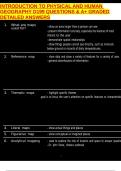
1. What are maps -show an area larger than a person can see
used for?
-present information concisely, especially the features of most
interest to the user
-demonstrate spatial relationships
-show things people cannot see directly, such as minerals
below ground or records of daily temperatures.
2. Reference map - store data and show a variety of features for a variety of uses.
-general storehouses of information
3. Thematic maps - highlight specific themes
-goal is to focus the user's attention on specific features or characteristic
4. Literal maps - show actual things and places
5. Figurative map - show conceptual or imagined places
6. Analytical mapping - used to explore the role of location and space to answer questio
-Dr. John Snow, cholera outbreak
1/
52
,INTRODUCTION TO PHYSICAL AND HUMAN
GEOGRAPHY D199 QUESTIONS & A+ GRADED
DETAILED ANSWERS
7. Geographical -use of computers in mapping.
Informa- tion Science
(GIS) -excels at bringing together many layers of data for a location
and conducting a sophisticated analysis.
-allow investigators to store, manipulate, and analyze data on a
large variety of phenomena.
8. scale - how map units relate to real-world units
9. Projections - the methods and challenges around turning a three-dimensiona
(and
sort of lumpy) earth into a two-dimensional map.
10. Map scale - measures how much the features of the world are reduced to fit
2/
52
,INTRODUCTION TO PHYSICAL AND HUMAN
GEOGRAPHY D199 QUESTIONS & A+ GRADED
DETAILED ANSWERS
on
a map; or more precisely, map scale shows the proportion of a
given distance on a map to the corresponding distance on the
ground in the real world.
3/
52
,INTRODUCTION TO PHYSICAL AND HUMAN
GEOGRAPHY D199 QUESTIONS & A+ GRADED
DETAILED ANSWERS
11. Representative -map scale is shown as a ratio. With the numerator always set to
Frac- tion
1, the denominator represents how much greater the distance is
in the world.
12. Coordiantes - Locations on the earth's surface are measured in
-Cartesian coordinate system, simplest system, named after
René Descartes
13. Geographical -designed specifically to define positions on Earth's roughly
Coordi- nate
System spherical surface
4/
52
GEOGRAPHY D199 QUESTIONS & A+ GRADED
DETAILED ANSWERS
1. What are maps -show an area larger than a person can see
used for?
-present information concisely, especially the features of most
interest to the user
-demonstrate spatial relationships
-show things people cannot see directly, such as minerals
below ground or records of daily temperatures.
2. Reference map - store data and show a variety of features for a variety of uses.
-general storehouses of information
3. Thematic maps - highlight specific themes
-goal is to focus the user's attention on specific features or characteristic
4. Literal maps - show actual things and places
5. Figurative map - show conceptual or imagined places
6. Analytical mapping - used to explore the role of location and space to answer questio
-Dr. John Snow, cholera outbreak
1/
52
,INTRODUCTION TO PHYSICAL AND HUMAN
GEOGRAPHY D199 QUESTIONS & A+ GRADED
DETAILED ANSWERS
7. Geographical -use of computers in mapping.
Informa- tion Science
(GIS) -excels at bringing together many layers of data for a location
and conducting a sophisticated analysis.
-allow investigators to store, manipulate, and analyze data on a
large variety of phenomena.
8. scale - how map units relate to real-world units
9. Projections - the methods and challenges around turning a three-dimensiona
(and
sort of lumpy) earth into a two-dimensional map.
10. Map scale - measures how much the features of the world are reduced to fit
2/
52
,INTRODUCTION TO PHYSICAL AND HUMAN
GEOGRAPHY D199 QUESTIONS & A+ GRADED
DETAILED ANSWERS
on
a map; or more precisely, map scale shows the proportion of a
given distance on a map to the corresponding distance on the
ground in the real world.
3/
52
,INTRODUCTION TO PHYSICAL AND HUMAN
GEOGRAPHY D199 QUESTIONS & A+ GRADED
DETAILED ANSWERS
11. Representative -map scale is shown as a ratio. With the numerator always set to
Frac- tion
1, the denominator represents how much greater the distance is
in the world.
12. Coordiantes - Locations on the earth's surface are measured in
-Cartesian coordinate system, simplest system, named after
René Descartes
13. Geographical -designed specifically to define positions on Earth's roughly
Coordi- nate
System spherical surface
4/
52