PAS407 Muscles of the Back UPDATED ACTUAL Questions and CORRECT
Answers
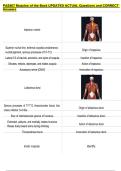
Identify:
trapezius muscle
Superior nuchal line, external occipital protuberance,
Origin of trapezius:
nuchal ligament, spinous processes of C7-T12
Lateral 1/3 of clavicle, acromion, and spine of scapula Insertion of trapezius:
Elevates, retracts, depresses, and rotates scapula Action of trapezius:
Accessory nerve (CNXI) Innervation of trapezius:
Identify:
Latissimus dorsi
Spinous processes of T7-T12, thoracolumbar fascia, iliac
Origin of latissimus dorsi:
crest, inferior 3-4 ribs
floor of intertubercular groove of humerus Insertion of latissimus dorsi:
Extended, adducts, and medially rotates humerus
Action of latissimus dorsi
Raises body toward arms during climbing
Thoracodorsal nerve Innervation of latissimus dorsi:
levator scapulae Identify:
, Posterior tubercles of transverse processes of C1-C4 Origin of levator scapulae:
Superior part of medial border of scapula (above spine) Insertion of levator scapulae:
Elevates scapula; tilts glenoid cavity inferiorly by rotating
Action of levator scapulae:
scapula
dorsal scapular nerve; cervical nerves C3 and C4 Innervation of levator scapulae:
Identify:
Rhomboid minor
nuchal ligament and spinous processes of C7 and T1 Origin of rhomboid minor
Identify:
Rhomboid major
spinous processes of T2-T5 Origin of rhomboid major
medial border of scapula from spine to inferior angle Insertion of rhomboids (minor and major):
retract and rotate scapula; fix scapula to thoracic wall Action of rhomboids (minor and major):
Dorsal scapular nerve Innervation rhomboids (minor and major):
Answers
Identify:
trapezius muscle
Superior nuchal line, external occipital protuberance,
Origin of trapezius:
nuchal ligament, spinous processes of C7-T12
Lateral 1/3 of clavicle, acromion, and spine of scapula Insertion of trapezius:
Elevates, retracts, depresses, and rotates scapula Action of trapezius:
Accessory nerve (CNXI) Innervation of trapezius:
Identify:
Latissimus dorsi
Spinous processes of T7-T12, thoracolumbar fascia, iliac
Origin of latissimus dorsi:
crest, inferior 3-4 ribs
floor of intertubercular groove of humerus Insertion of latissimus dorsi:
Extended, adducts, and medially rotates humerus
Action of latissimus dorsi
Raises body toward arms during climbing
Thoracodorsal nerve Innervation of latissimus dorsi:
levator scapulae Identify:
, Posterior tubercles of transverse processes of C1-C4 Origin of levator scapulae:
Superior part of medial border of scapula (above spine) Insertion of levator scapulae:
Elevates scapula; tilts glenoid cavity inferiorly by rotating
Action of levator scapulae:
scapula
dorsal scapular nerve; cervical nerves C3 and C4 Innervation of levator scapulae:
Identify:
Rhomboid minor
nuchal ligament and spinous processes of C7 and T1 Origin of rhomboid minor
Identify:
Rhomboid major
spinous processes of T2-T5 Origin of rhomboid major
medial border of scapula from spine to inferior angle Insertion of rhomboids (minor and major):
retract and rotate scapula; fix scapula to thoracic wall Action of rhomboids (minor and major):
Dorsal scapular nerve Innervation rhomboids (minor and major):