??
ED
OV
PR
AP
?_
IA
UV
ST
, ??
ED
OV
PR
AP
?_
IA
UV
ST
, ??
ED
OV
PR
AP
?_
IA
UV
ST
,ST
UV
IA
?_
AP
PR
OV
ED
??
ED
OV
PR
AP
?_
IA
UV
ST
, ??
ED
OV
PR
AP
?_
IA
UV
ST
, ??
ED
OV
PR
AP
?_
IA
UV
ST
,ST
UV
IA
?_
AP
PR
OV
ED
??


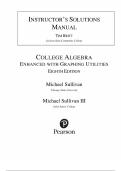
The Instructor’s / Student Solutions Manual for College Algebra: Enhanced with Graphing Utilities, 8th Edition (text ISBN 9780135811924; solutions manual ISBN 9780135812020) provides fully worked-out solutions to the textbook’s problems, typically including all odd-numbered exercises or full solutions (depending on publisher policy). The manual supports instructors in planning lessons, verifying student work, and designing quizzes or exams, while offering clarity on graphing utility methods alongside algebraic approaches. The manual follows the verified textbook’s Table of Contents structure. According to Pearson’s site, the text opens with R. Review (R.1 Real Numbers; R.2 Algebra Essentials; R.3 Geometry Essentials; R.4 Polynomials; R.5 Factoring Polynomials; R.6 Synthetic Division; R.7 Rational Expressions; R.8 nth Roots and Rational Exponents). Next is Chapter 1: Graphs, Equations, and Inequalities (1.1 Graphing Utilities; Introduction to Graphing Equations; 1.2 Solving Equations Using a Graphing Utility; Linear and Rational Equations; 1.3 Quadratic Equations; 1.4 Complex Numbers; 1.5 Radical & Absolute Value Equations; 1.6 Modeling Applications; 1.7 Inequalities). Then comes Chapter 2: Graphs (2.1 Distance and Midpoint Formulas; 2.2 Intercepts, Symmetry, Key Graphs; 2.3 Lines; 2.4 Circles; 2.5 Variation). Chapter 3: Functions and Their Graphs covers functions, graph of a function, properties, library of functions, piecewise, transformations, modeling. Chapter 4: Linear and Quadratic Functions addresses linear models, quadratic functions and properties, modeling from data, inequalities. Chapter 5: Polynomial and Rational Functions includes polynomial graphs, real and complex zeros, rational functions, inequalities. Chapter 6: Exponential and Logarithmic Functions spans inverse functions, exponential and logarithmic definitions, properties, solving exponential/logarithmic equations, modeling growth/decay, and financial models. Chapter 7: Analytic Geometry covers conic sections (parabola, ellipse, hyperbola). Chapter 8: Systems of Equations and Inequalities treats linear systems, matrices, determinants, partial fractions, nonlinear systems, linear programming. Chapter 9: Sequences; Induction; the Binomial Theorem includes sequences, arithmetic and geometric series, induction, binomial theorem. Chapter 10: Counting and Probability covers counting principles, permutations, combinations, probability. Some versions of the textbook also include additive chapters like A Preview of Calculus (limits, derivative, integral) in advanced editions.

Quality you can trust: written by students who passed their tests and reviewed by others who've used these notes.
No worries! You can instantly pick a different document that better fits what you're looking for.
No subscription, no commitments. Pay the way you're used to via credit card and download your PDF document instantly.

“Bought, downloaded, and aced it. It really can be that simple.”
