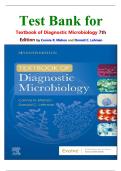
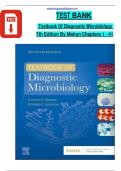
Test Bank For Textbook Of Diagnostic Microbiology
6th Edition By Connie R. Mahon
Chapters 1 - 41
, Mahon: Textbook of Diagnostic Microbiology, 6th Edition Test Bank
Table of contents
Part 1: Introduction to Clinical Microbiology
Chapter 1. Bacterial Cell Structure, Physiology, Metabolism, and Genetics
Chapter 2. Host-Parasite Interaction
Chapter 3. The Laboratory Role in Infection Control
Chapter 4. Control of Microorganisms: Disinfection, Sterilization, and Microbiology Safety
Chapter 5. Performance Improvement in the Microbiology Laboratory
Chapter 6. Specimen Collection and Processing
Chapter 7. Microscopic Examination of Materials from Infected Sites
Chapter 8. Use of Colony Morphology for the Presumptive Identification of Microorganisms
Chapter 9. Biochemical Identification of Gram-Negative Bacteria
Chapter 10. Immunodiagnosis of Infectious Diseases
Chapter 11. Applications of Molecular Diagnostics
Chapter 12. Antibacterial Mechanisms of Action and Bacterial Resistance Mechanisms
Chapter 13. Antimicrobial Susceptibility Testing
Part 2: Laboratory Identification of Significant Isolates
Chapter 14. Staphylococci
Chapter 15. Streptococcus, Enterococcus, and Other Catalase-Negative, Gram-Positive Cocci
Chapter 16. Aerobic Gram-Positive Bacilli
Chapter 17. Neisseria Species and Moraxella catarrhalis
Chapter 18. Haemophilus, HACEK, Legionella and Other Fastidious Gram-Negative Bacilli
Chapter 19. Enterobacteriaceae
Chapter 20. Vibrio, Aeromonas, and Campylobacter Species
Chapter 21. Nonfermenting and Miscellaneous Gram-Negative Bacilli
Chapter 22. Anaerobes of Clinical Importance
Chapter 23. The Spirochetes
Chapter 24. Chlamydia, Rickettsia, and Similar Organisms
Chapter 25. Mycoplasma and Ureaplasma
Chapter 26. Mycobacterium tuberculosis and Nontuberculous Mycobacteria
Chapter 27. Medically Significant Fungi
Chapter 28. Diagnostic Parasitology
Chapter 29. Clinical Virology
Chapter 30. Agents of Bioterror and Forensic Microbiology
Chapter 31. Biofilms: Architects of Disease
Part 3: Laboratory Diagnosis of Infectious Diseases: and Organ System Approach to Diagnostic
Microbiology
Chapter 32. Upper and Lower Respiratory Tract Infections
Chapter 33. Skin and Soft Tissue Infections
Chapter 34. Gastrointestinal Infections and Food Poisoning
Chapter 35. Infections of the Central Nervous System
Chapter 36. Bacteremia and Sepsis
Chapter 37. Urinary Tract Infections
Chapter 38. Genital Infections and Sexually Transmitted Infections
Chapter 39. Infections in Special Populations
Chapter 40. Zoonotic Diseases
Chapter 41. Ocular Infections
-
,Chapter 01: Bacterial Cell Structure, Physiology, Metabolism, and Genetics
Mahon: Textbook of Diagnostic Microbiology, 6th Edition Test Bank
MULTIPLE CHOICE
1. To survive, microbial inhabitants have learned to adapt by varying all of the following, except
a. growth rate.
b. growth in all atmospheric conditions.
c. growth at particular temperatures.
d. bacterial shape.
ANSWER: D
The chapter begins by discussing the way microbial inhabitants have had to evolve to survive
in many different niches and habitats. It discusses slow growers, rapid growers, and
replication with scarce or abundant nutrients, under different atmospheric conditions,
temperature requirements, and cell structure. Bacterial shape as a form of evolution is not
discussed.
OBJ: Level 2: Interpretation
2. Who was considered the father of protozoology and bacteriology?
a. Anton van Leeuwenhoek
b. Louis Pasteur
c. Carl Landsteiner
d. Michael Douglas
ANSWER: A
The book discusses Anton van Leeuwenhoek as the inventor of the microscope and the first
person to see the “beasties.” So they dubbed him the father of protozoology and bacteriology.
The other three individuals were not discussed.
OBJ: Level 1: Recall
3. Prokaryotic cells have which of the following structures in their cytoplasm?
a. Golgi apparatus
b. Ribosomes
c. Mitochondria
d. Endoplasmic reticulum
ANSWER: B
All the structures listed are found in eukaryotic cells, but ribosomes are the only ones that
apply to prokaryotic cells.
OBJ: Level 1: Recall
4. This form of DNA is commonly found in eukaryotic cells.
a. Linear
b. Circular
c. Plasmid
d. Colloid
, ANSWER: A
Circular aand aplasmid aDNA aare ausually afound aonly ain abacteria, anot aeukaryotic acells.
aColloid aisaa aproperty aof aprotein amolecules aand ais anot aassociated awith anucleotides.
OBJ: a Level a1: aRecall
5. The anuclear amembrane ain aprokaryotes ais
a. missing.
b. impenetrable.
c. a aclassic amembrane.
d. a alipid abilayer amembrane.
ANSWER: a A
Prokaryotic acells ado anot ahave aany amembrane-bound astructures ain athe acytoplasm
aincluding aaastructured anucleus.
OBJ: a Level a1: aRecall
6. A amicroorganism athat ais aa aunicellular aorganism aand alacks aa anuclear amembrane
aand atrueanucleus abelongs ato awhich aclassification?
a. Fungi
b. Bacteria
c. Algae
d. Parasite
ANSWER: a B
Fungi, aalgae, aand aparasites aare aunicellular aeukaryotic aorganisms athat acontain aa atrue
anucleus.aBacteria aare aprokaryotic a and ado anot a contain aa atrue anucleus aor anuclear
amembrane.
OBJ: a Level a1: aRecall
7. In athe alaboratory, athe aclinical amicrobiologist ais aresponsible afor aall athe afollowing, aexcept
a. isolating amicroorganisms.
b. selecting atreatment afor apatients.
c. identifying amicroorganisms.
d. analyzing abacteria athat acause adisease.
ANSWER: a B
Clinical amicrobiologists ado anot aselect athe atreatment afor apatients. aThey aprovide athe
adoctor awithathe aname aof athe aorganism aand athe aantibiotics athat acan akill athe abacteria, abut
anot ain athe afinal aselection aof atreatment aprotocols.
OBJ: a Level a2: aRecall
8. What aenables athe amicrobiologist ato aselect athe acorrect amedia afor aprimary aculture aand
aoptimizeathe achance aof aisolating aa apathogenic aorganism?
a. Determining astaining acharacteristics
b. Understanding athe acell astructure aand abiochemical apathways aof aan aorganism
c. Understanding athe agrowth arequirements aof apotential apathogens aat aspecific abody asite
d. Knowing athe adifferences ain acell awalls aof aparticular abacteria
ANSWER: a C
6th Edition By Connie R. Mahon
Chapters 1 - 41
, Mahon: Textbook of Diagnostic Microbiology, 6th Edition Test Bank
Table of contents
Part 1: Introduction to Clinical Microbiology
Chapter 1. Bacterial Cell Structure, Physiology, Metabolism, and Genetics
Chapter 2. Host-Parasite Interaction
Chapter 3. The Laboratory Role in Infection Control
Chapter 4. Control of Microorganisms: Disinfection, Sterilization, and Microbiology Safety
Chapter 5. Performance Improvement in the Microbiology Laboratory
Chapter 6. Specimen Collection and Processing
Chapter 7. Microscopic Examination of Materials from Infected Sites
Chapter 8. Use of Colony Morphology for the Presumptive Identification of Microorganisms
Chapter 9. Biochemical Identification of Gram-Negative Bacteria
Chapter 10. Immunodiagnosis of Infectious Diseases
Chapter 11. Applications of Molecular Diagnostics
Chapter 12. Antibacterial Mechanisms of Action and Bacterial Resistance Mechanisms
Chapter 13. Antimicrobial Susceptibility Testing
Part 2: Laboratory Identification of Significant Isolates
Chapter 14. Staphylococci
Chapter 15. Streptococcus, Enterococcus, and Other Catalase-Negative, Gram-Positive Cocci
Chapter 16. Aerobic Gram-Positive Bacilli
Chapter 17. Neisseria Species and Moraxella catarrhalis
Chapter 18. Haemophilus, HACEK, Legionella and Other Fastidious Gram-Negative Bacilli
Chapter 19. Enterobacteriaceae
Chapter 20. Vibrio, Aeromonas, and Campylobacter Species
Chapter 21. Nonfermenting and Miscellaneous Gram-Negative Bacilli
Chapter 22. Anaerobes of Clinical Importance
Chapter 23. The Spirochetes
Chapter 24. Chlamydia, Rickettsia, and Similar Organisms
Chapter 25. Mycoplasma and Ureaplasma
Chapter 26. Mycobacterium tuberculosis and Nontuberculous Mycobacteria
Chapter 27. Medically Significant Fungi
Chapter 28. Diagnostic Parasitology
Chapter 29. Clinical Virology
Chapter 30. Agents of Bioterror and Forensic Microbiology
Chapter 31. Biofilms: Architects of Disease
Part 3: Laboratory Diagnosis of Infectious Diseases: and Organ System Approach to Diagnostic
Microbiology
Chapter 32. Upper and Lower Respiratory Tract Infections
Chapter 33. Skin and Soft Tissue Infections
Chapter 34. Gastrointestinal Infections and Food Poisoning
Chapter 35. Infections of the Central Nervous System
Chapter 36. Bacteremia and Sepsis
Chapter 37. Urinary Tract Infections
Chapter 38. Genital Infections and Sexually Transmitted Infections
Chapter 39. Infections in Special Populations
Chapter 40. Zoonotic Diseases
Chapter 41. Ocular Infections
-
,Chapter 01: Bacterial Cell Structure, Physiology, Metabolism, and Genetics
Mahon: Textbook of Diagnostic Microbiology, 6th Edition Test Bank
MULTIPLE CHOICE
1. To survive, microbial inhabitants have learned to adapt by varying all of the following, except
a. growth rate.
b. growth in all atmospheric conditions.
c. growth at particular temperatures.
d. bacterial shape.
ANSWER: D
The chapter begins by discussing the way microbial inhabitants have had to evolve to survive
in many different niches and habitats. It discusses slow growers, rapid growers, and
replication with scarce or abundant nutrients, under different atmospheric conditions,
temperature requirements, and cell structure. Bacterial shape as a form of evolution is not
discussed.
OBJ: Level 2: Interpretation
2. Who was considered the father of protozoology and bacteriology?
a. Anton van Leeuwenhoek
b. Louis Pasteur
c. Carl Landsteiner
d. Michael Douglas
ANSWER: A
The book discusses Anton van Leeuwenhoek as the inventor of the microscope and the first
person to see the “beasties.” So they dubbed him the father of protozoology and bacteriology.
The other three individuals were not discussed.
OBJ: Level 1: Recall
3. Prokaryotic cells have which of the following structures in their cytoplasm?
a. Golgi apparatus
b. Ribosomes
c. Mitochondria
d. Endoplasmic reticulum
ANSWER: B
All the structures listed are found in eukaryotic cells, but ribosomes are the only ones that
apply to prokaryotic cells.
OBJ: Level 1: Recall
4. This form of DNA is commonly found in eukaryotic cells.
a. Linear
b. Circular
c. Plasmid
d. Colloid
, ANSWER: A
Circular aand aplasmid aDNA aare ausually afound aonly ain abacteria, anot aeukaryotic acells.
aColloid aisaa aproperty aof aprotein amolecules aand ais anot aassociated awith anucleotides.
OBJ: a Level a1: aRecall
5. The anuclear amembrane ain aprokaryotes ais
a. missing.
b. impenetrable.
c. a aclassic amembrane.
d. a alipid abilayer amembrane.
ANSWER: a A
Prokaryotic acells ado anot ahave aany amembrane-bound astructures ain athe acytoplasm
aincluding aaastructured anucleus.
OBJ: a Level a1: aRecall
6. A amicroorganism athat ais aa aunicellular aorganism aand alacks aa anuclear amembrane
aand atrueanucleus abelongs ato awhich aclassification?
a. Fungi
b. Bacteria
c. Algae
d. Parasite
ANSWER: a B
Fungi, aalgae, aand aparasites aare aunicellular aeukaryotic aorganisms athat acontain aa atrue
anucleus.aBacteria aare aprokaryotic a and ado anot a contain aa atrue anucleus aor anuclear
amembrane.
OBJ: a Level a1: aRecall
7. In athe alaboratory, athe aclinical amicrobiologist ais aresponsible afor aall athe afollowing, aexcept
a. isolating amicroorganisms.
b. selecting atreatment afor apatients.
c. identifying amicroorganisms.
d. analyzing abacteria athat acause adisease.
ANSWER: a B
Clinical amicrobiologists ado anot aselect athe atreatment afor apatients. aThey aprovide athe
adoctor awithathe aname aof athe aorganism aand athe aantibiotics athat acan akill athe abacteria, abut
anot ain athe afinal aselection aof atreatment aprotocols.
OBJ: a Level a2: aRecall
8. What aenables athe amicrobiologist ato aselect athe acorrect amedia afor aprimary aculture aand
aoptimizeathe achance aof aisolating aa apathogenic aorganism?
a. Determining astaining acharacteristics
b. Understanding athe acell astructure aand abiochemical apathways aof aan aorganism
c. Understanding athe agrowth arequirements aof apotential apathogens aat aspecific abody asite
d. Knowing athe adifferences ain acell awalls aof aparticular abacteria
ANSWER: a C