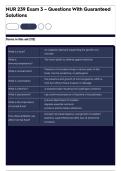
NUR 239 Exam 3 – Questions With Guaranteed
Solutions
Save
Terms in this set (112)
An organism (person) supporting the growth of a
What is a host?
microbe
What is The host's ability to defend against infection
immunocompetence?
Presence of microbes living in various parts of the
What is normal flora?
body. Can be protective, or pathogenic
the presence and growth of microorganisms within a
What is colonization
host but without tissue invasion or damage
What is infection? A diseased state resulting from pathogen presence
What is bacteremia? Lab confirmed presence of bacteria in bloodstream.
prevent attachment of invaders
What is the importance
deplete essential nutrients
of normal flora?
produce antimicrobial substances
Disrupts microbial balance, overgrowth of resistant
How does antibiotic use
bacteria, superinfections(c.diff), loss of protective
affect normal flora?
functions
, Creates an opportunity for harmful bacteria to
overgrow.
Causes GI infections (C.diff; toxin-producing
bacteria causes diarrhea, abd. pain, colitis),
If normal flora is Thrush (candidiasis; white patches, soreness in
decreased, what types of mouth),
infections result? vaginal yeast infections, UTIs,
respiratory infections,
skin infections,
vaginosis,
superinfections (sepsis)
-Humans (mother -> child)
Describe various means - animals
of bacterial -fomites (inanimate objects)
transmission/sources -vehicles (food, water, blood, feces, urine)
-vectors (mainly insects)
-penetrating skin
-mucous membranes
Describe various portals
-direct contact with infected
of entry for infectious
-indirect contact (vector/fomites)
agents
-ingesting contaminated food/water
-inhaling microbes in lungs
- In tact skin, mucous membranes
-mechanical movement: cilia, peristalsis, coughing
Describe the defense -secretions: enzymes in tears/respiratory
mechanisms to protect -mucous layer in GI, GU tract
the human body -normal flora
-if microbe passes first line: phagocytosis, immune
response, inflammatory response
Local: redness, swelling, pain/tenderness, warmth,
What are clinical loss of function (limited to one body part)
manifestations of Systemic: fever, increased pulse, increased
infection? respiratory rate, fatigue, nausea, anorexia, enlarged
lymph
, Nonspecific: fever, myalgia, headache, lethargy
Compare nonspecific
Specific: GI-NAUSEA, vomiting, diarrhea. skin-rash,
and specific clinical
purulent drainage. Respiratory-cough, congestion,
manifestations
dyspnea
1. Incubation = active replication of microbes (the
time between exposure and the start of symptoms).
ASYMPTOMATIC during this time
2. Prodromal = initial appearance of vague, general,
nonspecific sxs
(fever, malaise, fatigue)
What are the stages of
infection? Assessment 3. Full (acute) = max impact of infection, rapid
finding in each growth of microbes, immune/inflammatory
response. ex. swollen lymph nodes, sore throat,
muscle pain, sinus congestion, increased WBCs and
neutrophils
4. Convalescent: Infection contained, repair of
damaged tissues, recovery, back to normal. May
have lingering fatigue.
Community-acquired: acquired outside
healthcare/hospital settings
Healthcare-acquired: Broad range of places, any
healthcare-type facility
Compare the types of Hospital-acquired: at risk- neutropenia, incisions,
infections urinary catheter, ventilators, IVs, central lines
Superinfection: 2nd infection related to the change
in normal flora from antibiotic use allowing
microbes to grow. C.diff (diarrhea), candidiasis
(mouth, vaginitis)
life threatening organ dysfunction caused by
What is sepsis? dysregulated response of body to infection. Low BP,
pale, mottled.
Solutions
Save
Terms in this set (112)
An organism (person) supporting the growth of a
What is a host?
microbe
What is The host's ability to defend against infection
immunocompetence?
Presence of microbes living in various parts of the
What is normal flora?
body. Can be protective, or pathogenic
the presence and growth of microorganisms within a
What is colonization
host but without tissue invasion or damage
What is infection? A diseased state resulting from pathogen presence
What is bacteremia? Lab confirmed presence of bacteria in bloodstream.
prevent attachment of invaders
What is the importance
deplete essential nutrients
of normal flora?
produce antimicrobial substances
Disrupts microbial balance, overgrowth of resistant
How does antibiotic use
bacteria, superinfections(c.diff), loss of protective
affect normal flora?
functions
, Creates an opportunity for harmful bacteria to
overgrow.
Causes GI infections (C.diff; toxin-producing
bacteria causes diarrhea, abd. pain, colitis),
If normal flora is Thrush (candidiasis; white patches, soreness in
decreased, what types of mouth),
infections result? vaginal yeast infections, UTIs,
respiratory infections,
skin infections,
vaginosis,
superinfections (sepsis)
-Humans (mother -> child)
Describe various means - animals
of bacterial -fomites (inanimate objects)
transmission/sources -vehicles (food, water, blood, feces, urine)
-vectors (mainly insects)
-penetrating skin
-mucous membranes
Describe various portals
-direct contact with infected
of entry for infectious
-indirect contact (vector/fomites)
agents
-ingesting contaminated food/water
-inhaling microbes in lungs
- In tact skin, mucous membranes
-mechanical movement: cilia, peristalsis, coughing
Describe the defense -secretions: enzymes in tears/respiratory
mechanisms to protect -mucous layer in GI, GU tract
the human body -normal flora
-if microbe passes first line: phagocytosis, immune
response, inflammatory response
Local: redness, swelling, pain/tenderness, warmth,
What are clinical loss of function (limited to one body part)
manifestations of Systemic: fever, increased pulse, increased
infection? respiratory rate, fatigue, nausea, anorexia, enlarged
lymph
, Nonspecific: fever, myalgia, headache, lethargy
Compare nonspecific
Specific: GI-NAUSEA, vomiting, diarrhea. skin-rash,
and specific clinical
purulent drainage. Respiratory-cough, congestion,
manifestations
dyspnea
1. Incubation = active replication of microbes (the
time between exposure and the start of symptoms).
ASYMPTOMATIC during this time
2. Prodromal = initial appearance of vague, general,
nonspecific sxs
(fever, malaise, fatigue)
What are the stages of
infection? Assessment 3. Full (acute) = max impact of infection, rapid
finding in each growth of microbes, immune/inflammatory
response. ex. swollen lymph nodes, sore throat,
muscle pain, sinus congestion, increased WBCs and
neutrophils
4. Convalescent: Infection contained, repair of
damaged tissues, recovery, back to normal. May
have lingering fatigue.
Community-acquired: acquired outside
healthcare/hospital settings
Healthcare-acquired: Broad range of places, any
healthcare-type facility
Compare the types of Hospital-acquired: at risk- neutropenia, incisions,
infections urinary catheter, ventilators, IVs, central lines
Superinfection: 2nd infection related to the change
in normal flora from antibiotic use allowing
microbes to grow. C.diff (diarrhea), candidiasis
(mouth, vaginitis)
life threatening organ dysfunction caused by
What is sepsis? dysregulated response of body to infection. Low BP,
pale, mottled.