Robbins & Cotran 10th Ed. Pathology Test Bank | Chapter-
by-Chapter Questions & Verified Solutions
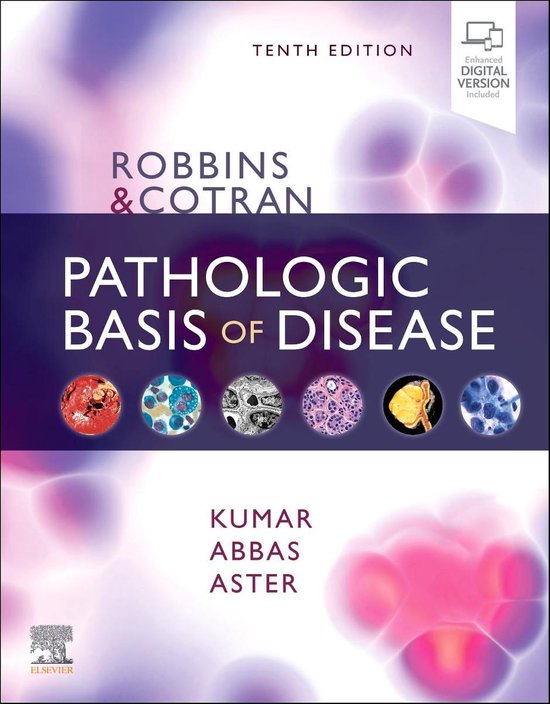
Robbins & Cotran Pathologic Basis of Disease
10th Edition
• Author(s)Vinay Kumar; Abul K. Abbas; Jon C. Aster
1. Chapter 1 & Section: The Genome
A 45-year-old patient is diagnosed with a disorder linked
to a variation in the number of copies of a specific DNA
segment. This type of genetic variation best describes a:
A. Single nucleotide polymorphism (SNP)
B. Point mutation
C. Copy number variation (CNV)
D. Frameshift mutation
Correct Answer: C
Rationale: Copy number variations (CNVs) are a form of
structural variation in the genome involving an abnormal
number of copies of a particular DNA segment, which can
contribute to disease susceptibility . SNPs involve a change
in a single nucleotide, not segment copies, while point and
,frameshift mutations alter the DNA sequence itself, not the
copy number.
Teaching Point: CNVs are alterations in the number of
copies of large segments of DNA, distinct from single-base
changes.
2. Chapter 1 & Section: The Genome
A pathology lecture discusses the majority of the human
genome that does not code for proteins. Which of the
following is a primary function of this noncoding DNA?
A. Serving as the template for all mitochondrial proteins
B. Directly determining amino acid sequences for structural
proteins
C. Providing critical regulatory roles, such as controlling
gene expression
D. Acting as the sole source of genetic variation between
individuals
Correct Answer: C
Rationale: Only about 1.5% of the human genome
consists of protein-encoding genes . The remaining 98.5%
of noncoding DNA plays crucial regulatory roles through
mechanisms like epigenetics and the production of
noncoding RNAs, which determine how and when genes
are expressed. Noncoding DNA does not template
mitochondrial proteins (largely encoded by mtDNA) nor is
it the sole source of genetic variation.
,Teaching Point: Noncoding DNA is essential for
regulating gene expression, not merely "junk" DNA.
3. Chapter 1 & Section: Cellular Housekeeping
A researcher is studying cellular mechanisms that maintain
the integrity of the proteome. The process by which cells
degrade and recycle damaged cytosolic components and
organelles is known as:
A. Apoptosis
B. Autophagy
C. Heterophagy
D. Necrosis
Correct Answer: B
Rationale: Autophagy is a fundamental housekeeping
process responsible for the degradation of a cell's own
damaged organelles and unused proteins, crucial for
cellular maintenance and survival during stress . Apoptosis
and necrosis are forms of cell death, while heterophagy
involves the ingestion of materials from outside the cell.
Teaching Point: Autophagy is a conserved lysosomal
degradation pathway for a cell's own components.
🔬 Cellular Metabolism and Mitochondrial Function
4. Chapter 1 & Section: Cellular Metabolism and
Mitochondrial Function
While reviewing a electron micrograph, a medical student
, notes that a patient's mitochondria have abnormally
simplified cristae. Which mitochondrial function is most
directly compromised by this structural defect?
A. Calcium ion storage
B. Heme synthesis
C. Oxidative phosphorylation (OXPHOS)
D. Fatty acid β-oxidation
Correct Answer: C
Rationale: The cristae, folds of the inner mitochondrial
membrane, house the electron transport chain complexes
and the ATP synthase complex . Their expanded surface
area is essential for efficient oxidative phosphorylation.
While mitochondria are involved in the other processes,
cristae structure is most critical for ATP production.
Teaching Point: Cristae architecture is optimized for the
efficiency of oxidative phosphorylation.
5. Chapter 1 & Section: Cellular Metabolism and
Mitochondrial Function
A patient has a mutation in a nuclear gene encoding a
subunit of mitochondrial complex I. This defect would be
expected to directly impair which of the following
fundamental processes?
A. The citric acid (Krebs) cycle in the matrix
B. The electron transport chain and generation of the
proton gradient
by-Chapter Questions & Verified Solutions
Robbins & Cotran Pathologic Basis of Disease
10th Edition
• Author(s)Vinay Kumar; Abul K. Abbas; Jon C. Aster
1. Chapter 1 & Section: The Genome
A 45-year-old patient is diagnosed with a disorder linked
to a variation in the number of copies of a specific DNA
segment. This type of genetic variation best describes a:
A. Single nucleotide polymorphism (SNP)
B. Point mutation
C. Copy number variation (CNV)
D. Frameshift mutation
Correct Answer: C
Rationale: Copy number variations (CNVs) are a form of
structural variation in the genome involving an abnormal
number of copies of a particular DNA segment, which can
contribute to disease susceptibility . SNPs involve a change
in a single nucleotide, not segment copies, while point and
,frameshift mutations alter the DNA sequence itself, not the
copy number.
Teaching Point: CNVs are alterations in the number of
copies of large segments of DNA, distinct from single-base
changes.
2. Chapter 1 & Section: The Genome
A pathology lecture discusses the majority of the human
genome that does not code for proteins. Which of the
following is a primary function of this noncoding DNA?
A. Serving as the template for all mitochondrial proteins
B. Directly determining amino acid sequences for structural
proteins
C. Providing critical regulatory roles, such as controlling
gene expression
D. Acting as the sole source of genetic variation between
individuals
Correct Answer: C
Rationale: Only about 1.5% of the human genome
consists of protein-encoding genes . The remaining 98.5%
of noncoding DNA plays crucial regulatory roles through
mechanisms like epigenetics and the production of
noncoding RNAs, which determine how and when genes
are expressed. Noncoding DNA does not template
mitochondrial proteins (largely encoded by mtDNA) nor is
it the sole source of genetic variation.
,Teaching Point: Noncoding DNA is essential for
regulating gene expression, not merely "junk" DNA.
3. Chapter 1 & Section: Cellular Housekeeping
A researcher is studying cellular mechanisms that maintain
the integrity of the proteome. The process by which cells
degrade and recycle damaged cytosolic components and
organelles is known as:
A. Apoptosis
B. Autophagy
C. Heterophagy
D. Necrosis
Correct Answer: B
Rationale: Autophagy is a fundamental housekeeping
process responsible for the degradation of a cell's own
damaged organelles and unused proteins, crucial for
cellular maintenance and survival during stress . Apoptosis
and necrosis are forms of cell death, while heterophagy
involves the ingestion of materials from outside the cell.
Teaching Point: Autophagy is a conserved lysosomal
degradation pathway for a cell's own components.
🔬 Cellular Metabolism and Mitochondrial Function
4. Chapter 1 & Section: Cellular Metabolism and
Mitochondrial Function
While reviewing a electron micrograph, a medical student
, notes that a patient's mitochondria have abnormally
simplified cristae. Which mitochondrial function is most
directly compromised by this structural defect?
A. Calcium ion storage
B. Heme synthesis
C. Oxidative phosphorylation (OXPHOS)
D. Fatty acid β-oxidation
Correct Answer: C
Rationale: The cristae, folds of the inner mitochondrial
membrane, house the electron transport chain complexes
and the ATP synthase complex . Their expanded surface
area is essential for efficient oxidative phosphorylation.
While mitochondria are involved in the other processes,
cristae structure is most critical for ATP production.
Teaching Point: Cristae architecture is optimized for the
efficiency of oxidative phosphorylation.
5. Chapter 1 & Section: Cellular Metabolism and
Mitochondrial Function
A patient has a mutation in a nuclear gene encoding a
subunit of mitochondrial complex I. This defect would be
expected to directly impair which of the following
fundamental processes?
A. The citric acid (Krebs) cycle in the matrix
B. The electron transport chain and generation of the
proton gradient