Robbins & Cotran 10th Ed. Pathology Test Bank | Chapter-
by-Chapter Questions & Verified Solutions
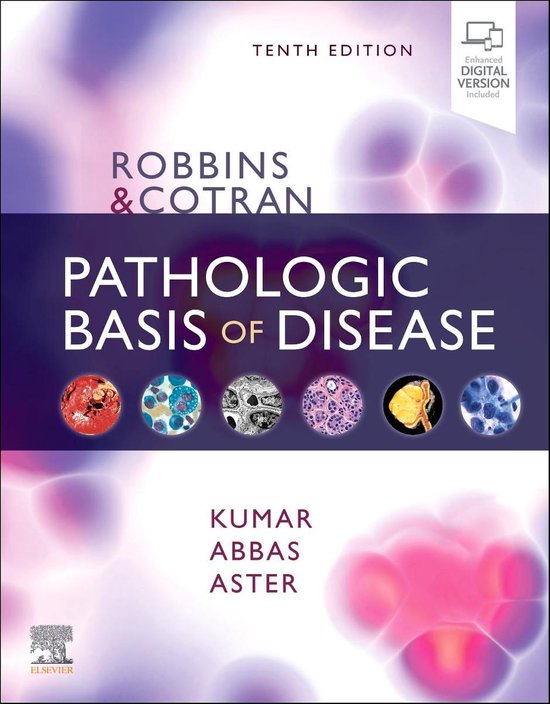
Robbins & Cotran Pathologic Basis of Disease
10th Edition
• Author(s)Vinay Kumar; Abul K. Abbas; Jon C. Aster
Chapter 1 — The Genome
Stem: A 42-year-old man presents after exposure to ionizing
radiation. Which cellular mechanism most directly prevents
fixation of radiation-induced double-strand DNA breaks into
permanent mutations?
A. Base excision repair
B. Homologous recombination repair
C. Nucleotide excision repair
D. Mismatch repair
Correct Answer: B
Rationales:
• Correct (B): Homologous recombination uses an intact
sister chromatid as a template to accurately repair double-
strand breaks, preventing mutation fixation; Robbins
, describes this as a high-fidelity repair pathway for double-
strand breaks.
• A: Base excision repair corrects small base lesions (e.g.,
oxidized bases), not double-strand breaks.
• C: Nucleotide excision repair removes bulky helix-
distorting lesions (e.g., thymine dimers), not DNA double-
strand breaks.
• D: Mismatch repair corrects replication errors (mispaired
bases/loops), not double-strand breaks from radiation.
Teaching Point: Homologous recombination is the high-fidelity
repair for double-strand DNA breaks.
Citation: Robbins & Cotran, 10th Ed., Chapter 1 — The Genome
(DNA repair mechanisms)
2) Chapter 1 — The Genome
Stem: A patient’s tumor shows loss of heterozygosity of a
tumor suppressor locus and subsequent malignant progression.
Which principle best explains how genomic instability
contributed to cancer in this case?
A. Oncogene amplification requires promoter methylation
B. Single functional allele suffices for tumor suppression
C. Failure of DNA repair increases mutation accumulation
D. Increased telomerase activity causes allele loss
Correct Answer: C
,Rationales:
• Correct (C): Loss of DNA repair fidelity increases
accumulation of mutations, including second-hit events at
tumor suppressor loci; Robbins emphasizes how defective
repair pathways promote genomic instability and cancer.
• A: Oncogene amplification is independent of promoter
methylation; methylation typically silences genes.
• B: Tumor suppressor genes typically require biallelic
inactivation (two hits), not a single allele.
• D: Telomerase activity affects replicative potential but
does not directly cause allele loss.
Teaching Point: DNA repair failure drives mutation
accumulation and tumor progression.
Citation: Robbins & Cotran, 10th Ed., Chapter 1 — The Genome
(genomic instability and cancer)
3) Chapter 1 — Cellular Housekeeping
Stem: A patient with a neurodegenerative disorder
accumulates ubiquitinated proteins in neurons. Which
intracellular pathway is most likely impaired?
A. Lysosomal autophagy
B. Proteasomal (ubiquitin-dependent) degradation
C. Mitochondrial β-oxidation
D. Endoplasmic reticulum secretion
, Correct Answer: B
Rationales:
• Correct (B): The ubiquitin–proteasome system targets
polyubiquitinated proteins for proteasomal degradation;
Robbins describes impairment of this system in
neurodegenerative protein-aggregation diseases.
• A: Autophagy clears organelles and aggregated proteins,
but ubiquitinated soluble proteins are primarily handled
by the proteasome.
• C: Mitochondrial β-oxidation handles fatty acids, unrelated
to ubiquitinated protein clearance.
• D: ER secretion moves secretory proteins out of the cell
and is not the primary route for ubiquitinated cytosolic
proteins.
Teaching Point: Ubiquitin–proteasome dysfunction causes
intracellular accumulation of ubiquitinated proteins.
Citation: Robbins & Cotran, 10th Ed., Chapter 1 — Cellular
Housekeeping (protein degradation systems)
4) Chapter 1 — Cellular Housekeeping
Stem: A 55-year-old woman has long-standing diabetes and
develops impaired wound healing with persistent cellular
debris. Which cellular process, when defective, would most
directly impair clearance of damaged organelles and
by-Chapter Questions & Verified Solutions
Robbins & Cotran Pathologic Basis of Disease
10th Edition
• Author(s)Vinay Kumar; Abul K. Abbas; Jon C. Aster
Chapter 1 — The Genome
Stem: A 42-year-old man presents after exposure to ionizing
radiation. Which cellular mechanism most directly prevents
fixation of radiation-induced double-strand DNA breaks into
permanent mutations?
A. Base excision repair
B. Homologous recombination repair
C. Nucleotide excision repair
D. Mismatch repair
Correct Answer: B
Rationales:
• Correct (B): Homologous recombination uses an intact
sister chromatid as a template to accurately repair double-
strand breaks, preventing mutation fixation; Robbins
, describes this as a high-fidelity repair pathway for double-
strand breaks.
• A: Base excision repair corrects small base lesions (e.g.,
oxidized bases), not double-strand breaks.
• C: Nucleotide excision repair removes bulky helix-
distorting lesions (e.g., thymine dimers), not DNA double-
strand breaks.
• D: Mismatch repair corrects replication errors (mispaired
bases/loops), not double-strand breaks from radiation.
Teaching Point: Homologous recombination is the high-fidelity
repair for double-strand DNA breaks.
Citation: Robbins & Cotran, 10th Ed., Chapter 1 — The Genome
(DNA repair mechanisms)
2) Chapter 1 — The Genome
Stem: A patient’s tumor shows loss of heterozygosity of a
tumor suppressor locus and subsequent malignant progression.
Which principle best explains how genomic instability
contributed to cancer in this case?
A. Oncogene amplification requires promoter methylation
B. Single functional allele suffices for tumor suppression
C. Failure of DNA repair increases mutation accumulation
D. Increased telomerase activity causes allele loss
Correct Answer: C
,Rationales:
• Correct (C): Loss of DNA repair fidelity increases
accumulation of mutations, including second-hit events at
tumor suppressor loci; Robbins emphasizes how defective
repair pathways promote genomic instability and cancer.
• A: Oncogene amplification is independent of promoter
methylation; methylation typically silences genes.
• B: Tumor suppressor genes typically require biallelic
inactivation (two hits), not a single allele.
• D: Telomerase activity affects replicative potential but
does not directly cause allele loss.
Teaching Point: DNA repair failure drives mutation
accumulation and tumor progression.
Citation: Robbins & Cotran, 10th Ed., Chapter 1 — The Genome
(genomic instability and cancer)
3) Chapter 1 — Cellular Housekeeping
Stem: A patient with a neurodegenerative disorder
accumulates ubiquitinated proteins in neurons. Which
intracellular pathway is most likely impaired?
A. Lysosomal autophagy
B. Proteasomal (ubiquitin-dependent) degradation
C. Mitochondrial β-oxidation
D. Endoplasmic reticulum secretion
, Correct Answer: B
Rationales:
• Correct (B): The ubiquitin–proteasome system targets
polyubiquitinated proteins for proteasomal degradation;
Robbins describes impairment of this system in
neurodegenerative protein-aggregation diseases.
• A: Autophagy clears organelles and aggregated proteins,
but ubiquitinated soluble proteins are primarily handled
by the proteasome.
• C: Mitochondrial β-oxidation handles fatty acids, unrelated
to ubiquitinated protein clearance.
• D: ER secretion moves secretory proteins out of the cell
and is not the primary route for ubiquitinated cytosolic
proteins.
Teaching Point: Ubiquitin–proteasome dysfunction causes
intracellular accumulation of ubiquitinated proteins.
Citation: Robbins & Cotran, 10th Ed., Chapter 1 — Cellular
Housekeeping (protein degradation systems)
4) Chapter 1 — Cellular Housekeeping
Stem: A 55-year-old woman has long-standing diabetes and
develops impaired wound healing with persistent cellular
debris. Which cellular process, when defective, would most
directly impair clearance of damaged organelles and