Robbins & Cotran 10th Ed. Pathology Test Bank | Chapter-
by-Chapter Questions & Verified Solutions
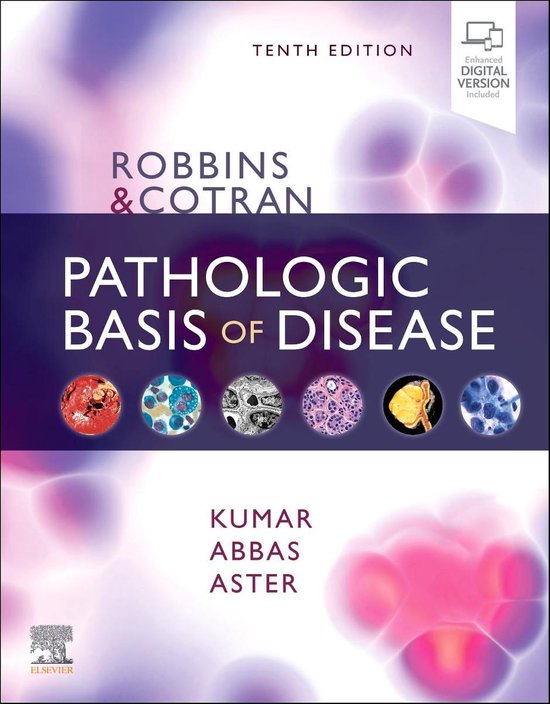
Robbins & Cotran Pathologic Basis of Disease
10th Edition
• Author(s)Vinay Kumar; Abul K. Abbas; Jon C. Aster
Chapter 1 — The Genome
Question: A 42-year-old woman undergoes genetic testing after
several family members are found to carry BRCA1 mutations.
Her report shows a variant in a noncoding region that alters a
miRNA binding site in the 3′-UTR of BRCA1 mRNA. Which is the
most likely consequence of this variant?
A. A change in BRCA1 amino-acid sequence leading to a
dysfunctional protein
B. Increased or decreased BRCA1 expression via post-
transcriptional regulation
C. Insertion of a premature stop codon in BRCA1 transcription
leading to nonsense-mediated decay
D. Complete loss of BRCA1 gene from the chromosome (large
deletion)
,Correct Answer: B
Rationale (correct): Noncoding 3′-UTR elements regulate mRNA
stability and translation, and variants that alter miRNA binding
can up- or down-regulate protein expression without changing
amino-acid sequence. This mechanism is described in Robbins
as an important mode of gene regulation. ClinicalKey+1
Rationale (A): A change in amino-acid sequence requires a
coding-region (exonic) variant; 3′-UTR changes do not alter
protein sequence.
Rationale (C): Nonsense mutations introducing premature stop
codons occur in coding sequences, not typically from 3′-UTR
miRNA site variants.
Rationale (D): Large chromosomal deletions remove gene loci;
a single 3′-UTR variant would not cause whole-gene deletion.
Teaching Point: Noncoding variants can alter gene expression
via miRNA and UTR regulation.
Citation: Robbins & Cotran, 10th ed., Chapter 1: The Genome.
ClinicalKey
2 — The Genome
Question: In a patient with unexplained familial disease, whole-
genome sequencing reveals many single-nucleotide
polymorphisms (SNPs) in noncoding regulatory regions near
several genes. Which mechanism best explains how these SNPs
might influence disease susceptibility?
,A. Causing frameshift mutations in nearby coding exons
B. Altering transcription factor binding and gene expression
levels
C. Generating novel proteins with dominant-negative activity
D. Converting heterochromatin to euchromatin by changing
DNA sequence
Correct Answer: B
Rationale (correct): SNPs in regulatory elements can change
transcription factor binding affinities and therefore modulate
gene expression — a major mechanism by which noncoding
variation affects disease risk. ClinicalKey
Rationale (A): Frameshifts arise from indels in coding regions,
not SNPs in noncoding regulatory elements.
Rationale (C): Novel proteins result from coding-sequence
changes, not from noncoding SNPs.
Rationale (D): Chromatin state is influenced by epigenetic
marks (methylation, histone modification), not directly by
single-nucleotide changes in most cases.
Teaching Point: Noncoding regulatory SNPs often alter
transcription factor binding and gene expression.
Citation: Robbins & Cotran, 10th ed., Chapter 1: The Genome.
ClinicalKey
3 — The Genome
, Question: A researcher treats cultured cells with a DNA
methyltransferase inhibitor and observes reactivation of
several silenced genes. Which epigenetic mechanism most
directly explains this reactivation?
A. Removal of acetyl groups from histone tails
B. Demethylation of CpG islands in promoter regions leading to
increased transcription
C. Cleavage of promoter DNA sequences by nucleases
D. Permanent change in DNA sequence converting methylated
cytosine to thymine
Correct Answer: B
Rationale (correct): DNA methylation of CpG islands in
promoters represses transcription; inhibiting
methyltransferases prevents methylation maintenance and can
reactivate silenced genes. Robbins describes DNA methylation
as a key epigenetic regulator of gene expression. ClinicalKey
Rationale (A): Histone acetylation (not deacetylation) is
associated with increased transcription; removal of acetyl
groups represses gene expression.
Rationale (C): Nuclease-mediated cleavage is not an epigenetic
regulatory mechanism used to silence or reactivate promoters.
Rationale (D): Methylated cytosine can deaminate to thymine
over time, but the drug effect is epigenetic (methylation
status), not alteration of base identity.
Teaching Point: Inhibition of DNA methylation can reactivate
epigenetically silenced genes.
by-Chapter Questions & Verified Solutions
Robbins & Cotran Pathologic Basis of Disease
10th Edition
• Author(s)Vinay Kumar; Abul K. Abbas; Jon C. Aster
Chapter 1 — The Genome
Question: A 42-year-old woman undergoes genetic testing after
several family members are found to carry BRCA1 mutations.
Her report shows a variant in a noncoding region that alters a
miRNA binding site in the 3′-UTR of BRCA1 mRNA. Which is the
most likely consequence of this variant?
A. A change in BRCA1 amino-acid sequence leading to a
dysfunctional protein
B. Increased or decreased BRCA1 expression via post-
transcriptional regulation
C. Insertion of a premature stop codon in BRCA1 transcription
leading to nonsense-mediated decay
D. Complete loss of BRCA1 gene from the chromosome (large
deletion)
,Correct Answer: B
Rationale (correct): Noncoding 3′-UTR elements regulate mRNA
stability and translation, and variants that alter miRNA binding
can up- or down-regulate protein expression without changing
amino-acid sequence. This mechanism is described in Robbins
as an important mode of gene regulation. ClinicalKey+1
Rationale (A): A change in amino-acid sequence requires a
coding-region (exonic) variant; 3′-UTR changes do not alter
protein sequence.
Rationale (C): Nonsense mutations introducing premature stop
codons occur in coding sequences, not typically from 3′-UTR
miRNA site variants.
Rationale (D): Large chromosomal deletions remove gene loci;
a single 3′-UTR variant would not cause whole-gene deletion.
Teaching Point: Noncoding variants can alter gene expression
via miRNA and UTR regulation.
Citation: Robbins & Cotran, 10th ed., Chapter 1: The Genome.
ClinicalKey
2 — The Genome
Question: In a patient with unexplained familial disease, whole-
genome sequencing reveals many single-nucleotide
polymorphisms (SNPs) in noncoding regulatory regions near
several genes. Which mechanism best explains how these SNPs
might influence disease susceptibility?
,A. Causing frameshift mutations in nearby coding exons
B. Altering transcription factor binding and gene expression
levels
C. Generating novel proteins with dominant-negative activity
D. Converting heterochromatin to euchromatin by changing
DNA sequence
Correct Answer: B
Rationale (correct): SNPs in regulatory elements can change
transcription factor binding affinities and therefore modulate
gene expression — a major mechanism by which noncoding
variation affects disease risk. ClinicalKey
Rationale (A): Frameshifts arise from indels in coding regions,
not SNPs in noncoding regulatory elements.
Rationale (C): Novel proteins result from coding-sequence
changes, not from noncoding SNPs.
Rationale (D): Chromatin state is influenced by epigenetic
marks (methylation, histone modification), not directly by
single-nucleotide changes in most cases.
Teaching Point: Noncoding regulatory SNPs often alter
transcription factor binding and gene expression.
Citation: Robbins & Cotran, 10th ed., Chapter 1: The Genome.
ClinicalKey
3 — The Genome
, Question: A researcher treats cultured cells with a DNA
methyltransferase inhibitor and observes reactivation of
several silenced genes. Which epigenetic mechanism most
directly explains this reactivation?
A. Removal of acetyl groups from histone tails
B. Demethylation of CpG islands in promoter regions leading to
increased transcription
C. Cleavage of promoter DNA sequences by nucleases
D. Permanent change in DNA sequence converting methylated
cytosine to thymine
Correct Answer: B
Rationale (correct): DNA methylation of CpG islands in
promoters represses transcription; inhibiting
methyltransferases prevents methylation maintenance and can
reactivate silenced genes. Robbins describes DNA methylation
as a key epigenetic regulator of gene expression. ClinicalKey
Rationale (A): Histone acetylation (not deacetylation) is
associated with increased transcription; removal of acetyl
groups represses gene expression.
Rationale (C): Nuclease-mediated cleavage is not an epigenetic
regulatory mechanism used to silence or reactivate promoters.
Rationale (D): Methylated cytosine can deaminate to thymine
over time, but the drug effect is epigenetic (methylation
status), not alteration of base identity.
Teaching Point: Inhibition of DNA methylation can reactivate
epigenetically silenced genes.