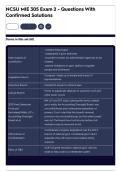
NCSU MIE 305 Exam 2 - Questions With
Confirmed Solutions
Save
Terms in this set (61)
-created federal govt
-established 3 govt. branches
Main impacts of -provided a means for administrative agencies to be
constitution created
-placed limitations on govt. ability to regulate
people and businesses
Congress- made up of senate and house of
Legislative branch
representatives.
Executive Branch President's power to enforce laws
Power to adjudicate disputes to supreme court and
Judicial Branch
other lower courts
BW LLP and FEF sued, claiming the newly created
2010 Free Enterprise govt. entity, the Accounting Oversight Board, was
Fund and unconstitutional and contravened separation of
Beckstead/Watts LLP v. powers. Court ruled that the board's removal
Accounting Oversight provision was unconstitutional, but the entire board
Board et al. was not. The board now functions as before, but
members may be removed at will.
Confederate congress (legislative) was the SOLE
1781 Articles of branch of national govt. Confederal govt. had 2
Confederation separate units with lower levels (states) being
supreme
USA's 1st great recession, national govt. was too
Panic of 1785
weak to help under a confederate system
, Constitution article 1 section 8 says federal govt.
can:
-regulate commerce with foreign nations and
Enumerated Powers
between states
-coin and borrow money
-enact laws of bankruptcy, patents, and copyrights
-AKA 'elastic clause' because of congress' ability to
Necessary and Proper flex to cover legislative areas
Clause -establishes implied powers of congress
-important case: McCulloch v Maryland
Legal question regarding whether congress could
legislate under implied powers given by the elastic
1819 McCulloch v. clause.
Maryland Court ruled that the elastic clause was a broad grant
of power to congress, NOT a restriction as Maryland
had argued.
Exercised by both federal AND state govt.
Concurrent powers -ability to tax a business
-govt. power to spend money
Article IV section 2 of the Constitution: guarantees
Priveleges and
that 'foreign' citizens are afforded the same rights as
immunities clause
citizens of all other states.
Article IV section 1 of the Constitution that ensures
judicial decrees and contracts made in one state will
Full faith and credit
be binding and enforceable in any other state.
clause
Encourages commerce among entities in different
states.
Article 1 section 8: permits congress to regulate
interstate commerce
Commerce clause
-technically 3 separate clauses: foreign commerce,
indian commerce, and interstate commerce (ICC)
Supreme court ruled that congress could regulate
intrastate commerce if it significantly affected
1824 Gibbons v. Ogden
interstate commerce. The federal monopoly in
question overruled the state monopoly.
Confirmed Solutions
Save
Terms in this set (61)
-created federal govt
-established 3 govt. branches
Main impacts of -provided a means for administrative agencies to be
constitution created
-placed limitations on govt. ability to regulate
people and businesses
Congress- made up of senate and house of
Legislative branch
representatives.
Executive Branch President's power to enforce laws
Power to adjudicate disputes to supreme court and
Judicial Branch
other lower courts
BW LLP and FEF sued, claiming the newly created
2010 Free Enterprise govt. entity, the Accounting Oversight Board, was
Fund and unconstitutional and contravened separation of
Beckstead/Watts LLP v. powers. Court ruled that the board's removal
Accounting Oversight provision was unconstitutional, but the entire board
Board et al. was not. The board now functions as before, but
members may be removed at will.
Confederate congress (legislative) was the SOLE
1781 Articles of branch of national govt. Confederal govt. had 2
Confederation separate units with lower levels (states) being
supreme
USA's 1st great recession, national govt. was too
Panic of 1785
weak to help under a confederate system
, Constitution article 1 section 8 says federal govt.
can:
-regulate commerce with foreign nations and
Enumerated Powers
between states
-coin and borrow money
-enact laws of bankruptcy, patents, and copyrights
-AKA 'elastic clause' because of congress' ability to
Necessary and Proper flex to cover legislative areas
Clause -establishes implied powers of congress
-important case: McCulloch v Maryland
Legal question regarding whether congress could
legislate under implied powers given by the elastic
1819 McCulloch v. clause.
Maryland Court ruled that the elastic clause was a broad grant
of power to congress, NOT a restriction as Maryland
had argued.
Exercised by both federal AND state govt.
Concurrent powers -ability to tax a business
-govt. power to spend money
Article IV section 2 of the Constitution: guarantees
Priveleges and
that 'foreign' citizens are afforded the same rights as
immunities clause
citizens of all other states.
Article IV section 1 of the Constitution that ensures
judicial decrees and contracts made in one state will
Full faith and credit
be binding and enforceable in any other state.
clause
Encourages commerce among entities in different
states.
Article 1 section 8: permits congress to regulate
interstate commerce
Commerce clause
-technically 3 separate clauses: foreign commerce,
indian commerce, and interstate commerce (ICC)
Supreme court ruled that congress could regulate
intrastate commerce if it significantly affected
1824 Gibbons v. Ogden
interstate commerce. The federal monopoly in
question overruled the state monopoly.