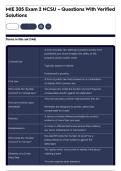
MIE 305 Exam 2 NCSU – Questions With Verified
Solutions
Save
Terms in this set (146)
A form of public law seeking to protect society from
prohibited acts which threaten the safety of life,
property, and/or public order.
Criminal Law
Typically based on statute
Punishment is punitive;
A form of public law that is based on a combination
Civil Law
of statute AND common law
Who holds the "burden The prosecutor holds the burden of proof "beyond
of proof" in criminal law? a reasonable doubt" against the defendant
They are typically punitive; imprisonment, fine, etc
How are criminal cases
remedied? Remedies are designed to punish, rather than
compensate for losses
A serious criminal offense punishable by a prison
Felonies
sentence of more than one year
A crime or offense that is less serious than a felony;
Misdemeanors
any minor misbehavior or misconduct
the plaintiff holds the "burden of proof" by a
Who holds the "burden
preponderance of the evidence against the
of proof" in civil law?
defendant
The "guilty mind"; not a crime to merely think about
Elements of a Crime: robbing a bank
Mens Rea
*A crime requires both elements
, The "guilty act"; not a crime to accidentally pick up a
Elements of a Crime: suitcase at the airport that's identical to yours
Actus Reus
*A crime requires both elements
It is a crime to plan or agree with another to carry
out a crime
Elements of a Crime:
Conspiracy (Exception!)
*Even if the conspired crime does not occur, the
actus reus is in the planning and agreement
1) Purposefulness
2) Knowing
States of Mind
3) Recklessness
4) Negligence
Conscious object is to commit the act
States of Mind:
Purposefulness Premeditation can be SOM that imposes a higher
standard of purposefulness
Commission of the act with understanding that it is
practically certain it will result in a certain outcome
States of Mind: Knowing
Awareness of cause-effect
States of Mind: Conscious disregard of a substantial and
Recklessness unjustifiable risk attendant to one's behavior
Ignoring a reasonable perception of undue risk in
States of Mind:
an act that is a "gross deviation from the standard of
Negligence
care" of a reasonable person in those circumstances
Offenses where "states of mind" are not required;
the completion of the act itself is enough to hold
the perpetrator responsible
Strict Liability
*Liability without fault, traditionally for inherently
dangerous activities (handling wild animals,
blasting/building demo, etc)
, A federal prosecutorial doctrine which holds that
some business acts (or omissions with significant
potential to harm the public) are essentially strict
liability offenses
Park Doctrine
(Responsible Corporate
An RCO within the organization can be held
Officer)
personally criminally liable for them
1st time typically misdemeanor, after which they are
felonies
1) Entrapment
Defenses to Criminal 2) Immunity
Charges 3) Insanity
4) Statute of Limitations
Defenses to Criminal Due process argument about enticement (by police)
Charges: Entrapment to commit a crime
Defenses to Criminal Technical defense; they claim of a promise by
Charges: Immunity prosecution that they will not be prosecuted
Not often applicable in business setting; rare use in
Defenses to Criminal other settings too, but standard in many states is the
Charges: Insanity M'Naghten Rule (could the accused distinguish right
from wrong?)
Defenses to Criminal Like insanity, it is an affirmative defense; there is a
Charges: Statute of time limit on prosecution for criminal offenses
Limitations
Protection against unreasonable searches and
seizures, warrant requirement (probable cause- no
general warrants)
Fourth Amendment
Exclusionary Rule: prohibits use of improperly
seized evidence
1) Charge Bargain
Plea Bargaining 2) Count Bargain
3) Sentence Bargain
Plea Bargaining: Charge Multiple offenses, Defendant pleads to lesser of all
Bargain charged offenses
Solutions
Save
Terms in this set (146)
A form of public law seeking to protect society from
prohibited acts which threaten the safety of life,
property, and/or public order.
Criminal Law
Typically based on statute
Punishment is punitive;
A form of public law that is based on a combination
Civil Law
of statute AND common law
Who holds the "burden The prosecutor holds the burden of proof "beyond
of proof" in criminal law? a reasonable doubt" against the defendant
They are typically punitive; imprisonment, fine, etc
How are criminal cases
remedied? Remedies are designed to punish, rather than
compensate for losses
A serious criminal offense punishable by a prison
Felonies
sentence of more than one year
A crime or offense that is less serious than a felony;
Misdemeanors
any minor misbehavior or misconduct
the plaintiff holds the "burden of proof" by a
Who holds the "burden
preponderance of the evidence against the
of proof" in civil law?
defendant
The "guilty mind"; not a crime to merely think about
Elements of a Crime: robbing a bank
Mens Rea
*A crime requires both elements
, The "guilty act"; not a crime to accidentally pick up a
Elements of a Crime: suitcase at the airport that's identical to yours
Actus Reus
*A crime requires both elements
It is a crime to plan or agree with another to carry
out a crime
Elements of a Crime:
Conspiracy (Exception!)
*Even if the conspired crime does not occur, the
actus reus is in the planning and agreement
1) Purposefulness
2) Knowing
States of Mind
3) Recklessness
4) Negligence
Conscious object is to commit the act
States of Mind:
Purposefulness Premeditation can be SOM that imposes a higher
standard of purposefulness
Commission of the act with understanding that it is
practically certain it will result in a certain outcome
States of Mind: Knowing
Awareness of cause-effect
States of Mind: Conscious disregard of a substantial and
Recklessness unjustifiable risk attendant to one's behavior
Ignoring a reasonable perception of undue risk in
States of Mind:
an act that is a "gross deviation from the standard of
Negligence
care" of a reasonable person in those circumstances
Offenses where "states of mind" are not required;
the completion of the act itself is enough to hold
the perpetrator responsible
Strict Liability
*Liability without fault, traditionally for inherently
dangerous activities (handling wild animals,
blasting/building demo, etc)
, A federal prosecutorial doctrine which holds that
some business acts (or omissions with significant
potential to harm the public) are essentially strict
liability offenses
Park Doctrine
(Responsible Corporate
An RCO within the organization can be held
Officer)
personally criminally liable for them
1st time typically misdemeanor, after which they are
felonies
1) Entrapment
Defenses to Criminal 2) Immunity
Charges 3) Insanity
4) Statute of Limitations
Defenses to Criminal Due process argument about enticement (by police)
Charges: Entrapment to commit a crime
Defenses to Criminal Technical defense; they claim of a promise by
Charges: Immunity prosecution that they will not be prosecuted
Not often applicable in business setting; rare use in
Defenses to Criminal other settings too, but standard in many states is the
Charges: Insanity M'Naghten Rule (could the accused distinguish right
from wrong?)
Defenses to Criminal Like insanity, it is an affirmative defense; there is a
Charges: Statute of time limit on prosecution for criminal offenses
Limitations
Protection against unreasonable searches and
seizures, warrant requirement (probable cause- no
general warrants)
Fourth Amendment
Exclusionary Rule: prohibits use of improperly
seized evidence
1) Charge Bargain
Plea Bargaining 2) Count Bargain
3) Sentence Bargain
Plea Bargaining: Charge Multiple offenses, Defendant pleads to lesser of all
Bargain charged offenses