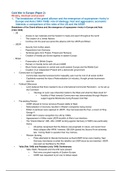
Cold War in Europe (Paper 2)
Rivalry, mistrust and accord
1. The breakdown of the grand alliance and the emergence of superpower rivalry in
Europe and Asia (1943–1949): role of ideology; fear and aggression; economic
interests; a comparison of the roles of the US and the USSR
Breakdown of the Grand alliance and the emergence of superpower rivalry in Europe and Asia
(1943-1949)
• US
• Access to raw materials and the freedom to trade and export throughout the world
• The creation of a United Nations
• Continue into the post-war period the alliance with the USSR and Britain
• USSR
• Security from further attack
• Reparations from Germany
• Territorial gains from Poland, Finland and Romania
• Creation of friendly pro-Soviet regimes in eastern Europe
• Britain
• Preservation of British Empire
• Remain on friendly terms with US and USSR
• Block Soviet expansion in central and south-eastern Europe and the Middle East
• Creation of an independent Poland with a democratic government
• Communism vs Capitalism
◦ Communists resented socioeconomic inequality, saw it as the root of all social conflict
◦ Capitalists resented the idea of Nationalisation (of industry), thought private businesses
were fair
• Political Differences
◦ Lenin believed that there needed to be an international Communist Revolution - so he set up
the Comintern
▪ “Ideology of Lenin was inherently hostile to the West and what the West stood for”
▪ Hostility of West towards Communism was demonstrated through Western
support against Bolsheviks during Russian Civil War
• Pre-existing Tension
◦ USSR refused to honour previous Russian debts to West
◦ Nationalisation of economy resulted in Western companies losing money
◦ British in particular were opposed to USSR - they had executed the Tsar, a cousin of King
George V
◦ USSR didn’t receive recognition by LoN by 1930s
◦ Appeasement of Hitler made USSR doubtful of Allie’s true intentions
◦ The “Grand Alliance” (GB, USA, USSR working against Germany in WWII) was particularly
thorny
▪ All parties recognised that the Alliance was pragmatic in nature, and would most
likely collapse after WWII. However, GB/USA opened the Second Front extremely
late - forcing Stalin to question their true motives.
◦ Warsaw Uprising
▪ Poles attempted to liberate themselves as Nazi/USSR forces were treating. Nazi
Germany mercilessly crushed the rebellion as USSR stood by and watched. USSR
was seen as heartless by the West.
• Yalta (Feb 1945) and Potsdam (July 1945) Conferences
◦ Yalta: Stalin, Roosevelt and Churchill were present
▪ Red army occupied majority of Eastern Europe.
▪ USSR was requested to join war to defeat Japan.
, ▪ Poland was to be the boundary line between new territory (USSR wanted to keep all
the territory it conquered during WWII)
▪ Nazi Germany was to be disarmed and demilitarized, split into 4 regions
◦ Potsdam: Stalin, Truman, Atlee
▪ Could not agree as to how to disarm and demilitarize Nazi Germany
▪ Truman was not happy with treatment of Poland, or borders negotiated by Roosevelt
▪ Stalin was extremely irritated by behaviour of new American/British leadership, felt
betrayed. As a result, relations were strained, the stage was set for the Cold War
Role of ideology
• USA Ideology
• Capitalism is an economic system based upon the values of individualism and promotes individual
liberty over government regulation and control.
• For example, laissez-faire capitalism is a form of the ideology that translates to “leave us
alone” meaning that the government should remain out of the economy and instead allow
individuals to freely carry out their own economic affairs.
• The development of capitalism as an economic system, sought to reject the idea of government control
of the economy and instead put the focus on individuals.
• On the economic spectrum, capitalism is a right-wing ideology that is fundamentally based on: private
ownership, competition, free trade, self-reliance, self-interest, and the principles of supply and
demand.
• Capitalist societies are often based on free-market economies.
• This system differs from communism wherein the government usually controls the means of production
and makes all important economic decisions.
• Democracy is a political system that is associated with the idea that power or authority in a society
rests with the people.
• In general, the people exercise their authority through elections in which they choose others to
represent their interests in a formal legislative structure.
• This system differs from dictatorships wherein many of the decisions are made by the government
which is often a single person and single political party.
• Soviet Ideology
• Communism is an economic system that is based on the principles of socialism, especially the earlier
development of Marxism and the ideas of Karl Marx as expressed in the Communist Manifesto.
• Similar to Marxism, communism is centered on the idea of establishing a society based upon public
ownership of the means of production and the removal of any form of social classes.
• For example, communism generally focuses on the conditions of the working-class, and the wide
income gap that existed in laissez-faire capitalist societies.
• Communist countries such as the Soviet Union are also often dictatorships.
• Communism differs from capitalism because it focuses on the government having much more control
over the economy, and is often referred to as a command economy.
• A dictatorship is a form of government in which most or all authority of the country is in the hands of a
single individual; the leader.
Economic Interests:
• USA
• Britain and US wanted a moderate German economic recovery —> wanted their zones to at least pay
for their own food imports
• This was due to western zones absorbing more German refugees and they subsequently had
more mouths to feed
• US refused reparations payments until overall German economic plan achieved
, • US Secretary of state argued that reparations could only be paid once Germany had a trade surplus
that would cover the cost of food
• British and US zones in Bizonia were merged economically - US argued that the amalgamation would
eventually create the economic conditions for fulfilling the Potsdam Agreement
• USSR
• Was reluctant to agree with the US methods of rebuilding German economy
• Saw it as a push for capitalist reconstruction to benefit US/British industry and trade
• Soviets increase eastern German industrial production and seized 213 German companies
• USSR Foreign Minister insisted that Germany should pay the USSR the equivalent of $10billion in
reparations
Comparison of the Roles of the US and USSR:
US USSR
Traditionalist • Clear B + F too econ + pol weak to • Firmly blame Stalin for staring CW –
defend W Eur à US intervened & ignored promises at Yalta to support
made decisions which marked the dem govs
beginning of the CW
• Creation of Bizonia
• Truman Doctrine
• Marshall Plan
• US responded defensively to
aggressive Sov moves
Revisionist • Pursued pols causing CW in Eur – •
aimed to force SU to join global
econ + open to US imports & pol
ideas à undermined Stalin’s gov
• US pol aimed to restructure world
economically so US bus could
trade, operate & profit w no
restrictions
Post-Revisionist – • • Local communists in Sov zone had
can use Sov considerable inf on pols which
archive materials sometimes ran counter to Stalin’s own
intentions
• Stalin’s pol in Eur more subtle than
trad view – determined to turn P,
Romania, Bulgaria into satellite
states, he had flexible views à
allowed Hungary & Czech to retain
connections to W for 2 years + for
Finland to remain neutral non-com
Western-style democracy
, • TD + MP contrib to escalation of • Exaggerated to say Stalin pursued a
CW relatively more moderate line in E Eur
• Seismic events of 47 – Brit near up to 47 and that his Ger pol was
broke, Ger econ, civil war in Greece more a clumsy attempt to neutralise G
+ China, strength of French + Italian + gain reps needed, rather than a
com parties à galvanised US gov result of deep-laid plans to take
into announcing TD à provoked SU control of Ger-occupied territory
into tightening grip on SU + creating • By mid 47 Stalin pushed into
Cominform defensive by TD + MP
USA Phase USSR
Truman (45-53) 47-53 Stalin (22-53)
Truman Doctrine, Containment Origins + 1st CW Salami Tactics, Security
Eisenhower (53-61) 53-67 Malenkov (53-55)
Eisenhower Doctrine, Oscillatory Antagonism (Peaceful
New Look Coexistence) Khrushchev (56-64)
Peaceful Coexistence
JFK (61-63)
Space Race Brezhnev (64-82)
Brezhnev Doctrine
LBJ (63-69)
Towards Détente
Nixon (69-74) 67-79 Stagnation
Détente, SALT, Asia 1st Détente
Ford (74-77)
Détente
Carter (77-81)
Human Rights
Reagan (81-89)
Evil Empire, Star Wars
Bush Sr (89-93)
79-86 Andropov (82-84)
2nd Cold War
Chernenko (84-5)
Stagnation
Gorbachev (85-91)
Glasnost, Perestroika
Rivalry, mistrust and accord
1. The breakdown of the grand alliance and the emergence of superpower rivalry in
Europe and Asia (1943–1949): role of ideology; fear and aggression; economic
interests; a comparison of the roles of the US and the USSR
Breakdown of the Grand alliance and the emergence of superpower rivalry in Europe and Asia
(1943-1949)
• US
• Access to raw materials and the freedom to trade and export throughout the world
• The creation of a United Nations
• Continue into the post-war period the alliance with the USSR and Britain
• USSR
• Security from further attack
• Reparations from Germany
• Territorial gains from Poland, Finland and Romania
• Creation of friendly pro-Soviet regimes in eastern Europe
• Britain
• Preservation of British Empire
• Remain on friendly terms with US and USSR
• Block Soviet expansion in central and south-eastern Europe and the Middle East
• Creation of an independent Poland with a democratic government
• Communism vs Capitalism
◦ Communists resented socioeconomic inequality, saw it as the root of all social conflict
◦ Capitalists resented the idea of Nationalisation (of industry), thought private businesses
were fair
• Political Differences
◦ Lenin believed that there needed to be an international Communist Revolution - so he set up
the Comintern
▪ “Ideology of Lenin was inherently hostile to the West and what the West stood for”
▪ Hostility of West towards Communism was demonstrated through Western
support against Bolsheviks during Russian Civil War
• Pre-existing Tension
◦ USSR refused to honour previous Russian debts to West
◦ Nationalisation of economy resulted in Western companies losing money
◦ British in particular were opposed to USSR - they had executed the Tsar, a cousin of King
George V
◦ USSR didn’t receive recognition by LoN by 1930s
◦ Appeasement of Hitler made USSR doubtful of Allie’s true intentions
◦ The “Grand Alliance” (GB, USA, USSR working against Germany in WWII) was particularly
thorny
▪ All parties recognised that the Alliance was pragmatic in nature, and would most
likely collapse after WWII. However, GB/USA opened the Second Front extremely
late - forcing Stalin to question their true motives.
◦ Warsaw Uprising
▪ Poles attempted to liberate themselves as Nazi/USSR forces were treating. Nazi
Germany mercilessly crushed the rebellion as USSR stood by and watched. USSR
was seen as heartless by the West.
• Yalta (Feb 1945) and Potsdam (July 1945) Conferences
◦ Yalta: Stalin, Roosevelt and Churchill were present
▪ Red army occupied majority of Eastern Europe.
▪ USSR was requested to join war to defeat Japan.
, ▪ Poland was to be the boundary line between new territory (USSR wanted to keep all
the territory it conquered during WWII)
▪ Nazi Germany was to be disarmed and demilitarized, split into 4 regions
◦ Potsdam: Stalin, Truman, Atlee
▪ Could not agree as to how to disarm and demilitarize Nazi Germany
▪ Truman was not happy with treatment of Poland, or borders negotiated by Roosevelt
▪ Stalin was extremely irritated by behaviour of new American/British leadership, felt
betrayed. As a result, relations were strained, the stage was set for the Cold War
Role of ideology
• USA Ideology
• Capitalism is an economic system based upon the values of individualism and promotes individual
liberty over government regulation and control.
• For example, laissez-faire capitalism is a form of the ideology that translates to “leave us
alone” meaning that the government should remain out of the economy and instead allow
individuals to freely carry out their own economic affairs.
• The development of capitalism as an economic system, sought to reject the idea of government control
of the economy and instead put the focus on individuals.
• On the economic spectrum, capitalism is a right-wing ideology that is fundamentally based on: private
ownership, competition, free trade, self-reliance, self-interest, and the principles of supply and
demand.
• Capitalist societies are often based on free-market economies.
• This system differs from communism wherein the government usually controls the means of production
and makes all important economic decisions.
• Democracy is a political system that is associated with the idea that power or authority in a society
rests with the people.
• In general, the people exercise their authority through elections in which they choose others to
represent their interests in a formal legislative structure.
• This system differs from dictatorships wherein many of the decisions are made by the government
which is often a single person and single political party.
• Soviet Ideology
• Communism is an economic system that is based on the principles of socialism, especially the earlier
development of Marxism and the ideas of Karl Marx as expressed in the Communist Manifesto.
• Similar to Marxism, communism is centered on the idea of establishing a society based upon public
ownership of the means of production and the removal of any form of social classes.
• For example, communism generally focuses on the conditions of the working-class, and the wide
income gap that existed in laissez-faire capitalist societies.
• Communist countries such as the Soviet Union are also often dictatorships.
• Communism differs from capitalism because it focuses on the government having much more control
over the economy, and is often referred to as a command economy.
• A dictatorship is a form of government in which most or all authority of the country is in the hands of a
single individual; the leader.
Economic Interests:
• USA
• Britain and US wanted a moderate German economic recovery —> wanted their zones to at least pay
for their own food imports
• This was due to western zones absorbing more German refugees and they subsequently had
more mouths to feed
• US refused reparations payments until overall German economic plan achieved
, • US Secretary of state argued that reparations could only be paid once Germany had a trade surplus
that would cover the cost of food
• British and US zones in Bizonia were merged economically - US argued that the amalgamation would
eventually create the economic conditions for fulfilling the Potsdam Agreement
• USSR
• Was reluctant to agree with the US methods of rebuilding German economy
• Saw it as a push for capitalist reconstruction to benefit US/British industry and trade
• Soviets increase eastern German industrial production and seized 213 German companies
• USSR Foreign Minister insisted that Germany should pay the USSR the equivalent of $10billion in
reparations
Comparison of the Roles of the US and USSR:
US USSR
Traditionalist • Clear B + F too econ + pol weak to • Firmly blame Stalin for staring CW –
defend W Eur à US intervened & ignored promises at Yalta to support
made decisions which marked the dem govs
beginning of the CW
• Creation of Bizonia
• Truman Doctrine
• Marshall Plan
• US responded defensively to
aggressive Sov moves
Revisionist • Pursued pols causing CW in Eur – •
aimed to force SU to join global
econ + open to US imports & pol
ideas à undermined Stalin’s gov
• US pol aimed to restructure world
economically so US bus could
trade, operate & profit w no
restrictions
Post-Revisionist – • • Local communists in Sov zone had
can use Sov considerable inf on pols which
archive materials sometimes ran counter to Stalin’s own
intentions
• Stalin’s pol in Eur more subtle than
trad view – determined to turn P,
Romania, Bulgaria into satellite
states, he had flexible views à
allowed Hungary & Czech to retain
connections to W for 2 years + for
Finland to remain neutral non-com
Western-style democracy
, • TD + MP contrib to escalation of • Exaggerated to say Stalin pursued a
CW relatively more moderate line in E Eur
• Seismic events of 47 – Brit near up to 47 and that his Ger pol was
broke, Ger econ, civil war in Greece more a clumsy attempt to neutralise G
+ China, strength of French + Italian + gain reps needed, rather than a
com parties à galvanised US gov result of deep-laid plans to take
into announcing TD à provoked SU control of Ger-occupied territory
into tightening grip on SU + creating • By mid 47 Stalin pushed into
Cominform defensive by TD + MP
USA Phase USSR
Truman (45-53) 47-53 Stalin (22-53)
Truman Doctrine, Containment Origins + 1st CW Salami Tactics, Security
Eisenhower (53-61) 53-67 Malenkov (53-55)
Eisenhower Doctrine, Oscillatory Antagonism (Peaceful
New Look Coexistence) Khrushchev (56-64)
Peaceful Coexistence
JFK (61-63)
Space Race Brezhnev (64-82)
Brezhnev Doctrine
LBJ (63-69)
Towards Détente
Nixon (69-74) 67-79 Stagnation
Détente, SALT, Asia 1st Détente
Ford (74-77)
Détente
Carter (77-81)
Human Rights
Reagan (81-89)
Evil Empire, Star Wars
Bush Sr (89-93)
79-86 Andropov (82-84)
2nd Cold War
Chernenko (84-5)
Stagnation
Gorbachev (85-91)
Glasnost, Perestroika