SOCI 326 – Introduction to Political
Sociology
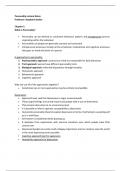
Student-Friendly Notes & Study Guide
Introductory Section
● Political sociology examines how politics and society shape each other.
● This course introduces the major theories and perspectives in political sociology.
● The goal: understand how power, social relations, and institutions interact.
What is Sociology?
● Sociology = the scientific study of patterns in social life.
● Focus: not just individuals, but the structures and relationships that shape behavior.
● Two main components:
1. Social Relations → recurring interactions between people.
■ Example: gender patterns in universities, family structures, workplace
hierarchies.
2. Scientific Analysis → systematic methods like observation, data collection,
and testing.
Key Concepts in Social Relations
● Social structure → stable patterns of social relations that persist over time.
○ Examples: patriarchy, residential segregation.
● Institutions → formal organizations with rules and norms (e.g., law, education,
capitalism, the state).
, ● Patterns: Sociologists look for recurring themes across groups (e.g., why Quebec has
higher cohabitation rates, why some communities are inclusive vs exclusive).
Sociology as a Science
● Uses the scientific method:
○ Form a question (e.g., “Who uses Tim Horton’s drive-thru?”).
○ Observe (collect data on who uses drive-thru vs counter).
○ Analyze (find trends in the data).
○ Test (interview people to check reasons behind behavior).
● Assumptions of science:
○ The world is real and external.
○ We can observe it with some accuracy.
○ There is order and regularity (things aren’t purely random).
● Challenges in social science:
○ Harder to run controlled experiments.
○ Human behavior is complex and influenced by many causes.
○ People act differently in the same situation; motives vary.
● Postmodern critique: Some argue sociology cannot be fully scientific, since biases
shape what we see (Foucault, Said). Instead, focus on exposing these biases.
Emergence of Sociology
● Sociology emerged in the 19th century.
● Driven by:
○ Scientific Revolution → faith in systematic knowledge.
○ Rapid social change → industrialization, nationalism, urbanization,
revolutions.
Sociology
Student-Friendly Notes & Study Guide
Introductory Section
● Political sociology examines how politics and society shape each other.
● This course introduces the major theories and perspectives in political sociology.
● The goal: understand how power, social relations, and institutions interact.
What is Sociology?
● Sociology = the scientific study of patterns in social life.
● Focus: not just individuals, but the structures and relationships that shape behavior.
● Two main components:
1. Social Relations → recurring interactions between people.
■ Example: gender patterns in universities, family structures, workplace
hierarchies.
2. Scientific Analysis → systematic methods like observation, data collection,
and testing.
Key Concepts in Social Relations
● Social structure → stable patterns of social relations that persist over time.
○ Examples: patriarchy, residential segregation.
● Institutions → formal organizations with rules and norms (e.g., law, education,
capitalism, the state).
, ● Patterns: Sociologists look for recurring themes across groups (e.g., why Quebec has
higher cohabitation rates, why some communities are inclusive vs exclusive).
Sociology as a Science
● Uses the scientific method:
○ Form a question (e.g., “Who uses Tim Horton’s drive-thru?”).
○ Observe (collect data on who uses drive-thru vs counter).
○ Analyze (find trends in the data).
○ Test (interview people to check reasons behind behavior).
● Assumptions of science:
○ The world is real and external.
○ We can observe it with some accuracy.
○ There is order and regularity (things aren’t purely random).
● Challenges in social science:
○ Harder to run controlled experiments.
○ Human behavior is complex and influenced by many causes.
○ People act differently in the same situation; motives vary.
● Postmodern critique: Some argue sociology cannot be fully scientific, since biases
shape what we see (Foucault, Said). Instead, focus on exposing these biases.
Emergence of Sociology
● Sociology emerged in the 19th century.
● Driven by:
○ Scientific Revolution → faith in systematic knowledge.
○ Rapid social change → industrialization, nationalism, urbanization,
revolutions.