
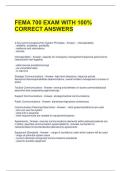
FEMA 700 EXAM WITH 100%
CORRECT ANSWERS
4 Key Communications/Info System Principles - Answer- - interoperability
- reliability, scalability, portability
- resilience and redundancy
- security
Interoperability - Answer- capacity for emergency management/response personnel to
interact/work well together
- within/across jurisdictions/orgs
- via voice/data/video
- in real time
Strategic Communications - Answer- high-level directions, resource priority
decisions/roles/responsibilities determinations, overall incident management courses of
action
Tactical Communications - Answer- among and between on-scene command/tactical
personnel and cooperating agencies/orgs
Support Communications - Answer- strategic/tactical communications
Public Communications - Answer- alerts/warnings/press conferences
Communication Planning Determines - Answer- - what systems/platforms are used
- who can use the system
- what info is essential
- what requirements are needed for equipment/systems
Agreements - Answer- ensures communications elements within plans/procedures are
in effect, specifies communication system/platform, includes connection of
networks/data format standards/cybersecurity agreements
Equipment Standards - Answer- - range of conditions under which system will be used
- range of potential system users
- current nationally recognized communications standards
- need for durable equipment
,Incident Info Is Used for Many Functions: - Answer- - aiding in planning
- communicating w/ public
- determining incident cost
- assessing need for additional resources
- identifying safety issues
- resolving information requests
Collaborative Approach Incident Personnel - Answer- - multiple jurisdictions
- combination of specialists/disciplines
- several levels of gov
- NGOs
- private sector
NIMS - Answer- National Incident Management System, defines the comprehensive
approach guiding the whole community/all levels of gov/NGOs/private sector to work
together seamlessly to prevent, protect against, mitigate, respond to and recover from
incidents
NIMS audience - Answer- - Emergency responders
- Other incident personnel
- Non-Governmental Organizations (NGOs) such as faith-based and community-based
groups
- The private sector
- Elected and appointed officials
- People with disabilities or access and functional needs
NIMS Scope - Answer- -all incidents, regardless of size, complexity or scope
-planned events such as sporting events
NIMS IS: - Answer- - comprehensive, nationwide, systematic approach to incident
management
- a set of concepts/principles for all threats/hazards/events (PRMRR)
- scalable/flexible/adaptable
- standard resource management procedures that enable coordination among different
jurisdictions or organizations
- essential principles for communications and information management
NIMS is NOT: - Answer- - only the incident command system
- only applicable to certain emergency/incident response personnel
- a static system
- a response plan
- used only during large scale incidents
- a resource ordering system
- a communications plan
, PRMRR Mission Areas - Answer- Prevention
Protection
Mitigation
Response
Recovery
Incident Management - Answer- the application of resources by organizations to plan
for, respond to and recover from an incident
Incident Management Priorities - Answer- save lives
stabilize the incident
protect property/environment
Incident Management + NIMS Principles - Answer- flexibility
standardization
unity of effort
NIMS Flexibility - Answer- enables NIMS to be applicable to incidents that vary in terms
of hazard/geography/demographics/climate/cultural/organizational authorities
NIMS Standardization - Answer- supports interoperability among multiple organizations
in incident response
Standard Organizational Structures - Answer- improve integration and connectivity
among organizations
Standard Practices - Answer- allow incident personnel and organizations to work
together effecitvely
Common Terminology - Answer- enables effective communication
- organizational functions
- resource descriptions
- incident facilities
Unity of Effort - Answer- coordinating activites among various organizational
representatives to achieve common objectives, enables orgs w/ jurisdictional
authority/functional responsibilities to support eachother
Jurisdictions/Orgs involved in incident management vary in their: - Answer- -authorities
-management structures
-communication capabilities/protocols
Resource Management NIMS - Answer- standard mechanisms to systematically
manage resources (personnel/equipment/supplies/teams/facilities) both before/during
incidents
- getting the right resources to the right place at the right time
CORRECT ANSWERS
4 Key Communications/Info System Principles - Answer- - interoperability
- reliability, scalability, portability
- resilience and redundancy
- security
Interoperability - Answer- capacity for emergency management/response personnel to
interact/work well together
- within/across jurisdictions/orgs
- via voice/data/video
- in real time
Strategic Communications - Answer- high-level directions, resource priority
decisions/roles/responsibilities determinations, overall incident management courses of
action
Tactical Communications - Answer- among and between on-scene command/tactical
personnel and cooperating agencies/orgs
Support Communications - Answer- strategic/tactical communications
Public Communications - Answer- alerts/warnings/press conferences
Communication Planning Determines - Answer- - what systems/platforms are used
- who can use the system
- what info is essential
- what requirements are needed for equipment/systems
Agreements - Answer- ensures communications elements within plans/procedures are
in effect, specifies communication system/platform, includes connection of
networks/data format standards/cybersecurity agreements
Equipment Standards - Answer- - range of conditions under which system will be used
- range of potential system users
- current nationally recognized communications standards
- need for durable equipment
,Incident Info Is Used for Many Functions: - Answer- - aiding in planning
- communicating w/ public
- determining incident cost
- assessing need for additional resources
- identifying safety issues
- resolving information requests
Collaborative Approach Incident Personnel - Answer- - multiple jurisdictions
- combination of specialists/disciplines
- several levels of gov
- NGOs
- private sector
NIMS - Answer- National Incident Management System, defines the comprehensive
approach guiding the whole community/all levels of gov/NGOs/private sector to work
together seamlessly to prevent, protect against, mitigate, respond to and recover from
incidents
NIMS audience - Answer- - Emergency responders
- Other incident personnel
- Non-Governmental Organizations (NGOs) such as faith-based and community-based
groups
- The private sector
- Elected and appointed officials
- People with disabilities or access and functional needs
NIMS Scope - Answer- -all incidents, regardless of size, complexity or scope
-planned events such as sporting events
NIMS IS: - Answer- - comprehensive, nationwide, systematic approach to incident
management
- a set of concepts/principles for all threats/hazards/events (PRMRR)
- scalable/flexible/adaptable
- standard resource management procedures that enable coordination among different
jurisdictions or organizations
- essential principles for communications and information management
NIMS is NOT: - Answer- - only the incident command system
- only applicable to certain emergency/incident response personnel
- a static system
- a response plan
- used only during large scale incidents
- a resource ordering system
- a communications plan
, PRMRR Mission Areas - Answer- Prevention
Protection
Mitigation
Response
Recovery
Incident Management - Answer- the application of resources by organizations to plan
for, respond to and recover from an incident
Incident Management Priorities - Answer- save lives
stabilize the incident
protect property/environment
Incident Management + NIMS Principles - Answer- flexibility
standardization
unity of effort
NIMS Flexibility - Answer- enables NIMS to be applicable to incidents that vary in terms
of hazard/geography/demographics/climate/cultural/organizational authorities
NIMS Standardization - Answer- supports interoperability among multiple organizations
in incident response
Standard Organizational Structures - Answer- improve integration and connectivity
among organizations
Standard Practices - Answer- allow incident personnel and organizations to work
together effecitvely
Common Terminology - Answer- enables effective communication
- organizational functions
- resource descriptions
- incident facilities
Unity of Effort - Answer- coordinating activites among various organizational
representatives to achieve common objectives, enables orgs w/ jurisdictional
authority/functional responsibilities to support eachother
Jurisdictions/Orgs involved in incident management vary in their: - Answer- -authorities
-management structures
-communication capabilities/protocols
Resource Management NIMS - Answer- standard mechanisms to systematically
manage resources (personnel/equipment/supplies/teams/facilities) both before/during
incidents
- getting the right resources to the right place at the right time


