Fall 2024
Exam 2 Form 3
MULTIPLE CHOICE. Choose the one alternative that best completes the statement or answers the
question.
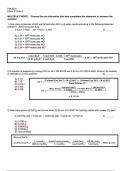
1) How many molecules of HCI are formed when 60.0 g of water reacts according to the following balanced
reaction? Assume excess ICI3.
2 I1CI3 + 3 H2O — ICI + HIO3 + 5 HCI 1)
A) 3.34 x 1025 molecules HCI
B) 4.00 x 1024 molecules HCI
C) 6.00 x 1024 molecules HCI
D) 2.00 x 1024 molecules HCI
E) 3.34 x 1024 molecules HCI
1mol H,0 5mol HCL 6.022 X 10²³ molecules
60.0
g H,0 * 3.
3.3 4 X 24 s
X 10“*moleculeHCI
18.01 g H,0 3 mol H,0
=
1 mol HCI
2) A solution is prepared by mixing 5.00 mL of 0.100 M HCI and 2.00 mL of 0.200 M NaCl. What is the molarity
of chloride ion in this solution? 2)
A) 0.171
B) 7.78 (I = (Volume(L)of NaCl x M of NaCl) + (Volume(L)of HCl x M of HCl)
C) 020143 B Total Volume (L)
D) 0.450 .200 mol NaCl —) + 0.005L Nacl .100 mol HCI )
E) 0.129 (1] = .002 L NaCl(**5 7y 1L HCI
(.002 L+.005 L)
=0.129 M
3) How many grams of CaCl2 are formed when 20.00 mL of 0.00237 M Ca(OH)2 reacts with excess Cl2 gas?
2 Ca(OH)2 (aq) + 2 Cl2 (g) — Ca(OCl)2 (aq) + CaCl2 (s) + 2 H20 (l) 3)
A) 0.0380 g
B) 0.0105 g
C) 0.00263 g
D) 0.00526 g
E) none of these
Mass of CaCl,
1L Ca(OH), 0.00237 moles Ca(OH), 1 mol CaCl, 110.98 g CacCl,
20.00 mL Ca(OH), * 1000 mL Ca(OH), 1L Ca(OH), 2mol Ca(0H), © 1molcCaCl, =.002
020348 Cath
, 4) Which of the following is NOT a strong electrolyte? 4)
A) MgCO3
B) K2504 MgCO; does not completely dissociates due its low solubility unlike
C) CaCl2 the rest of the other electrolytes
D) KOH
E) NaC2H302
5) Methane (CH4) and oxygen react to form carbon dioxide and water. What mass of water is formed if 1.6 g of
methane reacts with 6.4 g of oxygen to produce 4.4 g of carbon dioxide? 5)
A)8.0¢g
B)7.4¢
D)3.6¢g M H.O
E) none of these ass of Hz
16a CH ( 1molCH, ) 2molH,0 18.02gH,0 _ 3.6 g H.O
08 Y% \16.04 g CH,) " 1TmolCH, 1molH,0 9%z
1mol 0, 2molH,0 18.02gH,0
6.49 0y~ (32.0g 02) * 2mol0, ~ 1molH,0 _ >09H0
Neither is a limiting reagent
6) How many grams of NaOH (MW = 40.0) are there in 500.0 mL of a 0.250 M NaOH solution? ©6)
A) 14.0
B; 5.00 Mass of NaOH = Volume (L) X Molarity (M) X Molar Mass (%)
C) 0.00219
D) 0.125 500.0 mL NaOH 1L NaOH 250 mol NaOH 40.0g NaOH
E) 114 A *1000mLNaOH™~ 1L NaOH 1 mol NaOH
= . X * *
=5.00g
7) Calcium oxide reacts with water in a combination reaction to produce calcium hydroxide:
CaO(s) + H20 (I) —» Ca(OH)2 (s)
A 1.50-g sample of CaO is reacted with 1.45 g of H20. How many grams of water remain after the reaction is
complete? 7)
A) 1.04
B) 0.00 Remaining mass of H,0
=) 0-90297
D) 0.966 1molCa0 =~ 1molH,0
. —mottald 18.02 g H,0
~motH,0 2092910
E) 0.0536 1.50
g Ca0 > o 08 g Ca0 * TmolCa0 * TmolHo 029 H:20
1.45 g H,0—.482 gH,0 =.968 g H,0
Exam 2 Form 3
MULTIPLE CHOICE. Choose the one alternative that best completes the statement or answers the
question.
1) How many molecules of HCI are formed when 60.0 g of water reacts according to the following balanced
reaction? Assume excess ICI3.
2 I1CI3 + 3 H2O — ICI + HIO3 + 5 HCI 1)
A) 3.34 x 1025 molecules HCI
B) 4.00 x 1024 molecules HCI
C) 6.00 x 1024 molecules HCI
D) 2.00 x 1024 molecules HCI
E) 3.34 x 1024 molecules HCI
1mol H,0 5mol HCL 6.022 X 10²³ molecules
60.0
g H,0 * 3.
3.3 4 X 24 s
X 10“*moleculeHCI
18.01 g H,0 3 mol H,0
=
1 mol HCI
2) A solution is prepared by mixing 5.00 mL of 0.100 M HCI and 2.00 mL of 0.200 M NaCl. What is the molarity
of chloride ion in this solution? 2)
A) 0.171
B) 7.78 (I = (Volume(L)of NaCl x M of NaCl) + (Volume(L)of HCl x M of HCl)
C) 020143 B Total Volume (L)
D) 0.450 .200 mol NaCl —) + 0.005L Nacl .100 mol HCI )
E) 0.129 (1] = .002 L NaCl(**5 7y 1L HCI
(.002 L+.005 L)
=0.129 M
3) How many grams of CaCl2 are formed when 20.00 mL of 0.00237 M Ca(OH)2 reacts with excess Cl2 gas?
2 Ca(OH)2 (aq) + 2 Cl2 (g) — Ca(OCl)2 (aq) + CaCl2 (s) + 2 H20 (l) 3)
A) 0.0380 g
B) 0.0105 g
C) 0.00263 g
D) 0.00526 g
E) none of these
Mass of CaCl,
1L Ca(OH), 0.00237 moles Ca(OH), 1 mol CaCl, 110.98 g CacCl,
20.00 mL Ca(OH), * 1000 mL Ca(OH), 1L Ca(OH), 2mol Ca(0H), © 1molcCaCl, =.002
020348 Cath
, 4) Which of the following is NOT a strong electrolyte? 4)
A) MgCO3
B) K2504 MgCO; does not completely dissociates due its low solubility unlike
C) CaCl2 the rest of the other electrolytes
D) KOH
E) NaC2H302
5) Methane (CH4) and oxygen react to form carbon dioxide and water. What mass of water is formed if 1.6 g of
methane reacts with 6.4 g of oxygen to produce 4.4 g of carbon dioxide? 5)
A)8.0¢g
B)7.4¢
D)3.6¢g M H.O
E) none of these ass of Hz
16a CH ( 1molCH, ) 2molH,0 18.02gH,0 _ 3.6 g H.O
08 Y% \16.04 g CH,) " 1TmolCH, 1molH,0 9%z
1mol 0, 2molH,0 18.02gH,0
6.49 0y~ (32.0g 02) * 2mol0, ~ 1molH,0 _ >09H0
Neither is a limiting reagent
6) How many grams of NaOH (MW = 40.0) are there in 500.0 mL of a 0.250 M NaOH solution? ©6)
A) 14.0
B; 5.00 Mass of NaOH = Volume (L) X Molarity (M) X Molar Mass (%)
C) 0.00219
D) 0.125 500.0 mL NaOH 1L NaOH 250 mol NaOH 40.0g NaOH
E) 114 A *1000mLNaOH™~ 1L NaOH 1 mol NaOH
= . X * *
=5.00g
7) Calcium oxide reacts with water in a combination reaction to produce calcium hydroxide:
CaO(s) + H20 (I) —» Ca(OH)2 (s)
A 1.50-g sample of CaO is reacted with 1.45 g of H20. How many grams of water remain after the reaction is
complete? 7)
A) 1.04
B) 0.00 Remaining mass of H,0
=) 0-90297
D) 0.966 1molCa0 =~ 1molH,0
. —mottald 18.02 g H,0
~motH,0 2092910
E) 0.0536 1.50
g Ca0 > o 08 g Ca0 * TmolCa0 * TmolHo 029 H:20
1.45 g H,0—.482 gH,0 =.968 g H,0