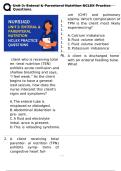
Unit 2: Enteral & Parenteral Nutrition NCLEX Practice
Questions.
ure (CHF) and pulmonary
edema. Which complication of
1.
TPN is the client most likely
1.
experiencing?
1.
1. A. Calcium imbalance
1.
B. Fluid volume deficit
1.
C. Fluid volume overload
1.
D. Potassium imbalance
1.
A3. A client is discharged home
client who is receiving total with an enteral feeding tube.
en- teral nutrition (TEN) What
exhibits acute confusion and
shallow breathing and says,
"I feel weak." As the client
begins to have a general-
ized seizure, how does the
nurse interpret this client's
signs and symptoms?
A. The enteral tube is
misplaced or dislodged.
B. Abdominal distention is
pre- sent.
C. A fluid and electrolyte
imbal- ance is present.
D. This is refeeding syndrome.
2. A client receiving total
parenter- al nutrition (TPN)
exhibits symp- toms of
congestive heart fail-
, Unit 2: Enteral & Parenteral Nutrition NCLEX Practice
Questions.
Answer D. Answer D.
Rationale:
Incorrect: If the enteral tube becomes misplaced
or dis- lodged, the client may develop aspiration
pneumonia dis- played by increased
temperature, increased pulse, de- hydration,
diminished breath sounds, and shortness of
breath.
Incorrect: Abdominal distention is most frequently
accom- panied by nausea and vomiting.
Incorrect: Signs and symptoms of fluid and
electrolyte problems resulting in circulatory
overload can include pe- ripheral edema, sudden
weight gain, crackles, dyspnea, increased blood
pressure, and bounding pulse.
Correct: Symptoms of refeeding syndrome
include shal- low respirations, weakness, acute
confusion, seizures, and increased bleeding
tendency.
Answer C.
Rationales:
Incorrect: This client's symptoms are not indicative
of cal- cium imbalance.
Incorrect: This client's symptoms are not indicative
of fluid deficit.
Correct: Congestive heart failure and pulmonary
edema are symptoms of fluid overload
Incorrect: This client's symptoms are not indicative
of potassium imbalance.
, Unit 2: Enteral & Parenteral Nutrition NCLEX Practice
Questions.
does the home health Rationales:
nurse do to determine the Incorrect: The client should have an x-ray
patency of the client's performed when the enteral tube is initially
enteral tube? inserted.
Incorrect: The presence of bowel sounds does not
A. Arranges for the client to
indicate that the enteral tube is in place.
have an x-ray performed
Incorrect: This traditional auscultatory method for
periodically
B. Auscultates the client's check- ing enteral tube placement is not reliable,
ab- domen for bowel especially for the client with a small-bore tube.
Correct: This is considered to be the most accurate
sounds before each method
feeding
C. Instills air into the tube to check for confirming enteral tube placement.
for placement and patency before
each feeding
D. Tests aspirated tube
contents for pH level before
each feeding Correct
4. A nurse is monitoring a client who Answer A.
is receiving an intravenous fat
emulsion (IVFE) nutritional the IVFE infusion
sup- plement. What action D. Switches the infusion to to-
does the nurse take in the
event that the client
develops fever, increased
triglycerides, and clotting
prob- lems?
A. Discontinues the IVFE
infusion
B. Documents the findings
and continues to monitor
C. Slows the rate of flow of
Questions.
ure (CHF) and pulmonary
edema. Which complication of
1.
TPN is the client most likely
1.
experiencing?
1.
1. A. Calcium imbalance
1.
B. Fluid volume deficit
1.
C. Fluid volume overload
1.
D. Potassium imbalance
1.
A3. A client is discharged home
client who is receiving total with an enteral feeding tube.
en- teral nutrition (TEN) What
exhibits acute confusion and
shallow breathing and says,
"I feel weak." As the client
begins to have a general-
ized seizure, how does the
nurse interpret this client's
signs and symptoms?
A. The enteral tube is
misplaced or dislodged.
B. Abdominal distention is
pre- sent.
C. A fluid and electrolyte
imbal- ance is present.
D. This is refeeding syndrome.
2. A client receiving total
parenter- al nutrition (TPN)
exhibits symp- toms of
congestive heart fail-
, Unit 2: Enteral & Parenteral Nutrition NCLEX Practice
Questions.
Answer D. Answer D.
Rationale:
Incorrect: If the enteral tube becomes misplaced
or dis- lodged, the client may develop aspiration
pneumonia dis- played by increased
temperature, increased pulse, de- hydration,
diminished breath sounds, and shortness of
breath.
Incorrect: Abdominal distention is most frequently
accom- panied by nausea and vomiting.
Incorrect: Signs and symptoms of fluid and
electrolyte problems resulting in circulatory
overload can include pe- ripheral edema, sudden
weight gain, crackles, dyspnea, increased blood
pressure, and bounding pulse.
Correct: Symptoms of refeeding syndrome
include shal- low respirations, weakness, acute
confusion, seizures, and increased bleeding
tendency.
Answer C.
Rationales:
Incorrect: This client's symptoms are not indicative
of cal- cium imbalance.
Incorrect: This client's symptoms are not indicative
of fluid deficit.
Correct: Congestive heart failure and pulmonary
edema are symptoms of fluid overload
Incorrect: This client's symptoms are not indicative
of potassium imbalance.
, Unit 2: Enteral & Parenteral Nutrition NCLEX Practice
Questions.
does the home health Rationales:
nurse do to determine the Incorrect: The client should have an x-ray
patency of the client's performed when the enteral tube is initially
enteral tube? inserted.
Incorrect: The presence of bowel sounds does not
A. Arranges for the client to
indicate that the enteral tube is in place.
have an x-ray performed
Incorrect: This traditional auscultatory method for
periodically
B. Auscultates the client's check- ing enteral tube placement is not reliable,
ab- domen for bowel especially for the client with a small-bore tube.
Correct: This is considered to be the most accurate
sounds before each method
feeding
C. Instills air into the tube to check for confirming enteral tube placement.
for placement and patency before
each feeding
D. Tests aspirated tube
contents for pH level before
each feeding Correct
4. A nurse is monitoring a client who Answer A.
is receiving an intravenous fat
emulsion (IVFE) nutritional the IVFE infusion
sup- plement. What action D. Switches the infusion to to-
does the nurse take in the
event that the client
develops fever, increased
triglycerides, and clotting
prob- lems?
A. Discontinues the IVFE
infusion
B. Documents the findings
and continues to monitor
C. Slows the rate of flow of