Robbins & Cotran 10th Ed. Pathology Test Bank | Chapter-
by-Chapter Questions & Verified Solutions
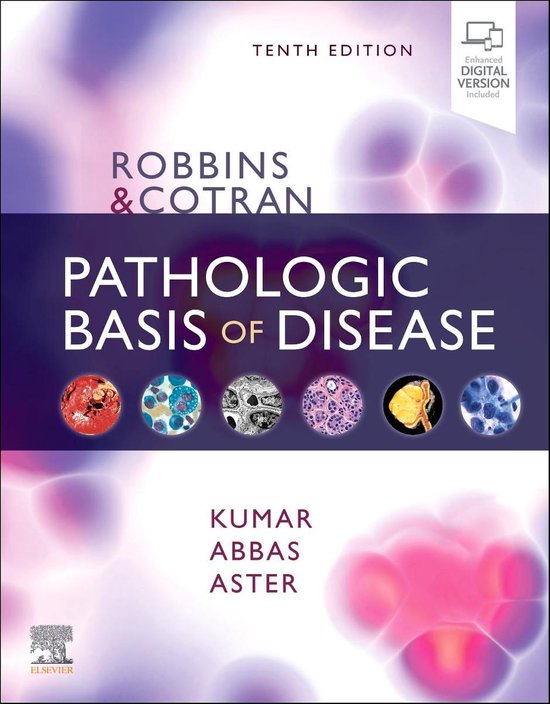
Robbins & Cotran Pathologic Basis of Disease
10th Edition
• Author(s)Vinay Kumar; Abul K. Abbas; Jon C. Aster
1. Chapter Reference – Chapter 1: The Cell as a Unit of Health
and Disease — The Genome
Stem: A 6-year-old boy has recurrent infections. Genetic
testing shows a single-nucleotide change that creates a
premature stop codon in a key immune gene, resulting in
truncated protein and loss of function. Which molecular
process most directly produced the truncated protein?
A. Alternative splicing of pre-mRNA
B. Nonsense mutation causing early termination during
translation
C. Missense mutation causing altered amino acid sequence
D. Frameshift mutation due to single base insertion
Correct Answer: B
,Rationale — Correct: A nonsense mutation converts a codon to
a stop codon; translation terminates prematurely producing
truncated, nonfunctional protein.
Rationale — A: Alternative splicing can alter protein isoforms
but does not create a premature stop codon inherently.
Rationale — C: Missense changes one amino acid but usually
produces full-length protein.
Rationale — D: A frameshift from insertion changes
downstream reading frame and typically alters many codons,
not a single premature stop necessarily.
Teaching Point: Nonsense mutations create early stop codons
and produce truncated, often nonfunctional proteins.
2. Chapter Reference – Chapter 1 — The Genome
Stem: A cancer patient’s tumor shows widespread
chromosomal instability with frequent whole-chromosome
gains and losses. Which mechanism most likely explains
this finding?
A. Defective DNA mismatch repair during replication
B. Faulty spindle assembly checkpoint during mitosis
C. Increased base deamination leading to point mutations
D. Impaired nucleotide excision repair of bulky adducts
Correct Answer: B
Rationale — Correct: Errors in the spindle assembly checkpoint
permit missegregation of chromosomes, producing aneuploidy
,and chromosomal instability.
Rationale — A: Mismatch repair defects cause microsatellite
instability and point mutation accumulation, not large-scale
chromosomal missegregation.
Rationale — C: Base deamination yields point mutations, not
whole-chromosome gains/losses.
Rationale — D: Nucleotide excision repair defects lead to
persistence of bulky lesions and point mutations, not
aneuploidy.
Teaching Point: Mitotic checkpoint failures cause chromosomal
instability and aneuploidy in tumors.
3. Chapter Reference – Chapter 1 — Cellular Housekeeping
Stem: A patient with hepatic steatosis has hepatocytes
filled with numerous enlarged lipid droplets and enlarged
rough endoplasmic reticulum on biopsy. Which cellular
process is primarily responsible for removing damaged
organelles and aggregated proteins?
A. Ubiquitin–proteasome system
B. Autophagy (macroautophagy)
C. Endosomal recycling pathway
D. Exocytosis via Golgi apparatus
Correct Answer: B
Rationale — Correct: Autophagy engulfs damaged organelles
and aggregated proteins in autophagosomes for lysosomal
, degradation, crucial in clearing large structures.
Rationale — A: The ubiquitin–proteasome system degrades
short-lived and misfolded soluble proteins, but not whole
organelles or large aggregates.
Rationale — C: Endosomal recycling sorts membrane proteins
but doesn’t remove organelles/protein aggregates.
Rationale — D: Exocytosis secretes materials but does not
degrade intracellular damaged organelles.
Teaching Point: Autophagy clears damaged organelles and
aggregates via lysosomal degradation.
4. Chapter Reference – Chapter 1 — Cellular Housekeeping
Stem: A neurodegenerative disease shows accumulation of
ubiquitin-tagged protein inclusions in neurons. Which
degradation pathway is most likely overwhelmed or
impaired?
A. Lysosomal acid hydrolases in autophagy
B. Proteasomal degradation of ubiquitinated proteins
C. Endoplasmic reticulum–associated degradation (ERAD)
export to Golgi
D. Phagocytosis by microglia
Correct Answer: B
Rationale — Correct: Ubiquitinated proteins are targeted to the
26S proteasome; accumulation suggests proteasomal
dysfunction or overload.
by-Chapter Questions & Verified Solutions
Robbins & Cotran Pathologic Basis of Disease
10th Edition
• Author(s)Vinay Kumar; Abul K. Abbas; Jon C. Aster
1. Chapter Reference – Chapter 1: The Cell as a Unit of Health
and Disease — The Genome
Stem: A 6-year-old boy has recurrent infections. Genetic
testing shows a single-nucleotide change that creates a
premature stop codon in a key immune gene, resulting in
truncated protein and loss of function. Which molecular
process most directly produced the truncated protein?
A. Alternative splicing of pre-mRNA
B. Nonsense mutation causing early termination during
translation
C. Missense mutation causing altered amino acid sequence
D. Frameshift mutation due to single base insertion
Correct Answer: B
,Rationale — Correct: A nonsense mutation converts a codon to
a stop codon; translation terminates prematurely producing
truncated, nonfunctional protein.
Rationale — A: Alternative splicing can alter protein isoforms
but does not create a premature stop codon inherently.
Rationale — C: Missense changes one amino acid but usually
produces full-length protein.
Rationale — D: A frameshift from insertion changes
downstream reading frame and typically alters many codons,
not a single premature stop necessarily.
Teaching Point: Nonsense mutations create early stop codons
and produce truncated, often nonfunctional proteins.
2. Chapter Reference – Chapter 1 — The Genome
Stem: A cancer patient’s tumor shows widespread
chromosomal instability with frequent whole-chromosome
gains and losses. Which mechanism most likely explains
this finding?
A. Defective DNA mismatch repair during replication
B. Faulty spindle assembly checkpoint during mitosis
C. Increased base deamination leading to point mutations
D. Impaired nucleotide excision repair of bulky adducts
Correct Answer: B
Rationale — Correct: Errors in the spindle assembly checkpoint
permit missegregation of chromosomes, producing aneuploidy
,and chromosomal instability.
Rationale — A: Mismatch repair defects cause microsatellite
instability and point mutation accumulation, not large-scale
chromosomal missegregation.
Rationale — C: Base deamination yields point mutations, not
whole-chromosome gains/losses.
Rationale — D: Nucleotide excision repair defects lead to
persistence of bulky lesions and point mutations, not
aneuploidy.
Teaching Point: Mitotic checkpoint failures cause chromosomal
instability and aneuploidy in tumors.
3. Chapter Reference – Chapter 1 — Cellular Housekeeping
Stem: A patient with hepatic steatosis has hepatocytes
filled with numerous enlarged lipid droplets and enlarged
rough endoplasmic reticulum on biopsy. Which cellular
process is primarily responsible for removing damaged
organelles and aggregated proteins?
A. Ubiquitin–proteasome system
B. Autophagy (macroautophagy)
C. Endosomal recycling pathway
D. Exocytosis via Golgi apparatus
Correct Answer: B
Rationale — Correct: Autophagy engulfs damaged organelles
and aggregated proteins in autophagosomes for lysosomal
, degradation, crucial in clearing large structures.
Rationale — A: The ubiquitin–proteasome system degrades
short-lived and misfolded soluble proteins, but not whole
organelles or large aggregates.
Rationale — C: Endosomal recycling sorts membrane proteins
but doesn’t remove organelles/protein aggregates.
Rationale — D: Exocytosis secretes materials but does not
degrade intracellular damaged organelles.
Teaching Point: Autophagy clears damaged organelles and
aggregates via lysosomal degradation.
4. Chapter Reference – Chapter 1 — Cellular Housekeeping
Stem: A neurodegenerative disease shows accumulation of
ubiquitin-tagged protein inclusions in neurons. Which
degradation pathway is most likely overwhelmed or
impaired?
A. Lysosomal acid hydrolases in autophagy
B. Proteasomal degradation of ubiquitinated proteins
C. Endoplasmic reticulum–associated degradation (ERAD)
export to Golgi
D. Phagocytosis by microglia
Correct Answer: B
Rationale — Correct: Ubiquitinated proteins are targeted to the
26S proteasome; accumulation suggests proteasomal
dysfunction or overload.