
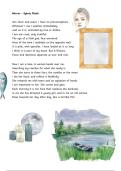
Mirror - Sylvia Plath
Iam silver and exact. I have no preconceptions.
Whatever I see I swallow immediately
Just as it is, unmisted by love or dislike.
I am not cruel, only truthful-
The eye of a little god, four-cornered.
Most of the time | meditate on the opposite wall.
It is pink, with speckles. I have looked at it so long
I think it is part of my heart. But it flickers.
Faces and darkness separate us over and over.
Now I am a lake. A woman bends over me,
Searching my reaches for what she really is.
Then she turns to those liars, the candles or the moon.
I see her back, and reflect it faithfully.
She rewards me with tears and an agitation of hands.
I am important to her. She comes and goes.
Each morning it is her face that replaces the darkness.
In me she has drowned a young girl, and in me an old woman
Rises towards her day after day, like a terrible fish
, - The title is simple yet symbolic, highlighting reflection, truth, and
self-examination.
- It emphasizes the mirror’s role as an impartial witness to the
Mirror
woman’s life, hinting at themes of aging, identity, and the
passage of time.
- The speaker immediately establishes its identity as something
pure, precise, and objective, suggesting both clarity and an
absence of bias.
- The choice of “silver” evokes not only the reflective surface of a
I am silver and exact.I mirror but also a sense of coldness and detachment, highlighting
have no preconceptions. its inability to soften or distort reality.
- By claiming to have no preconceptions, the mirror emphasizes its
role as a truth-teller, free from human subjectivity such as
judgment, memory, or emotion.
- This creates a contrast between the impartial nature of the
mirror and the often distorted ways people perceive themselves,
setting the stage for the poem’s exploration of self-confrontation
and the discomfort of seeing unfiltered truth.
- This line conveys the mirror’s absolute objectivity and immediacy
in reflecting reality.
- The verb “swallow” suggests both inevitability and a lack of
choice, emphasizing that the mirror consumes and reproduces
images instantly without judgment, distortion, or delay.
WhateverIsee I swallow The word choice also gives the mirror an almost predatory
-
quality, as though it devours whatever is before it, reinforcing its
immediately
power as an unflinching truth-teller.
At the same time, the action highlights the theme of passivity—
-
the mirror does not select or interpret what it sees, it simply
absorbs and presents it as it is.
This stark neutrality becomes central to the poem’s exploration of
-
self-perception, truth, and the sometimes harsh confrontation
with reality.
This line emphasizes the mirror’s absolute objectivity, presenting
-
reality without distortion or emotional influence.
By declaring that perception is not “misted” by feelings such as
-
affection or aversion, Plath highlights the mirror’s role as a
Just as it is,unmisted by truth-teller that cannot flatter or condemn—it simply reflects.
The choice of “unmisted” suggests clarity and purity, reinforcing
love ordislike. -
the contrast between human subjectivity and the mirror’s
impartial gaze.
It also underscores the discomfort people feel when confronted
-
with unfiltered truth, since human vision is often clouded by
desire, fear, or judgment, whereas the mirror strips away illusion.
Iam silver and exact. I have no preconceptions.
Whatever I see I swallow immediately
Just as it is, unmisted by love or dislike.
I am not cruel, only truthful-
The eye of a little god, four-cornered.
Most of the time | meditate on the opposite wall.
It is pink, with speckles. I have looked at it so long
I think it is part of my heart. But it flickers.
Faces and darkness separate us over and over.
Now I am a lake. A woman bends over me,
Searching my reaches for what she really is.
Then she turns to those liars, the candles or the moon.
I see her back, and reflect it faithfully.
She rewards me with tears and an agitation of hands.
I am important to her. She comes and goes.
Each morning it is her face that replaces the darkness.
In me she has drowned a young girl, and in me an old woman
Rises towards her day after day, like a terrible fish
, - The title is simple yet symbolic, highlighting reflection, truth, and
self-examination.
- It emphasizes the mirror’s role as an impartial witness to the
Mirror
woman’s life, hinting at themes of aging, identity, and the
passage of time.
- The speaker immediately establishes its identity as something
pure, precise, and objective, suggesting both clarity and an
absence of bias.
- The choice of “silver” evokes not only the reflective surface of a
I am silver and exact.I mirror but also a sense of coldness and detachment, highlighting
have no preconceptions. its inability to soften or distort reality.
- By claiming to have no preconceptions, the mirror emphasizes its
role as a truth-teller, free from human subjectivity such as
judgment, memory, or emotion.
- This creates a contrast between the impartial nature of the
mirror and the often distorted ways people perceive themselves,
setting the stage for the poem’s exploration of self-confrontation
and the discomfort of seeing unfiltered truth.
- This line conveys the mirror’s absolute objectivity and immediacy
in reflecting reality.
- The verb “swallow” suggests both inevitability and a lack of
choice, emphasizing that the mirror consumes and reproduces
images instantly without judgment, distortion, or delay.
WhateverIsee I swallow The word choice also gives the mirror an almost predatory
-
quality, as though it devours whatever is before it, reinforcing its
immediately
power as an unflinching truth-teller.
At the same time, the action highlights the theme of passivity—
-
the mirror does not select or interpret what it sees, it simply
absorbs and presents it as it is.
This stark neutrality becomes central to the poem’s exploration of
-
self-perception, truth, and the sometimes harsh confrontation
with reality.
This line emphasizes the mirror’s absolute objectivity, presenting
-
reality without distortion or emotional influence.
By declaring that perception is not “misted” by feelings such as
-
affection or aversion, Plath highlights the mirror’s role as a
Just as it is,unmisted by truth-teller that cannot flatter or condemn—it simply reflects.
The choice of “unmisted” suggests clarity and purity, reinforcing
love ordislike. -
the contrast between human subjectivity and the mirror’s
impartial gaze.
It also underscores the discomfort people feel when confronted
-
with unfiltered truth, since human vision is often clouded by
desire, fear, or judgment, whereas the mirror strips away illusion.



