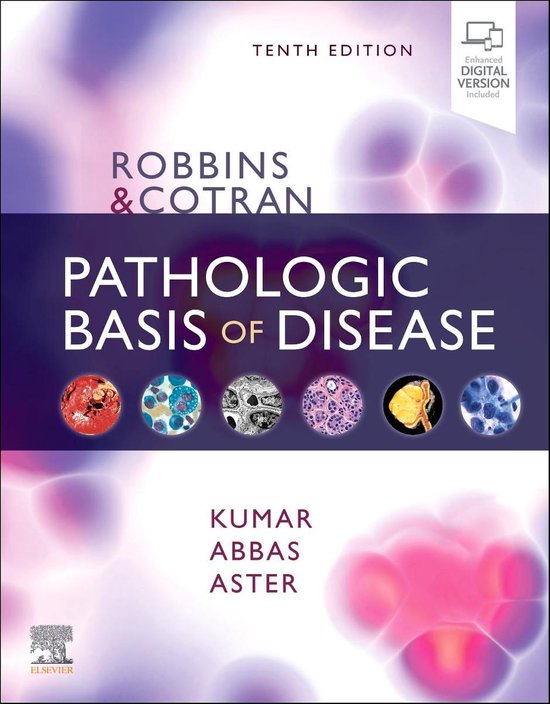
Robbins & Cotran 10th Ed. Pathology Test Bank | Chapter-
by-Chapter Questions & Verified Solutions
Robbins & Cotran Pathologic Basis of Disease
10th Edition
• Author(s)Vinay Kumar; Abul K. Abbas; Jon C. Aster
1.
Chapter Reference – The Genome
Stem: A 28-year-old man has recurrent infections and is found
to carry a point mutation that substitutes a single amino acid in
a transcription factor. Which of the following consequences is
most likely when a missense mutation occurs in a critical DNA-
binding domain?
A. Creation of a premature stop codon leading to truncated
protein
B. Production of unstable mRNA degraded by nonsense-
mediated decay
C. Altered protein conformation with reduced DNA-binding
affinity.
D. Large chromosomal deletion removing multiple genes
,Correct Answer: C
Rationale (correct): Missense mutations change one amino acid
and in a DNA-binding domain typically alter protein
conformation or binding affinity, impairing transcriptional
regulation.
Rationale (A): Premature stop codons result from nonsense,
not missense, mutations.
Rationale (B): Nonsense-mediated decay targets mRNAs with
premature termination codons; missense usually spares mRNA
stability.
Rationale (D): Large chromosomal deletions are structural
lesions, not single nucleotide missense changes.
Teaching Point: Missense mutations alter protein function by
substituting amino acids, often impairing domain-specific
activity.
2.
Chapter Reference – The Genome
Stem: A newborn screening identifies elevated phenylalanine.
Genetic testing reveals a mutation affecting tetrahydrobiopterin
(BH4) cofactor synthesis. Which genomic mechanism best
explains why some patients with hyperphenylalaninemia
respond to BH4 supplementation?
A. Complete gene deletion of PAH gene
B. Partial loss-of-function (hypomorphic) mutations in enzyme
,or cofactor pathway
C. Promoter methylation causing permanent gene silencing
D. Trinucleotide repeat expansion leading to toxic RNA
Correct Answer: B
Rationale (correct): BH4-responsive hyperphenylalaninemia
usually reflects partial loss-of-function in PAH or BH4 pathway—
supplementing cofactor improves residual enzymatic activity.
Rationale (A): Complete deletions eliminate enzyme and
generally don’t respond to cofactor replacement.
Rationale (C): Promoter methylation silences expression;
cofactor replacement would not restore enzyme abundance.
Rationale (D): Trinucleotide repeats cause toxicity via different
mechanisms and are unrelated to BH4 responsiveness.
Teaching Point: Hypomorphic mutations may retain residual
activity that cofactors can augment.
3.
Chapter Reference – The Genome
Stem: A tumor shows microsatellite instability (MSI) on testing.
Which genomic defect best explains MSI?
A. Defects in double-strand DNA break repair (BRCA1/2)
B. Loss of mismatch repair proteins (e.g., MLH1, MSH2)
C. Chromosomal nondisjunction during mitosis
D. Enhanced base excision repair activity
Correct Answer: B
, Rationale (correct): MSI results from defective mismatch repair
(MMR) proteins, causing insertion/deletion errors at repetitive
microsatellite sequences.
Rationale (A): BRCA defects produce homologous
recombination failure and chromosomal instability, not MSI.
Rationale (C): Nondisjunction alters chromosome number but
does not produce microsatellite length variation.
Rationale (D): Enhanced base excision repair would reduce, not
cause, MSI.
Teaching Point: Microsatellite instability reflects loss of
mismatch repair fidelity.
4.
Chapter Reference – The Genome
Stem: A patient’s leukocytes show extensive oxidative DNA base
damage. Which DNA repair pathway primarily removes oxidized
bases such as 8-oxoguanine?
A. Nucleotide excision repair (NER)
B. Mismatch repair (MMR)
C. Base excision repair (BER)
D. Non-homologous end joining (NHEJ)
Correct Answer: C
Rationale (correct): Base excision repair excises small damaged
bases (oxidized, deaminated) via DNA glycosylases and replaces
the correct nucleotide.
by-Chapter Questions & Verified Solutions
Robbins & Cotran Pathologic Basis of Disease
10th Edition
• Author(s)Vinay Kumar; Abul K. Abbas; Jon C. Aster
1.
Chapter Reference – The Genome
Stem: A 28-year-old man has recurrent infections and is found
to carry a point mutation that substitutes a single amino acid in
a transcription factor. Which of the following consequences is
most likely when a missense mutation occurs in a critical DNA-
binding domain?
A. Creation of a premature stop codon leading to truncated
protein
B. Production of unstable mRNA degraded by nonsense-
mediated decay
C. Altered protein conformation with reduced DNA-binding
affinity.
D. Large chromosomal deletion removing multiple genes
,Correct Answer: C
Rationale (correct): Missense mutations change one amino acid
and in a DNA-binding domain typically alter protein
conformation or binding affinity, impairing transcriptional
regulation.
Rationale (A): Premature stop codons result from nonsense,
not missense, mutations.
Rationale (B): Nonsense-mediated decay targets mRNAs with
premature termination codons; missense usually spares mRNA
stability.
Rationale (D): Large chromosomal deletions are structural
lesions, not single nucleotide missense changes.
Teaching Point: Missense mutations alter protein function by
substituting amino acids, often impairing domain-specific
activity.
2.
Chapter Reference – The Genome
Stem: A newborn screening identifies elevated phenylalanine.
Genetic testing reveals a mutation affecting tetrahydrobiopterin
(BH4) cofactor synthesis. Which genomic mechanism best
explains why some patients with hyperphenylalaninemia
respond to BH4 supplementation?
A. Complete gene deletion of PAH gene
B. Partial loss-of-function (hypomorphic) mutations in enzyme
,or cofactor pathway
C. Promoter methylation causing permanent gene silencing
D. Trinucleotide repeat expansion leading to toxic RNA
Correct Answer: B
Rationale (correct): BH4-responsive hyperphenylalaninemia
usually reflects partial loss-of-function in PAH or BH4 pathway—
supplementing cofactor improves residual enzymatic activity.
Rationale (A): Complete deletions eliminate enzyme and
generally don’t respond to cofactor replacement.
Rationale (C): Promoter methylation silences expression;
cofactor replacement would not restore enzyme abundance.
Rationale (D): Trinucleotide repeats cause toxicity via different
mechanisms and are unrelated to BH4 responsiveness.
Teaching Point: Hypomorphic mutations may retain residual
activity that cofactors can augment.
3.
Chapter Reference – The Genome
Stem: A tumor shows microsatellite instability (MSI) on testing.
Which genomic defect best explains MSI?
A. Defects in double-strand DNA break repair (BRCA1/2)
B. Loss of mismatch repair proteins (e.g., MLH1, MSH2)
C. Chromosomal nondisjunction during mitosis
D. Enhanced base excision repair activity
Correct Answer: B
, Rationale (correct): MSI results from defective mismatch repair
(MMR) proteins, causing insertion/deletion errors at repetitive
microsatellite sequences.
Rationale (A): BRCA defects produce homologous
recombination failure and chromosomal instability, not MSI.
Rationale (C): Nondisjunction alters chromosome number but
does not produce microsatellite length variation.
Rationale (D): Enhanced base excision repair would reduce, not
cause, MSI.
Teaching Point: Microsatellite instability reflects loss of
mismatch repair fidelity.
4.
Chapter Reference – The Genome
Stem: A patient’s leukocytes show extensive oxidative DNA base
damage. Which DNA repair pathway primarily removes oxidized
bases such as 8-oxoguanine?
A. Nucleotide excision repair (NER)
B. Mismatch repair (MMR)
C. Base excision repair (BER)
D. Non-homologous end joining (NHEJ)
Correct Answer: C
Rationale (correct): Base excision repair excises small damaged
bases (oxidized, deaminated) via DNA glycosylases and replaces
the correct nucleotide.