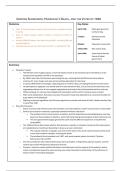
GERMAN SURRENDER, MUSSOLINI’S DEATH, AND THE VOTES OF 1946
Statistics Key Dates
• Over 12 million people voted for Italy to become a republic (mostly April 1945 Allies gain ground in
in north) northern Italy
• Over 10 million people voted to remain a monarchy (mostly in
27 April Partisans arrest
south)
Mussolini
• Around 500,000 Italians had died during WWII, including RSI and
partisan fighters 28 April Mussolini is executed
• Christian democrats won 207 seats, the PSI 114 and the PCI 104
2 May 1945 War ends in Italy
June 1946 votes held to decide
future of Italian
government
Summary
• Mussolini’s death
o The RSI was never hugely popular, and most Italians chose to try and hold out for the Allies to arrive
instead of joining either the RSI or the partisans
o By 1944 it was clear the Germans were losing the war, meaning that the RSI would not be able to
continue for much longer as it was almost entirely dependent on Germany
o In spring 1945 Allied forces began capturing parts of northern Italy, prompting Mussolini to take action
o He attempted to negotiate a surrender where he was allowed to flee, only to find out the Germans were
negotiating without him à he scrapped negotiations and tried to flee to Switzerland with his mistress
o While escaping, his convoy was stopped by the partisans and he and his mistress were arrested
o After some deliberation, they were executed, Mussolini’s body was attacked by a crowd and strung from
a gas station to be displayed
o Fighting continued regardless until Germany agreed to surrender and news of Hitler’s death reached Italy
in early May 1945
• Italy after Mussolini
o Italy’s economy and infrastructure were wrecked, and many Italians couldn’t access food or clean water
o Severe social division remained, especially between the North and South
§ The antifascist front (communists, socialists, and Christian Democrats) established a new Italy
based on the principles of rebellion, which left many feeling excluding due to their historical role
§ This new government largely ignored the south and the different experience of southerners
during WWII
o The 1946 elections determined whether Italy became a republic or stayed a monarchy (the referendum)
and established a Constituent Assembly to draw up a new constitution
§ The majority voted for a republic, but most of the areas in the south voted monarchy while most
in the north voted for republic, showing the divide
§ The antifascist front prevailed until 1947, with most popular parties (in order): Christian
Democrats, PSI, and PCI
o the new constitution saw a liberal democracy with a president, independent judiciary system, and the
Lateran pacts (from Mussolini) enshrined in the text
o however, massive crowds watched Mussolini’s entombment and the majority of the prefects, police
chiefs, and deputies stayed the same as they were under Mussolini’s dictatorship à the influence of
fascism didn’t necessarily disappear
, THE REPUBLIC OF SALO AND THE GOVERNMENT IN THE SOUTH 1943-46
Statistics
Key Dates
• The RSI was required to pay 7 billion lire to Germany per month
25 Sept 1943 Mussolini returns to
• Around 7500 Jews were taken from Italy and sent to death camps Italy to establish RSI
• Nearly 7000 of the 7500 Jews taken from Italy were executed
• By 1944, the RSI had around 570,000 men in the armed forces Nov 1943 Verona manifesto
(many more than the partisans) created
• 50,000 Italian men from the Kingdom of the South fought alongside
the Allies
Key Figures/Terms
Verona Manifesto: agreement drawn up
at congress of Vienna in 1943 to return
fascism to its 1919 roots
Partisans: the antifascist forces that the
RSI and Germany fought against in the
North
Summary
• The RSI/Republic of Salo
o By 13 September 1943, Mussolini had been rescued, taken to Germany, and ordered to establish a new
fascist government in Italy
o By 25 September 1943, Mussolini had returned and ran a government that was mostly a German puppet
state
§ Government bodies were spread out over 100 miles across northern Italy to prevent efficacy
§ Germans appointed officials without consulting Mussolini
§ Forced the Republic to sign a deal to pay billions of lire a month to Germany
o However, Mussolini did establish a new cabinet of radical fascists and announced a return to the 1919
policy under the Verona Manifesto (November 1943), which he didn’t end up having the time or resources
to implement
o Brutal crackdowns took place on partisans, with RSI forces constantly engaged in battle and German
forces promising that for every German soldier killed, ten Italians would be executed
o Deportation of Italian Jews was enforced under the Verona Manifesto as well
o The RSI was plagued by the ongoing civil war and Allied invasion, and little changed except for a marked
deterioration into violence
• The Kingdom of the South
o The king had fled south and established a royal government which was effectively a client state for the
Allies, who had occupied the south while they pushed north
o Most of the prefects and podestà remained the same, as they were monarchy supporters and helped
repress the social unrest spreading in the south
o Badoglio was replaced by antifascist liberal Bonomi, who tried to conscript 100,000 men but failed due
to anger over Badoglio’s actions in 1943 and the state of the war
o Some Italians did fight alongside the Allies, however most resisted conscription
o The antifascist civil war was fought almost entirely in the north and the differing wartime experience led
to heightened tensions post-war
, ALLIED INVASION AND DEPOSITION OF MUSSOLINI JULY 1943
Statistics Key Dates
• Badoglio guaranteed the assistance of 60,000 3 Sept Italian surrender signed
Italian troops for Allied forces
8 Sept Italy announces surrender to allies, king
• Over one million Italian soldiers were taken
and Badoglio flee south
prisoner in the early confusion of the invasion
• It took 5 months longer than planned to capture German invasion begins
Rome and a further eleven months to complete
the invasion 13 Sept Italy officially declared at war with
Germany
June 1944 Rome falls to Allies
May 1945 battle for the north finally ends
Summary
• Invasion of Sicily July 1943
o Allied forces landed in Sicily and quickly overtook Italian forces there
o Mussolini removed Axis forces from Sicily to reinforce the mainland and prepare for an invasion
o By that point, Mussolini was no longer dictator
• Mussolini’s deposition
o Leading fascists Dino Grandi and Ciano proposed seeking peace with the Allies, which negotiated in
secret through the King – and would not be permitted by the Allies if Mussolini was dictator
o The Fascist Grand Council met for the first time since 1939 and voted to remove Mussolini from power
§ they had no actual influence, so Mussolini met with the King to negotiate and was (to his
surprise) taken to prison as the king had eventually decided to support his deposition
• Allied invasion of Italy 3 September 1943
o Badoglio, who the king had chosen to replace Mussolini, surrendered to Allied forces with promises to
supply 60,000 troops to the Allied forces
o Italian troops were not informed of this or given clear orders, leading to many surrendering, deserting,
fighting alongside the Germans, or fighting against the Germans
o The delay in surrender gave Hitler time to plan an invasion, which prompted Badoglio and the king to flee
towards the Allies in the South à troops left without direction and unclear orders
o Italy was finally declared at war with Germany 10 days after surrender to Allied forces, but it was clear
that the promised troops would not be available
o It took 5 months longer than planned to capture Rome and a further eleven months to complete the
invasion
o Poor weather conditions and the ongoing civil war between fascist and antifascist forces made the
invasion particularly difficult, although it did successfully divert German soldiers from France
o Essentially, due to Badoglio and the king’s lack of clarity and hesitancy to give clear orders for fear of
provoking the Germans, the invasion was difficult, chaotic, and time-consuming
, INTERNAL POLITICAL TENSIONS DUE TO FOREIGN POLICY 1943
Statistics Key Dates
• The 1943 Turin strikes were Italy’s first in 18 years Late 1942 Conservative elite
• 100,000 workers went on strike in Turin in 1943 begin planning to
overthrow Mussolini
March 1943 Turin strikes
April 1943 All political groups (bar
republicans) agree to
oppose fascism
Key Figures/Terms
Christian Democrats: antifascist
political party
Summary
• Social unrest and political opposition were rising as a result of economic turmoil, rationing, and shortages during
the war
• 100,000 workers went on strike in Turin until the government agreed to increase pay for evacuated workers à
perceived as a sign of growing weakness of the fascist regime and was alarming to Mussolini
• Antifascist groups began growing, with communist newspapers cropping up and new, secret political factions
forming
• The Christian Democrats party was formed, made up of Catholic Action members with Church backing in 1942
• Notably, these opposition groups (except for the republicans) agreed to work together against fascism, a
considerable difference from twenty years earlier
• Even though they didn’t have the power to overthrow Mussolini, their existence indicated a significant change in
the population and government during the war
• More importantly, the conservative elite began looking for ways to depose him, including the Vatican, military
leaders, the police, and industrialists
• The conservative elite wanted to find a way to overthrow Mussolini without prompting a German occupation but
struggled to find a means to do so until pushed by the Allied invasion of Sicily
Statistics Key Dates
• Over 12 million people voted for Italy to become a republic (mostly April 1945 Allies gain ground in
in north) northern Italy
• Over 10 million people voted to remain a monarchy (mostly in
27 April Partisans arrest
south)
Mussolini
• Around 500,000 Italians had died during WWII, including RSI and
partisan fighters 28 April Mussolini is executed
• Christian democrats won 207 seats, the PSI 114 and the PCI 104
2 May 1945 War ends in Italy
June 1946 votes held to decide
future of Italian
government
Summary
• Mussolini’s death
o The RSI was never hugely popular, and most Italians chose to try and hold out for the Allies to arrive
instead of joining either the RSI or the partisans
o By 1944 it was clear the Germans were losing the war, meaning that the RSI would not be able to
continue for much longer as it was almost entirely dependent on Germany
o In spring 1945 Allied forces began capturing parts of northern Italy, prompting Mussolini to take action
o He attempted to negotiate a surrender where he was allowed to flee, only to find out the Germans were
negotiating without him à he scrapped negotiations and tried to flee to Switzerland with his mistress
o While escaping, his convoy was stopped by the partisans and he and his mistress were arrested
o After some deliberation, they were executed, Mussolini’s body was attacked by a crowd and strung from
a gas station to be displayed
o Fighting continued regardless until Germany agreed to surrender and news of Hitler’s death reached Italy
in early May 1945
• Italy after Mussolini
o Italy’s economy and infrastructure were wrecked, and many Italians couldn’t access food or clean water
o Severe social division remained, especially between the North and South
§ The antifascist front (communists, socialists, and Christian Democrats) established a new Italy
based on the principles of rebellion, which left many feeling excluding due to their historical role
§ This new government largely ignored the south and the different experience of southerners
during WWII
o The 1946 elections determined whether Italy became a republic or stayed a monarchy (the referendum)
and established a Constituent Assembly to draw up a new constitution
§ The majority voted for a republic, but most of the areas in the south voted monarchy while most
in the north voted for republic, showing the divide
§ The antifascist front prevailed until 1947, with most popular parties (in order): Christian
Democrats, PSI, and PCI
o the new constitution saw a liberal democracy with a president, independent judiciary system, and the
Lateran pacts (from Mussolini) enshrined in the text
o however, massive crowds watched Mussolini’s entombment and the majority of the prefects, police
chiefs, and deputies stayed the same as they were under Mussolini’s dictatorship à the influence of
fascism didn’t necessarily disappear
, THE REPUBLIC OF SALO AND THE GOVERNMENT IN THE SOUTH 1943-46
Statistics
Key Dates
• The RSI was required to pay 7 billion lire to Germany per month
25 Sept 1943 Mussolini returns to
• Around 7500 Jews were taken from Italy and sent to death camps Italy to establish RSI
• Nearly 7000 of the 7500 Jews taken from Italy were executed
• By 1944, the RSI had around 570,000 men in the armed forces Nov 1943 Verona manifesto
(many more than the partisans) created
• 50,000 Italian men from the Kingdom of the South fought alongside
the Allies
Key Figures/Terms
Verona Manifesto: agreement drawn up
at congress of Vienna in 1943 to return
fascism to its 1919 roots
Partisans: the antifascist forces that the
RSI and Germany fought against in the
North
Summary
• The RSI/Republic of Salo
o By 13 September 1943, Mussolini had been rescued, taken to Germany, and ordered to establish a new
fascist government in Italy
o By 25 September 1943, Mussolini had returned and ran a government that was mostly a German puppet
state
§ Government bodies were spread out over 100 miles across northern Italy to prevent efficacy
§ Germans appointed officials without consulting Mussolini
§ Forced the Republic to sign a deal to pay billions of lire a month to Germany
o However, Mussolini did establish a new cabinet of radical fascists and announced a return to the 1919
policy under the Verona Manifesto (November 1943), which he didn’t end up having the time or resources
to implement
o Brutal crackdowns took place on partisans, with RSI forces constantly engaged in battle and German
forces promising that for every German soldier killed, ten Italians would be executed
o Deportation of Italian Jews was enforced under the Verona Manifesto as well
o The RSI was plagued by the ongoing civil war and Allied invasion, and little changed except for a marked
deterioration into violence
• The Kingdom of the South
o The king had fled south and established a royal government which was effectively a client state for the
Allies, who had occupied the south while they pushed north
o Most of the prefects and podestà remained the same, as they were monarchy supporters and helped
repress the social unrest spreading in the south
o Badoglio was replaced by antifascist liberal Bonomi, who tried to conscript 100,000 men but failed due
to anger over Badoglio’s actions in 1943 and the state of the war
o Some Italians did fight alongside the Allies, however most resisted conscription
o The antifascist civil war was fought almost entirely in the north and the differing wartime experience led
to heightened tensions post-war
, ALLIED INVASION AND DEPOSITION OF MUSSOLINI JULY 1943
Statistics Key Dates
• Badoglio guaranteed the assistance of 60,000 3 Sept Italian surrender signed
Italian troops for Allied forces
8 Sept Italy announces surrender to allies, king
• Over one million Italian soldiers were taken
and Badoglio flee south
prisoner in the early confusion of the invasion
• It took 5 months longer than planned to capture German invasion begins
Rome and a further eleven months to complete
the invasion 13 Sept Italy officially declared at war with
Germany
June 1944 Rome falls to Allies
May 1945 battle for the north finally ends
Summary
• Invasion of Sicily July 1943
o Allied forces landed in Sicily and quickly overtook Italian forces there
o Mussolini removed Axis forces from Sicily to reinforce the mainland and prepare for an invasion
o By that point, Mussolini was no longer dictator
• Mussolini’s deposition
o Leading fascists Dino Grandi and Ciano proposed seeking peace with the Allies, which negotiated in
secret through the King – and would not be permitted by the Allies if Mussolini was dictator
o The Fascist Grand Council met for the first time since 1939 and voted to remove Mussolini from power
§ they had no actual influence, so Mussolini met with the King to negotiate and was (to his
surprise) taken to prison as the king had eventually decided to support his deposition
• Allied invasion of Italy 3 September 1943
o Badoglio, who the king had chosen to replace Mussolini, surrendered to Allied forces with promises to
supply 60,000 troops to the Allied forces
o Italian troops were not informed of this or given clear orders, leading to many surrendering, deserting,
fighting alongside the Germans, or fighting against the Germans
o The delay in surrender gave Hitler time to plan an invasion, which prompted Badoglio and the king to flee
towards the Allies in the South à troops left without direction and unclear orders
o Italy was finally declared at war with Germany 10 days after surrender to Allied forces, but it was clear
that the promised troops would not be available
o It took 5 months longer than planned to capture Rome and a further eleven months to complete the
invasion
o Poor weather conditions and the ongoing civil war between fascist and antifascist forces made the
invasion particularly difficult, although it did successfully divert German soldiers from France
o Essentially, due to Badoglio and the king’s lack of clarity and hesitancy to give clear orders for fear of
provoking the Germans, the invasion was difficult, chaotic, and time-consuming
, INTERNAL POLITICAL TENSIONS DUE TO FOREIGN POLICY 1943
Statistics Key Dates
• The 1943 Turin strikes were Italy’s first in 18 years Late 1942 Conservative elite
• 100,000 workers went on strike in Turin in 1943 begin planning to
overthrow Mussolini
March 1943 Turin strikes
April 1943 All political groups (bar
republicans) agree to
oppose fascism
Key Figures/Terms
Christian Democrats: antifascist
political party
Summary
• Social unrest and political opposition were rising as a result of economic turmoil, rationing, and shortages during
the war
• 100,000 workers went on strike in Turin until the government agreed to increase pay for evacuated workers à
perceived as a sign of growing weakness of the fascist regime and was alarming to Mussolini
• Antifascist groups began growing, with communist newspapers cropping up and new, secret political factions
forming
• The Christian Democrats party was formed, made up of Catholic Action members with Church backing in 1942
• Notably, these opposition groups (except for the republicans) agreed to work together against fascism, a
considerable difference from twenty years earlier
• Even though they didn’t have the power to overthrow Mussolini, their existence indicated a significant change in
the population and government during the war
• More importantly, the conservative elite began looking for ways to depose him, including the Vatican, military
leaders, the police, and industrialists
• The conservative elite wanted to find a way to overthrow Mussolini without prompting a German occupation but
struggled to find a means to do so until pushed by the Allied invasion of Sicily