

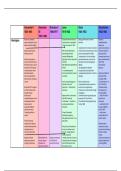
Alexander II Alexander Nicholas II Lenin Stalin Khrushchev
1855-1881 III 1894-1917 1918-1924 1924-1953 1953-1964
1881-1894
Ideologies Autocracy- absolute Erased marxism and set out Ideology of Marxism-Leninism- Moved to
power ordained by God & revised version in pamphlet Stalinism destalinisation &
belief of the Divine Right “what is to be done” 1902. away from
“superstructure” as base of society to governance based on
Supported by Russian After October Revolution, command economy centred on 5 year extreme repression
Orthodox Church implemented Marxist- plans & collectivisation 1928/9 because he felt
Leninism (Bolsheviks). “superstructure” to also be highly overseas tension had
Autocracy viewed as a Opposition to this caused the personalised under control of one been tarnished which
practical necessity since Civil War: individual to prevent damaging in- didn’t help
the Empire was so vast & Reds (Bolshevik) defeated the fighting. international
diverse and the majority Whites. -any disagreement labelled tensions.
of the population were = consolidated power bourgeoise & quickly dealt with
illiterate peasants. & one party state for socialist -propaganda & repression to enforce Denounced Stalin at
Autocracy allowed for revolution. ideology Twentieth Party
faster decision making & Congress 1956:
control. Had to adjust ideology and Shift to totalitarianism: -“Secret Speech” on
policies to stave off -manipulated marxism-leninism to the “Cult of the
Supporters of the regime opposition. = authoritarian serve his own megalomania Individual and its
such as Ponedonostev measures. -imposed cult of personality through Consequences”,
thought a liberal propaganda criticising Stalin
democracy & Replaced War Communism -centralised power by placing party -said Lenin didn’t
constitutional govt would with NEP to tolerate supporters in Party Central want him as
be disasterous as too “moderates”. = freedom to Committee & exiling opposition (eg. successor
many would’ve produce goods without Trotsky 1929) -said Stalin hadn’t
demanded different restriction prepared USSR for
policies and many conflict 1941
“lacked the ability to Closed Constituent -said he was
reason”. Assembly, bypassing responsible for 20
Petrograd Soviet Union = one million deaths
Faced increasing party state
resistance for failing to Destalinisation:
modernise Russia which Party Central Committee to -release of political
caused social and be voice of workers to set prisoners from Gulags
economic discontent. policies, manage party & & those in labour
control discipline. camps
Despite reformist Blamed father for Liberal concessions -initially served as a forum for -relaxed censorship &
tendencies, adhered moves towards in 1905 due to collective decision-making in allowed publications
strongly to autocracy. liberalism & economic crisis & line with Marxism but over criticising Stalin
adhered strongly to time became more
,Eg. Emancipation Edict autocracy through failure of Russo- centralised (eg. Creation of -eroded Cult of
1861 prevented peasant repression Japanese War. Cheka & suppression of Personality by
uprisings and kept them Eg. October opposition) changing Stalingrad to
in their place “Reaction rule”- Manifesto promised Volgograd & removing
Eg. Trial Of 50 maintained reversed liberal civil liberties, his pictures and
autocracy by imprisoning reforms creation of Duma & statues in public
& exiling intellectuals & expansion of places
members of revolutionary Ruthlessly electoral rights.
circles accused of suppressed Rule still authoritarian
conspiring against People’s Will and 1906: Fundamental -physical force used
autocracy 1877. other opposition Laws reiterated need -one-party, one-
through secret to preservation of leader state
police and autocracy: -some reforms but
repression. “All-Russian resisted demands for
Emperor possesses greater liberty from
Manifesto of 1881 the supreme strikes, riots &
made membership autocratic power… protests and
in revolutionary God himself dismissed rebellious
groups lead to exile commands politicians (eg.
or imprisonment obedience to his Zukhov) and used
authority” – diluted physical force where
Land Captains to effect of reforms necessary (eg. Sent
monitor & control tanks to Hungary 1956
peasant behaviour. Established Duma- to suppress Nagy
parliamentary body regime)
Statute concerning with Council of
measures for the Ministers
production of state -limited powers as
security & 1881 could only suggest
Social Order laws and could be
criminalised dissolved
revolutionary -outward
activity, expanded appearance of
state surveillance reform
& increased govt
control of the legal 1915: ordered
system & press. Russian armed
forces to be placed
under personal
control of the Tsar
Reforms appeased
opposition, but
mishandling of
Russia in WW1, lack
of political
, knowledge & strict
adherence to
autocracy proved
unacceptable to
prominent members
of govt = downfall.
Central Tsar at the top Abolished Pressured after 1905 Promised egalitarian society 1936 Constitution created Supreme Even with
Committee of (following Russo- never established. Soviet of the USSR, the Soviet of the destalinisation, the
administration Council of Ministers Ministers Japanese War, Union & Soviet of Nationalities to organisation and
chaired and chosen by Bloody Sunday & the 1918 New constitution provide better representation, structure of central
Tsar to draft legislation to Chancellery of his assassination of established one-party state. although all dominated by Bolsheviks. govt remained
be approved by the Tsar imperial majesty: various political virtually the same.
or Committee of tsars personal figures) to implement Constituent Assembly The Supreme Soviet of the USSR
Ministers. advisors and changes: elections shut down after elected the sovnarkom and was given
secret police only one day. the power to make laws. It was
Committee of Ministers 1905: created the divided into 2 houses, the Soviet of
to administer (not Duma under the Monarchy abolished. the Union & the Soviet of
formulate) policies. 13 October Manifesto. Nationalities. It met 2x a year to
ministers each had a Little administrative Council of Peoples debate and approve policies.
responsibility for a power- the Tsar, Commissars (sovnarkom)
particular aspect of Council of Ministers consisited of ministers with The Soviet of the Union contained
Russian administration. and the state council specific roles (eg. Trotsky in representatives from the whole of the
Each ministry was (checked the charge of foreign affairs and USSR and the Soviet of Nationalities
connected to activities of the Stalin in charge of contained members from every union
departments with Duma) were above nationalities) chaired by PM republic, autonomous republic,
specific repsonsibilities. them and chosen by Lenin region and national area.
The 4 most important the Tsar. However, it -resembled Tsarist Council
ministerial posts were the could still block of Ministers, and the Cheka By the early 1930s, 10% of the party
Ministry of the Interior legislation. The Tsar was like the old Okhrana. was made up of apparatchiki (full
(domestic affairs, law & could dismiss it time, paid party organisers) who were
order), Ministry for War, whenever he wanted People in sovnarkom elected educated and served mainly as party
Ministry of finance & . by Soviets- appeared secretaries.
Chief procurator for the democratic (although Soviets
Holy Synod (responsible First 2 Dumas were dominated by Republic status given to some states
for all religious affairs) disbanded quickly Bolsheviks) alongside greater representation of
due to Tsars the interest of separate nation states.
Senate – supreme court displeasure of their Early 1918: Closure of
until 1905. Acted as the liberal demand. Constituent Assembly Article 126 of the Constitution:
final court of appeal on Communist Party of the Soviet Union
major legal matters, the Vyborg Manifesto Democratic centralism. as the “nucleus of all the public &
promoter of manifestos caused tensions as it state organisations of the working
put together by the Tsar, demanded people Politburo, Orgburo & Ogburo- people”.
the conformed of titles of launch non-violent part of Central Executive
the nobility & the protest and not pay Committee & dominated by Continued use of secret police.
adjudicator over taxes to protest the Bolsheviks as Mensheviks &
disagreements between SRs were expelled.
, landowners & dissolution of the Used justice system and Show Trials
boundaries. first Duma. The Politburo was a small, for intimidation & removal of
elite group of Bolsheviks opposition.
Imperial council of state: 1906 Fundamental responsible for formulating
tsars advisors in finance Laws reasserted policy. The Orgburo Millions died in purges.
& legal matters Tsars autocratic organised party affairs & the
powers Ogburo maintained order and Extreme use of Terror and
Toleration of “Third dealt with opposition. propaganda to maintain control.
Element” 2nd Duma
demanded land Administration was swamped 1939: Estonia, Latvia, Lithuania &
reform and was by “leading cadres”. Moldova joined the USSR
largely ignored by the
Tsar & Stolypin Many found new careers &
opportunities as part of the
Electoral reforms Nomenklatura = membership
1907= conservative of party increased from 730k
3rd & 4th Duma. ’21 to 1 million ‘28
3rd Duma caused Congress of Soviets also
some judicial & Bolshevik dominated.
military reform,
replacing land 1921: Factions abolished
captains with Justice
of Peace and Decree on Land: sanctioned
expanding the navy requisition of private land by
and army. peasants, but stated that the
division & redistribution
Council of Ministers: could only be carried out by
main law making & village soviets. Similar to
administrative body what rival SRs had proposed
chaired by PM = won support of opponents.
(initially Witte) who All Russian land belonged to
was selected by the people- not landlords, nobles
Tsar. It also provided or the Church = appeased
material for the peasants.
upper & lower
houses to debate. Cheka established 1917 to
prevent counter-
Abolished revolutionary movement.
Committee of
Ministers 1906.
Changes in Before Emancipation, In 1881, the Tsar End of 19th century: Zemstva and Duma Highly centralised form of govt gave Some
provinces were largely moved away from govt became abolished (maybe pg instead) local govts virtually no independence decentralisation gave
local under jurisdiction of the “liberal” increasingly irritated as they had to follow orders from more power to local
Government noble landowners and approach to law by Zemstvas which Soviets took control and local above areas, especially in
village issues were and order: had become govt became run by workers the economy.
1855-1881 III 1894-1917 1918-1924 1924-1953 1953-1964
1881-1894
Ideologies Autocracy- absolute Erased marxism and set out Ideology of Marxism-Leninism- Moved to
power ordained by God & revised version in pamphlet Stalinism destalinisation &
belief of the Divine Right “what is to be done” 1902. away from
“superstructure” as base of society to governance based on
Supported by Russian After October Revolution, command economy centred on 5 year extreme repression
Orthodox Church implemented Marxist- plans & collectivisation 1928/9 because he felt
Leninism (Bolsheviks). “superstructure” to also be highly overseas tension had
Autocracy viewed as a Opposition to this caused the personalised under control of one been tarnished which
practical necessity since Civil War: individual to prevent damaging in- didn’t help
the Empire was so vast & Reds (Bolshevik) defeated the fighting. international
diverse and the majority Whites. -any disagreement labelled tensions.
of the population were = consolidated power bourgeoise & quickly dealt with
illiterate peasants. & one party state for socialist -propaganda & repression to enforce Denounced Stalin at
Autocracy allowed for revolution. ideology Twentieth Party
faster decision making & Congress 1956:
control. Had to adjust ideology and Shift to totalitarianism: -“Secret Speech” on
policies to stave off -manipulated marxism-leninism to the “Cult of the
Supporters of the regime opposition. = authoritarian serve his own megalomania Individual and its
such as Ponedonostev measures. -imposed cult of personality through Consequences”,
thought a liberal propaganda criticising Stalin
democracy & Replaced War Communism -centralised power by placing party -said Lenin didn’t
constitutional govt would with NEP to tolerate supporters in Party Central want him as
be disasterous as too “moderates”. = freedom to Committee & exiling opposition (eg. successor
many would’ve produce goods without Trotsky 1929) -said Stalin hadn’t
demanded different restriction prepared USSR for
policies and many conflict 1941
“lacked the ability to Closed Constituent -said he was
reason”. Assembly, bypassing responsible for 20
Petrograd Soviet Union = one million deaths
Faced increasing party state
resistance for failing to Destalinisation:
modernise Russia which Party Central Committee to -release of political
caused social and be voice of workers to set prisoners from Gulags
economic discontent. policies, manage party & & those in labour
control discipline. camps
Despite reformist Blamed father for Liberal concessions -initially served as a forum for -relaxed censorship &
tendencies, adhered moves towards in 1905 due to collective decision-making in allowed publications
strongly to autocracy. liberalism & economic crisis & line with Marxism but over criticising Stalin
adhered strongly to time became more
,Eg. Emancipation Edict autocracy through failure of Russo- centralised (eg. Creation of -eroded Cult of
1861 prevented peasant repression Japanese War. Cheka & suppression of Personality by
uprisings and kept them Eg. October opposition) changing Stalingrad to
in their place “Reaction rule”- Manifesto promised Volgograd & removing
Eg. Trial Of 50 maintained reversed liberal civil liberties, his pictures and
autocracy by imprisoning reforms creation of Duma & statues in public
& exiling intellectuals & expansion of places
members of revolutionary Ruthlessly electoral rights.
circles accused of suppressed Rule still authoritarian
conspiring against People’s Will and 1906: Fundamental -physical force used
autocracy 1877. other opposition Laws reiterated need -one-party, one-
through secret to preservation of leader state
police and autocracy: -some reforms but
repression. “All-Russian resisted demands for
Emperor possesses greater liberty from
Manifesto of 1881 the supreme strikes, riots &
made membership autocratic power… protests and
in revolutionary God himself dismissed rebellious
groups lead to exile commands politicians (eg.
or imprisonment obedience to his Zukhov) and used
authority” – diluted physical force where
Land Captains to effect of reforms necessary (eg. Sent
monitor & control tanks to Hungary 1956
peasant behaviour. Established Duma- to suppress Nagy
parliamentary body regime)
Statute concerning with Council of
measures for the Ministers
production of state -limited powers as
security & 1881 could only suggest
Social Order laws and could be
criminalised dissolved
revolutionary -outward
activity, expanded appearance of
state surveillance reform
& increased govt
control of the legal 1915: ordered
system & press. Russian armed
forces to be placed
under personal
control of the Tsar
Reforms appeased
opposition, but
mishandling of
Russia in WW1, lack
of political
, knowledge & strict
adherence to
autocracy proved
unacceptable to
prominent members
of govt = downfall.
Central Tsar at the top Abolished Pressured after 1905 Promised egalitarian society 1936 Constitution created Supreme Even with
Committee of (following Russo- never established. Soviet of the USSR, the Soviet of the destalinisation, the
administration Council of Ministers Ministers Japanese War, Union & Soviet of Nationalities to organisation and
chaired and chosen by Bloody Sunday & the 1918 New constitution provide better representation, structure of central
Tsar to draft legislation to Chancellery of his assassination of established one-party state. although all dominated by Bolsheviks. govt remained
be approved by the Tsar imperial majesty: various political virtually the same.
or Committee of tsars personal figures) to implement Constituent Assembly The Supreme Soviet of the USSR
Ministers. advisors and changes: elections shut down after elected the sovnarkom and was given
secret police only one day. the power to make laws. It was
Committee of Ministers 1905: created the divided into 2 houses, the Soviet of
to administer (not Duma under the Monarchy abolished. the Union & the Soviet of
formulate) policies. 13 October Manifesto. Nationalities. It met 2x a year to
ministers each had a Little administrative Council of Peoples debate and approve policies.
responsibility for a power- the Tsar, Commissars (sovnarkom)
particular aspect of Council of Ministers consisited of ministers with The Soviet of the Union contained
Russian administration. and the state council specific roles (eg. Trotsky in representatives from the whole of the
Each ministry was (checked the charge of foreign affairs and USSR and the Soviet of Nationalities
connected to activities of the Stalin in charge of contained members from every union
departments with Duma) were above nationalities) chaired by PM republic, autonomous republic,
specific repsonsibilities. them and chosen by Lenin region and national area.
The 4 most important the Tsar. However, it -resembled Tsarist Council
ministerial posts were the could still block of Ministers, and the Cheka By the early 1930s, 10% of the party
Ministry of the Interior legislation. The Tsar was like the old Okhrana. was made up of apparatchiki (full
(domestic affairs, law & could dismiss it time, paid party organisers) who were
order), Ministry for War, whenever he wanted People in sovnarkom elected educated and served mainly as party
Ministry of finance & . by Soviets- appeared secretaries.
Chief procurator for the democratic (although Soviets
Holy Synod (responsible First 2 Dumas were dominated by Republic status given to some states
for all religious affairs) disbanded quickly Bolsheviks) alongside greater representation of
due to Tsars the interest of separate nation states.
Senate – supreme court displeasure of their Early 1918: Closure of
until 1905. Acted as the liberal demand. Constituent Assembly Article 126 of the Constitution:
final court of appeal on Communist Party of the Soviet Union
major legal matters, the Vyborg Manifesto Democratic centralism. as the “nucleus of all the public &
promoter of manifestos caused tensions as it state organisations of the working
put together by the Tsar, demanded people Politburo, Orgburo & Ogburo- people”.
the conformed of titles of launch non-violent part of Central Executive
the nobility & the protest and not pay Committee & dominated by Continued use of secret police.
adjudicator over taxes to protest the Bolsheviks as Mensheviks &
disagreements between SRs were expelled.
, landowners & dissolution of the Used justice system and Show Trials
boundaries. first Duma. The Politburo was a small, for intimidation & removal of
elite group of Bolsheviks opposition.
Imperial council of state: 1906 Fundamental responsible for formulating
tsars advisors in finance Laws reasserted policy. The Orgburo Millions died in purges.
& legal matters Tsars autocratic organised party affairs & the
powers Ogburo maintained order and Extreme use of Terror and
Toleration of “Third dealt with opposition. propaganda to maintain control.
Element” 2nd Duma
demanded land Administration was swamped 1939: Estonia, Latvia, Lithuania &
reform and was by “leading cadres”. Moldova joined the USSR
largely ignored by the
Tsar & Stolypin Many found new careers &
opportunities as part of the
Electoral reforms Nomenklatura = membership
1907= conservative of party increased from 730k
3rd & 4th Duma. ’21 to 1 million ‘28
3rd Duma caused Congress of Soviets also
some judicial & Bolshevik dominated.
military reform,
replacing land 1921: Factions abolished
captains with Justice
of Peace and Decree on Land: sanctioned
expanding the navy requisition of private land by
and army. peasants, but stated that the
division & redistribution
Council of Ministers: could only be carried out by
main law making & village soviets. Similar to
administrative body what rival SRs had proposed
chaired by PM = won support of opponents.
(initially Witte) who All Russian land belonged to
was selected by the people- not landlords, nobles
Tsar. It also provided or the Church = appeased
material for the peasants.
upper & lower
houses to debate. Cheka established 1917 to
prevent counter-
Abolished revolutionary movement.
Committee of
Ministers 1906.
Changes in Before Emancipation, In 1881, the Tsar End of 19th century: Zemstva and Duma Highly centralised form of govt gave Some
provinces were largely moved away from govt became abolished (maybe pg instead) local govts virtually no independence decentralisation gave
local under jurisdiction of the “liberal” increasingly irritated as they had to follow orders from more power to local
Government noble landowners and approach to law by Zemstvas which Soviets took control and local above areas, especially in
village issues were and order: had become govt became run by workers the economy.



