

100% satisfaction guarantee Immediately available after payment Both online and in PDF No strings attached 4.2 TrustPilot
logo-home
Presentation

CYBER LAWS AND ETHICS

Rating
-
Sold
1
Pages
14
Uploaded on
14-12-2020
Written in
2020/2021

THIS PPT IS BASED ON CYBER LAW AND ETHICS and Cyber law is the legal issues that is, it is the standard rules and regulation (law) adopted by any government or organizations to control and minimize the computer crime and it is related to the use of inter-networked information technology. 1.  Cyber law is the area of law that deals with the Internet's relationship to technological and electronic elements, including computers, software, hardware and information systems (IS).  Cyber law is also known as Cyber Law or Internet Law.  Cyber laws prevent or reduce large scale damage from cybercriminal activities by protecting information access, privacy, communications, intellectual property (IP) and freedom of speech related to the use of the Internet, websites, email, computers, cell phones, software and hardware, such as data storage devices. 2.  The increase in Internet traffic has led to a higher proportion of legal issues worldwide.  Because cyber laws vary by jurisdiction and country, enforcement is challenging, and restitution ranges from fines to imprisonment. 3.  The Information Technology Amendment Act, 2008 (IT Act 2008) is a substantial addition to India's Information Technology Act (ITA-2000).  The IT Amendment Act was passed by the Indian Parliament in October 2008 and came into force a year later. The Act is administered by the Indian Computer Emergency Response Team (CERT-IN).  The original Act was developed to promote the IT industry, regulate e-commerce, facilitate e- governance and prevent cybercrime.  The Act also sought to foster security practices within India that would serve the country in a global context. 4.  The Amendment was created to address issues that the original bill failed to cover and to accommodate further development of IT and related security concerns since the original law was passed.  Changes in the Amendment include: redefining terms such as "communication device" to reflect current use; validating electronic signatures and contracts; making the owner of a given IP address responsible for content accessed or distributed through it; and making corporations responsible for implementing effective data security practices and liable for breaches. 5.  The following are its main objectives of I T Act 2000  1. It is objective of I.T. Act 2000 to give legal recognition to any transaction which is done by electronic way or use of internet.  2. To give legal recognition to digital signature for accepting any agreement via computer.  3. To provide facility of filling document online relating to school admission or registration in employment exchange. 6.  4. According to I.T. Act 2000, any company can store their data in electronic storage.  5. To stop computer crime and protect privacy of internet users.  6. To give legal recognition for keeping books of accounts by bankers and other companies in electronic form.  7. To make more power to IPO, RBI and Indian Evidence act for restricting electronic crime. 7.  1. Thou shalt not copy or use proprietary software for which you have not paid.  2. Thou shalt not use other people's computer resources without authorization or proper compensation.  3. Thou shalt not appropriate other people's intellectual output.  4. Thou shalt think about the social consequences of the program you are writing or the system you are designing.  5. Thou shalt always use a computer in ways that ensure consideration and respect for your fellow humans. 8.  6. Thou shalt not use a computer to harm other people.  7. Thou shalt not interfere with other people's computer work.  8. Thou shalt not snoop around in other people's computer files.  9. Thou shalt not use a computer to steal.  10. Thou shalt not use a computer to bear false witness. 9.  Computer crime, or cybercrime, is any crime that involves a computer and a network.  Dr. Debarati Halder and Dr. K. Jaishankar (2011) define Cybercrimes as: "Offences that are committed against individuals or groups of individuals with a criminal motive to intentionally harm the reputation of the victim or cause physical or mental harm, or loss, to the victim directly or indirectly, using modern telecommunication networks such as Internet (Chat rooms, emails, notice boards and groups) and mobile phones (SMS/MMS)". 10.  Such crimes may threaten a nation’s security and financial health.  Surrounding these types of crimes have become high- profile, particularly those surrounding hacking, copyright infringement , child pornography, and child grooming.  The computer may have been used in the commission of a crime, or it may be the target. 11.  There are also problems of privacy when confidential information is intercepted or disclosed, lawfully or otherwise.  Internationally, both governmental and non-state actors engage in cybercrimes, including espionage, financial theft, and other cross-border crimes. Activity crossing international borders and involving the interests of at least one nation state is sometimes referred to as cyber welfare.  The international legal system is attempting to hold actors accountable for their actions through the International Criminal Court.

Show more Read less
Institution
Course


Whoops! We can’t load your doc right now. Try again or contact support.

Connected book

Written for

Institution
Study
Course

Document information

Uploaded on
December 14, 2020
Number of pages
14
Written in
2020/2021
Type
Presentation
Person
Unknown

Subjects

Content preview

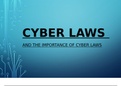
CYBER LAWS
AND THE IMPORTANCE OF CYBER LAWS

,WHAT IS CYBER LAW :

• Cyber law can be considered as a part of the overall legal
system that deals with the Internet, E-commerce, digital
contracts, electronic evidence, cyberspace, and their
respective legal issues. Cyber law covers a fairly broad area,
encompassing several subtopics including freedom of
expression, data protection, data security, digital
transactions, electronic communication, access to and usage
of the Internet, and online privacy.

,IMPORTANCE OF CYBER LAW :

• Cyber law or internet law is important because it touches almost all
aspects of transactions and activities on and involving the internet, World
Wide Web and cyberspace. Every action and reaction in cyberspace has
some legal and cyber legal perspectives.
• Such crimes may threaten a nation’s security and financial health. Issues
surrounding this type of crime has become high-profile, mainly those
surrounding cracking, copyright infringement. There are problems of
privacy when private information is lost or intercepted, lawfully or
otherwise. To ignore these threats we need cyber laws.

,OBJECTIVES OF IT ACT, 2000 :

• It is objective of I.T. Act 2000 to give legal recognition to any transaction which is done by
electronic way or use of internet.
• To give legal recognition to digital signature for accepting any agreement via computer.
• To provide facility of filling document online relating to school admission or registration in
employment exchange.
• According to I.T. Act 2000, any company can store their data in electronic storage.
• To stop computer crime and protect privacy of internet users.
• To give legal recognition for keeping books of accounts by bankers and other companies in
electronic form.
• To make more power to IPO, RBI and Indian Evidence act for restricting electronic crime.

,THREE MAJOR CATEGORIES OF CYBER
CRIMES :

• CYBER CRIMES AGAINST PERSONS.
• CYBER CRIMES AGAINST PROPERTY.
• CYBER CRIMES AGAINST GOVERNMENT.

,CYBER CRIMES AGAINST PERSONS :

• Crimes that happen in the Cyber space against persons include
various crimes such as transmission of child-pornography, cybe
harassment, cyber stalking, cyber bullying, cyber defamation,
revenge porn, email spoofing, cracking, carding, sms spoofing,
pornography, credit card frauds, online libel / slander, cyber
smearing, trafficking, financial frauds, identity theft, etc.

,CYBER CRIMES AGAINST PROPERTY :


• Cyber crimes against property includes computer vandalism,
IPR violations, cyber squatting, typo squatting, cyber
trespass, DDOS attacks, worm attacks, hacking, transmitting
viruses, intellectual property theft, infringement, etc.

,CYBER CRIMES AGAINST GOVERNMENT :


• Cyber crimes against government are serious in nature as it
is considered as an act of war against the Sovereignty. Cyber
crimes such as cyber terrorism, cyber warfare, pirated
software, possessing of unauthorised information, hacking
into confidential military data are some of the real dangers
that Governments face these days.

,THE VARIOUS OFFENCES RELATED TO
INTERNET WHICH HAVE BEEN MADE
PUNISHABLE UNDER THE IT ACT,2000
AND THE IPC ARE ENUMERATED ON THE
NEXT THREE SLIDES

JUST TAKE A LOOK :

, 1. CYBER CRIMES UNDER THE IT ACT,
2000:

• Tampering with Computer source documents – Sec.65
• Hacking with Computer systems, Data alteration – Sec.66
• Publishing obscene information – Sec.67
• Un-authorized access to protected system -- Sec.70
• Breach of Confidentiality and Privacy – Sec.72
• Publishing false digital signature certificates – Sec.73
$4.15
Get access to the full document:

100% satisfaction guarantee
Immediately available after payment
Both online and in PDF
No strings attached

Get to know the seller
Seller avatar
mrdp

Get to know the seller

Seller avatar
mrdp DHRUV
Follow You need to be logged in order to follow users or courses
Sold
2
Member since
5 year
Number of followers
2
Documents
4
Last sold
3 year ago
B.TECH CSE

ALL THE SOURCES THAT HELP IN PERSUING B.TECH ARE AVAILABLE OVER HERE . THERE IS NO EXTRA HUSTEL FOR FINDING ANYTHING . EVERY THING IS AVAILABLE OPENLY . B Tech - Computer Science Engineering (CSE) with emphasis on Digital Transformation Technologies B Tech Computer Science True to its commitment to the core principle of Industry Linked, NU has recognized the urgent need of the industry for next generation digitally skilled engineers. Responding to this need, it has upgraded its curriculum to incorporate Digital Transformation Technologies – a pool of digital technologies that will transform the way organisations are run. According to a recent release by NASSCOM, the skills of the future would be Big Data Analytics, Cloud & Cybersecurity Services, IoT, Artificial Intelligence and many other Digital Technologies. A huge demand is foreseen for roles such as mobile app development, social media, data scientists & platform engineering. According to a McKinsey report on ‘Technology Jobs & the Future of Work’, digital technologies could contribute $550 billion to $ 1 trillion of economic impact per year in India by the year 2025. According to another renowned survey, 69% of IT leaders expect huge surge in the job market in the next 3 to 5 years due to digital technologies. This has led NU to infuse the CSE curriculum with relevant digital technologies that will enable students to add immense value to the organisations they will join. The B.Tech in CSE with emphasis on Digital Transformation Technologies has received instant endorsement by industry leaders. “Nasscom is playing a critical role in evangelising digital opportunity for the IT sector, and we will support the industry in facilitating skilling and re-skilling efforts through disruptive models. The sector needs a workforce trained in futuristic digital technologies to transform themselves from IT services providers to digital-transformation partners. Higher education institutes can play a key role here and I would like to welcome the pioneering initiative from NIIT University in creating this new-age talent pool.” Mr. Raman Roy, Chairman, NASSCOM “The scenario is changing rapidly. One the one hand, new areas of work are opening up as technology embeds itself more deeply within different industries and at the same time, existing service lines are being transformed through increasing intelligent automation. I am leading a pan-industry taskforce on behalf of NASSCOM on ‘Skilling for the Future’ and in our estimate, at least 50% future jobs would need skills in new Digital Technologies such as Artificial Intelligence and Anaytics. It is commendable that NIIT University has identified this need and taken it upon itself to create a talent pool with new-age skill sets” Mr. Mohit Thukral, Executive Council Member at NASSCOM With industry backing of the B.Tech CSE curriculum with emphasis on Digital Transformation Technologies, B.Tech CSE students can look forward to take on leadership roles in digitally transforming organisations that is the need of the future. Innovative Features in the B.Tech CSE with emphasis on Digital Transformation Technologies Curriculum Will be powered by a project based learning methodology which enables the teacher and the group of students to mould the learning style dependent on the profile of the learners and create an environment to provide constructivism and collaborative learning. The ‘flipped-classroom’ model and a unique mastery learning platform integrated into the project based learning approach. Will be embedded with Full Stack Programming, Big Data, Machine Learning, Natural Language Processing, Artificial Intelligence and Internet of Things (IOT) curriculum to make it more industry relevant. Industry experts will work as mentors, along with NU professors in guiding the students as per the specified methodology. Specialisation Data Science Big Data Engineering Cyber Security Artificial Intelligence Cloud Computing Programme Outline NU B Tech in Computer Science with emphasis on Digital Transformation Technologies, is mainly focused on building a strong foundation in mathematical and algorithmic concepts. It has a strong industry linkage to make students industry-ready. It also includes sufficient depth of knowledge in Computer Science Engineering (CSE) for those interested in higher studies. B Tech in Computer Science with emphasis on Digital Transformation Technologies at NU also offers adequate flexibility to students to pursue their own interests through electives and projects.

Read more Read less
0.0

0 reviews

5
0
4
0
3
0
2
0
1
0

Recently viewed by you

Why students choose Stuvia

Created by fellow students, verified by reviews

Quality you can trust: written by students who passed their tests and reviewed by others who've used these notes.

Didn't get what you expected? Choose another document

No worries! You can instantly pick a different document that better fits what you're looking for.

Pay as you like, start learning right away

No subscription, no commitments. Pay the way you're used to via credit card and download your PDF document instantly.

Student with book image

“Bought, downloaded, and aced it. It really can be that simple.”

Alisha Student

Frequently asked questions

