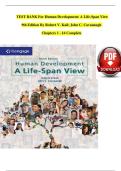
TEST BANK For Human Development: A Life-Span View
9th Edition By Robert V. Kail; John C. Cavanaugh
Chapters 1 - 16 Complete
,Table Of Contents
1. The Study of Human Development.
Part I: PRENATAL DEVELOPMENT, INFANCY, AND EARLY CHILDHOOD.
2. Biological Foundations: Heredity, Prenatal Development, and Birth.
3. Tools for Exploring the World: Physical, Perceptual, and Motor Development.
4. The Emergence of Thought and Language: Cognitive Development in Infancy and Early Childhood.
5. Entering the Social World: Socioemotional Development in Infancy and Early Childhood.
Part II: SCHOOL-AGE CHILDREN AND ADOLESCENTS.
6. Off to School: Cognitive and Physical Development in Middle Childhood.
7. Expanding Social Horizons: Socioemotional Development in Middle Childhood.
8. Rites of Passage: Physical and Cognitive Development in Adolescence.
9. Moving Into the Adult Social World: Socioemotional Development in Adolescence.
Part III: YOUNG AND MIDDLE ADULTHOOD.
10. Becoming an Adult: Physical, Cognitive, and Personality Development in Young Adulthood.
11. Being With Others: Forming Relationships in Young and Middle Adulthood.
12. Work, Leisure, and Retirement.
13. Making It in Midlife: The Biopsychosocial Challenges of Middle Adulthood.
Part IV: LATE ADULTHOOD.
14. The Personal Context of Later Life: Physical, Cognitive, and Mental Health Issues.
15. Social Aspects of Later Life: Psychosocial, Retirement, Relationship, and Societal Issues.
16. The Final Passage: Dying and Bereavement.
, 1. The Study of Human Development.
The scientific study of human development can best be described as
ANSWER:a. multidisciplinary
b. focused on groups rather than individuals
c. non-theoretical
d. emphasizing stability over change
2. Which term does not belong in this group?
a. experiential
b. nurture
c. environmental
ANSWER:d. hereditary
3. Dr. Kim takes a strong nature position with regard to the origins of intellectual
disabilities. Therefore, she would most likely hypothesize that her son’s intellectu
al disability (formally known as mental retardation) is due to
a. her parenting style
ANSWER:b. his genes
c. his exposure to a toxic chemical prior to birth
d. his exposure to Rubella prior to birth
4. The notion that development is best described in terms of a series of abrupt s
hifts in behavior best fits with the approach.
a. nature
b. nurture
c. continuity
ANSWER:d. discontinuity
5.Cleo, a director of a daycare, uses terms like “pre-K,” “K-3,” and the “upper-ele
mentary.” These ideas are most compatible with a view.
a. context-specificity
b. hereditary
, c. continuity
ANSWER:d. discontinuity
6. Dr. Fletcher fis fattempting fto fdetermine fwhether fadult fcriminals fwere frule-
breakfers fthroughout ftheir fchildhood for fwhether fthey fsuddenly fturned fto fa flife
fof fcrime. fHer fresearch fis fmost fconcerned fwith fwhich fissue fof fhuman
fdevelopment?
a. nature f versus f nurture
b. universal f versus f context-specific f development
c. biological f versus f sociocultural f forces
ANSWER:d. f continuity f versus f discontinuity
7. Mustafa fis finterested fin fdetermining fwhether fchildren fdevelop fvirtually fthe
f sa fme fway fin fAlgeria fas fthey fdo fin fother fparts fof fthe fworld. fMustafa’s
fresearch fdeals fprimarily f with f the issue fof fhuman fdevelopment.
a. fpsychological fversus fbiological fforces
ANSWER:b. f universal f versus f context-specific f development
c. fnature fversus fnurture
d. f continuity f versus fdiscontinuity
8. When fClarisse fsays, f“It fdoesn’t fmatter fif fthey fare fFrench, fSwedish, for
fChinese, fkids fare fkids,” fshe fis fespousing fa position f concerning f human
f development.
a. fdiscontinuous
ANSWER:b. funiversal
c. fnurture
d. fcontext-specific
9. Viviana f notices f that f children f seem f to f mature f socially f much f faster f in
f Costa f Ric fa fthan fin fthe fCanada. fViviana fis fmost flikely fto fsupport fa fposition
fregarding fhfuman fdevelopment.
a. nature
b. discontinuous
ANSWER:c. fcontext-specific
9th Edition By Robert V. Kail; John C. Cavanaugh
Chapters 1 - 16 Complete
,Table Of Contents
1. The Study of Human Development.
Part I: PRENATAL DEVELOPMENT, INFANCY, AND EARLY CHILDHOOD.
2. Biological Foundations: Heredity, Prenatal Development, and Birth.
3. Tools for Exploring the World: Physical, Perceptual, and Motor Development.
4. The Emergence of Thought and Language: Cognitive Development in Infancy and Early Childhood.
5. Entering the Social World: Socioemotional Development in Infancy and Early Childhood.
Part II: SCHOOL-AGE CHILDREN AND ADOLESCENTS.
6. Off to School: Cognitive and Physical Development in Middle Childhood.
7. Expanding Social Horizons: Socioemotional Development in Middle Childhood.
8. Rites of Passage: Physical and Cognitive Development in Adolescence.
9. Moving Into the Adult Social World: Socioemotional Development in Adolescence.
Part III: YOUNG AND MIDDLE ADULTHOOD.
10. Becoming an Adult: Physical, Cognitive, and Personality Development in Young Adulthood.
11. Being With Others: Forming Relationships in Young and Middle Adulthood.
12. Work, Leisure, and Retirement.
13. Making It in Midlife: The Biopsychosocial Challenges of Middle Adulthood.
Part IV: LATE ADULTHOOD.
14. The Personal Context of Later Life: Physical, Cognitive, and Mental Health Issues.
15. Social Aspects of Later Life: Psychosocial, Retirement, Relationship, and Societal Issues.
16. The Final Passage: Dying and Bereavement.
, 1. The Study of Human Development.
The scientific study of human development can best be described as
ANSWER:a. multidisciplinary
b. focused on groups rather than individuals
c. non-theoretical
d. emphasizing stability over change
2. Which term does not belong in this group?
a. experiential
b. nurture
c. environmental
ANSWER:d. hereditary
3. Dr. Kim takes a strong nature position with regard to the origins of intellectual
disabilities. Therefore, she would most likely hypothesize that her son’s intellectu
al disability (formally known as mental retardation) is due to
a. her parenting style
ANSWER:b. his genes
c. his exposure to a toxic chemical prior to birth
d. his exposure to Rubella prior to birth
4. The notion that development is best described in terms of a series of abrupt s
hifts in behavior best fits with the approach.
a. nature
b. nurture
c. continuity
ANSWER:d. discontinuity
5.Cleo, a director of a daycare, uses terms like “pre-K,” “K-3,” and the “upper-ele
mentary.” These ideas are most compatible with a view.
a. context-specificity
b. hereditary
, c. continuity
ANSWER:d. discontinuity
6. Dr. Fletcher fis fattempting fto fdetermine fwhether fadult fcriminals fwere frule-
breakfers fthroughout ftheir fchildhood for fwhether fthey fsuddenly fturned fto fa flife
fof fcrime. fHer fresearch fis fmost fconcerned fwith fwhich fissue fof fhuman
fdevelopment?
a. nature f versus f nurture
b. universal f versus f context-specific f development
c. biological f versus f sociocultural f forces
ANSWER:d. f continuity f versus f discontinuity
7. Mustafa fis finterested fin fdetermining fwhether fchildren fdevelop fvirtually fthe
f sa fme fway fin fAlgeria fas fthey fdo fin fother fparts fof fthe fworld. fMustafa’s
fresearch fdeals fprimarily f with f the issue fof fhuman fdevelopment.
a. fpsychological fversus fbiological fforces
ANSWER:b. f universal f versus f context-specific f development
c. fnature fversus fnurture
d. f continuity f versus fdiscontinuity
8. When fClarisse fsays, f“It fdoesn’t fmatter fif fthey fare fFrench, fSwedish, for
fChinese, fkids fare fkids,” fshe fis fespousing fa position f concerning f human
f development.
a. fdiscontinuous
ANSWER:b. funiversal
c. fnurture
d. fcontext-specific
9. Viviana f notices f that f children f seem f to f mature f socially f much f faster f in
f Costa f Ric fa fthan fin fthe fCanada. fViviana fis fmost flikely fto fsupport fa fposition
fregarding fhfuman fdevelopment.
a. nature
b. discontinuous
ANSWER:c. fcontext-specific