

100% tevredenheidsgarantie Direct beschikbaar na je betaling Lees online óf als PDF Geen vaste maandelijkse kosten 4.2 TrustPilot
logo-home
Tentamen (uitwerkingen)

ECPI University: NUR 168/NUR168 Final Exam | Complete Questions and Answers | Already graded A| 100% Updated Fall 2025/26.

Beoordeling
-
Verkocht
-
Pagina's
44
Cijfer
A+
Geüpload op
09-09-2025
Geschreven in
2025/2026

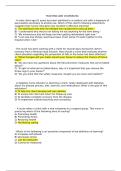
ECPI University: NUR 168/NUR168 Final Exam | Complete Questions and Answers | Already graded A| 100% Updated Fall 2025/26. TEACHING AND COUNSELING - A male client age 61 years has been admitted to a medical unit with a diagnosis of pancreatitis secondary to alcohol use. Which of the client's following statements suggests that nurses' education has resulted in affective learning? A) "I'm starting to see how my lifestyle has caused me to end up here." B) "I understand why they're not letting me eat anything for the time being." C) "My intravenous drip will keep me from getting dehydrated right now." D) "I can see how things could have been much worse if I hadn't gotten to the hospital when I did." - The nurse has been working with a client for several days during the client's recovery from a femoral head fracture. How should a nurse best evaluate whether client education regarding the prevention of falls in the home has been effective? A) "What changes will you make around your house to reduce the chance of future falls?" B) "Do you have any questions about the fall prevention measures that we've talked about?" C) "In light of what we've talked about, why is it important that you remove the throw rugs in your house?" D) "Do you think that the safety measures I taught you are clear and realistic?" - A diabetes nurse educator is teaching a client, newly diagnosed with diabetes, about his disease process, diet, exercise, and medications. What is the goal of this education? A) To help the client develop self-care abilities B) To ensure the client will return for follow-up care C) To facilitate complete recovery from the disease D) To implement ordered teaching and counseling - A nurse refers a client with a new colostomy to a support group. This nurse is practicing which of the following aims of nursing? A) Promoting health B) Preventing illness C) Restoring health D) Facilitating coping - Which of the following is an essential component of the definition of learning? A) Increases self-esteem B) Decreases stress C) Can be measured D) Cannot be measured - A nursing faculty member is teaching a class of second-degree students who have an average age of 32. What is important to remember when teaching adult learners? A) A focus on the immediate application of new material B) A need for support to reduce anxiety about new learning C) Older students may feel inferior in terms of new learning D) All students, regardless of age, learn the same - A nurse is designing a teaching program for individuals who have recently immigrated to the United States from Iraq. Which of the following considerations is necessary for culturally competent client teaching? A) Use materials developed previously for U.S. citizens. B) Use all visual materials when teaching content. C) Use a lecture format to teach content with few questions. D) Develop written materials in the client's native language. - Which of the following strategies might a nurse use to increase compliance with education? A) Include the client and family as partners. B) Use short, simple sentences for all ages. C) Provide verbal instruction at all times. D) Maintain clear role as the authority. - A young mother asks the nurse in a pediatric office for information about safety, diet, and immunizations for her baby. Which nursing diagnosis would be appropriate for this client? A) Knowledge Deficit: Infant care B) Impaired Health Maintenance C) Readiness for Enhanced Parenting D) Readiness for Enhanced Coping - Developing an education plan is comparable to what other nursing activity? A) Documenting in the nurses notes B) Formulating a nursing care plan C) Performing a complex technical skill D) Using a standardized form or format - A student is developing an education plan for her assigned client. The student wants to educate the client on what symptoms to report after chemotherapy. What would the student need to do first? A) Ask other students what should be included in content. B) Ask the client what he or she wants to know. C) Tell the instructor that this topic hasn't been covered yet. D) Review information available in writing and on the Internet. - What education strategy would be most effective in helping her learn? A) Lecture B) Discussion C) Demonstration D) Discovery - A nurse instructs a client to tell her about the side effects of a medication. What learning domain is the nurse evaluating? A) Affective B) Cognitive C) Psychomotor D) Emotional - When is the best time to evaluate one's own teaching effectiveness? A) During the education session B) Immediately after an education session C) 1 week after the education session D) 1 month after the education session - A male client age 42 years recovering from a MI is having difficulty following the care plan to stop smoking and exercise. What is the nurse's best response to this client? A) Praise him for trying. B) Tell him that he will have another MI and it will be his own fault. C) Tell him that his cigarettes will be taken away if he smokes again. D) Ignore the behavior and recommend a behavior modification program. - What is the most critical element of documentation of education? A) A summary of the education plan B) The implementation of the education plan C) the client's need for learning D) Evidence that learning has occurred - What word or phrase best describes an effective counselor? A) Technically skilled B) Knowledgeable C) Practical D) Caring - An older adult client is very stressed about who will care for his pets while he is hospitalized for a fall that caused a 18. fractured hip. What type of counseling would the nurse conduct? A) None B) Long-term C) Short-term D) Motivational - A nurse is using motivational interviewing to find out why a client refuses to participate in the recommended rehabilitation program. Which of the following is an example of using the skill of reflective listening to help motivate this client? A) So, you feel that you are not ready to start a program this week...? B) Why do you feel that you are not ready to start rehabilitation? C) I understand that you are afraid to start rehabilitation; where do you see yourself in a week? D) Remember we discussed what needs to be done to get you back on your feet...How do you feel about getting started? - At completion of the health education for a client, the nurse documents the details of the health education in the client's medical record. What can be determined by this documentation? A) Proof of compliance with education standards B) Client's response to the health education C) Self-administration of medications D) Dietary instructions for the client - A client 36 years of age is able to understand the health education when she is given the opportunity to put the education into practice. The nurse helps the client to self-administer the medication dosage before the client is discharged from the health care facility. Which domain correctly identifies the client's learning style? A) Cognitive domain B) Affective domain C) Psychomotor domain D) Interpersonal domain - When caring for a client, the nurse gives day-to-day examples to explain certain points of the health education. The nurse also notes the client's concentration level and educates when the client is active. Which category does the client fall into? A) Motivation B) Attention and concentration C) Learning readiness D) Learning needs - A nurse notices that a toddler is constantly snatching toys from the hands of other preschool children at the health care facility, placing the toddler and other children at risk for injury. Which of the following would be a most effective method for teaching the toddler not to snatch toys? A) Ask the children to play another game. B) Tell the toddler that God punishes children who snatch. C) Give the toddler another toy with which to play. D) Enlist the aid of the toddler's parents in education. - To meet accreditation standards regarding client care, a health care facility must show evidence of what? A) Employee satisfaction surveys B) Financial accounts and statements C) Documentation of indigent care D) Client education documentation - When providing client education it is essential for the nurse to incorporate what action so that learning can be optimized? A) Have the clients read material after client education B) Be sure that clients are formally engaged C) Include educational strategies that encourage clients to be active participants D) Administer tests to evaluate learning The parents of an infant suffering from apnea need to be educated on the apnea monitor and cardiopulmonary resuscitation. What should the nurse assess first regarding the parents? A) Educational levels B) Home environment C) Infant bonding D) Baseline knowledge of these concepts -When the newly diagnosed, insulin-dependent diabetic client tells the nurse that he has never received instruction on the administration of injections, an appropriately stated nursing diagnosis for the client is what? A) Self-care deficit related to lack of knowledge about injections B) Knowledge deficit related to lack of knowledge about injections C)Deficient knowledge of injection administration as verbalized by the client, related to the lack of instruction and experience D) Ineffective health care maintenance related to diabetic instructions - A nurse is writing learning outcomes for a client recovering from severe burns. Which of the following verbs would be good choices to use when preparing outcomes related to learning how to change dressings? Select all that apply. A) Assembles B) Demonstrates C) Gives examples D) Identifies E) Chooses -A nurse educating a new mother on how to bathe her infant uses the acronym TEACH to maximize the effectiveness of the education plan. Which of the following are guidelines based on this acronym? Select all that apply. A) Tune out the individual client. B) Edit client information. C) Act on every teaching moment. D) Always refer a client to counseling. E) Clarify often. -The National Patient Safety Foundation recently collaborated with the Partnership for Clear Health Communication (2007) to create awareness of the need for improved health literacy and developed the Ask Me 3 tool. Which of the 30. following is an Ask Me 3 question? Select all that apply. A) Who will be my health care provider? B) What is my main problem? C) What do I need to do? D) Where will I get help? E) Why is it important for me to do this? - A nurse is educating an elderly client with diabetes and his family members about the importance of a nutritious diet. The nurse knows that client education promotes which of the following purposes? Select all that apply. A) Helps the nurse to restore optimal health in the client B) Helps the client to cope with alterations in health status C) Helps the nurse to be more aware of the client's health D) Helps the nurse to diagnose the client's illness early E) Helps the nurse to be well-informed about the client's care - A nurse in a neighborhood clinic is conducting educational sessions on weight loss. What aim of nursing is met by these educational programs? Select all that apply. A) Practicing advocacy B) Preventing illness C) Restoring health D) Facilitating coping E) Maintaining and promoting health - What client characteristic is important to assess when using the health belief model as the framework for teaching? A) Developmental level B) Source of information C) Motivation to learn D) Family support - A nurse is working with an older adult client, educating the client on how to ambulate with the aid of a walker. The nurse notes that the client appears to lack the motivation to learn how to use device. The client states, "I'm just too old to learn." Which of the following would be most appropriate for the nurse to do to motivate this client? A) Tell the client how to move the walker as he ambulates. B) Explain how the walker supports the client's lower extremities C) Fully discuss the rationale for using the walker. D) Describe how the walker can improve the client's quality of life. -According to Rosenstock, which of the following are health beliefs critical for client motivation? Select all that apply. A) Clients view themselves as susceptible to the disease in question. B) Clients view the disease as a serious threat. C) Clients believe there are actions that they can take to reduce the probability of contracting the disease. D) Clients believe the threat of taking these actions is greater than the disease itself. E) Patients view themselves as victims of the disease in question. COMUNICATION - A group of nursing students is working together on a presentation for their clinical instructor. One student in the group participates by arguing and attempting to block each step of the process of this presentation. The student's behavior is causing frustration for the others and slowing their progress. Which of the following best describes the role this individual student is playing in relationship to the group dynamics? A) Self-serving B) Task-oriented C) Maintenance D) Group-building - The nurse is caring for a client who speaks Chinese, and the nurse does not speak Chinese. An appropriate approach for communication with this client includes what? A) Using a caring voice and repeating messages frequently B) Speaking directly and loudly to the client C) Avoiding the use of gesture or play-acting D) Writing messages for the client and offering him a dictionary for translation. - The daughter of an older adult female client has asked the nurse why a urine specimen was collected from her mother earlier that morning. How can the nurse best respond to the daughter's query? A) "We want to test your mother's urine to make sure she doesn't have a urinary tract infection." B) "Your mother's doctor ordered a urine C&S to rule out a UTI." C) "We want to do everything we can to get your mother healthy again." D) "Sometimes sick urine can make the whole person sick, and this might be causing her fever." - A nurse has drafted an SBAR communication before contacting the primary care provider of a client whose condition has worsened suddenly. How should the nurse best conclude this communication? A) Ask the care provider to come and assess the client. B) Provide the client's most recent vital signs. C) Ask the care provider if he or she is familiar with this client. D) Provide the most likely diagnosis of the problem. - The nurse has entered a client's room and observes that the client is hunched over and appears to be breathing rapidly. What type of question should the nurse first implement in this interaction? A) A yes/no question B) A directing question C) An open-ended question D) A reflective question - The nurse has entered a client's room after receiving a morning report. The nurse rapidly assessed the client's airway, breathing, and circulation and greeted the client by saying "Good morning." The client has made no reciprocal response to the nurse. How should the nurse best respond to the client's silence? A) The nurse should ask appropriate questions to understand the reasons for the client's silence. B) The nurse should apologize for bothering the client, perform necessary assessments efficiently and leave the room. C) The nurse should document the client's withdrawal and diminished mood in the nurse's notes. D) The nurse should ask the client if he feels afraid or angry. - A nurse touches a client's hand to indicate caring and support. What channel of communication is the nurse using? A) Auditory B) Visual C) Olfactory D) Kinesthetic - A nurse is educating a home care client on how to administer a topical medication. The client is watching television while the nurse is talking. What might be the result of this interaction? A) The message will likely be misunderstood. B) The stimulus for communication is unclear. C) The receiver will accurately interpret the message. D) The communication will be reciprocal. - The family of a client in a burn unit asks the nurse for information. The nurse sits with the family and discusses their concerns. What type of communication is this? A) Intrapersonal B) Interpersonal C) Organizational D) Focused - Which of the following is an example of nonverbal communication? A) A nurse says, "I am going to help you walk now." B) A nurse presents information to a group of clients. C) A client's face is contorted with pain. D) A client asks the nurse for a pain shot. - A nursing student caring for an unconscious client knows that communication is important even if the client does not respond. Which nonverbal action by the nursing student would communicate caring? A) Making constant eye contact with the client B) Waving to the client when entering the room C) Sighing frequently while providing care D) Holding the client's hand while talking - Which of the following statements is true of factors that influence communication? A) Nurses provide the same information to all clients, regardless of age. B) Men and women have similar communication styles. C) Culture and lifestyle influence the communication process. D) Distance from a client has little effect on a nurse's message. - A nurse is sitting near a client while conducting a health history. The client keeps edging away from the nurse. What might this mean in terms of personal space? A) The nurse is outside the client's personal space. B) The nurse is in the client's personal space. C) The client does not like the nurse. D) The client has concerns about the questions. - Why is communication important to the "assessing" step of the nursing process? A) The major focus of assessing is to gather information. B) Assessing is primarily focused on physical findings. C) Assessing involves only nonverbal cues. D) Written information is rarely used in assessment. - A nurse uses the SBAR method to hand off the communication to the health care team. Which of the following might be listed under the "B" of the acronym? A) Vital signs (SITUATION) B) Mental status (BACKGROUND) C) Client request (ASSESSING) D) Further testing (RECOMMENDATION) - What is the goal of the nurse in a helping relationship with a client? A) To provide hands-on physical care B) To ensure safety while caring for the client C) To assist the client to identify and achieve goals D) To facilitate the client's interactions with others - What action by the nurse will facilitate the helping relationship during the orientation phase? A) Providing assistance to meet activities of daily living B) Introducing oneself to the client by name C) Designing a specific teaching plan of care D) Preparing for termination of the relationship - Which of the nursing roles is primarily performed during the working phase of the helping relationship? A) Educator and counselor B) Provider of care C) Leader and manager D) Researcher - Which term describes a nurse who is sensitive to the client's feelings, but remains objective enough to help the client achieve positive outcomes? A) Competent B) Caring C) Honest D) Empathic - What is the primary focus of communication during the nurse-client relationship? A) Time available to the nurse B) Nursing activity to be performed C) Client and client needs D) Environment of the client - Which of the following is an example of a closed-ended question or statement? A) "How did that make you feel?" B) "Did you take those drugs?" C) "What medications do you take at home?" D) "Describe the type of pain you have." - A client tells the nurse that he is very worried about his surgery. Which of the following responses by the nurse is a cliché? A) "Tell me what you are worried about." B) "Have you spoken to your family about your concerns?" C) "Do you want to cancel your surgery?" D) "Don't worry, everything will be fine." - A nurse tells a client, "Aren't you going to get out of bed or are you just going to sleep all day and night?" This is an example of which of the following barriers to communication? A) Using comments that give advice B) Using judgmental or belittling language C) Using leading questions D) Using probing questions - A nurse is caring for a client who is visually impaired. Which of the following is a recommended guideline for communication with this client? A) Ease into the room without acknowledging presence until the client can be touched. B) Speak in a louder tone of voice to make up for lack of visual cues. C) Explain reason for touching client before doing so. D) Keep communication simple and concrete. - A client has been recently diagnosed with diabetes. He is seen in the emergency room every day with high blood sugar. The client apologizes to the nurse for bothering them every day, but he cannot give himself insulin injections. What should the nurse's response be? A) "I myself cannot take insulin injections." B) "Has someone taught you how to take them?" C) "You should learn to take injections yourself." D) "Ask the doctor to change the medications." - A nurse pays a house visit to a client who is on total parenteral nutrition. The client expresses that he misses enjoying food with his family. What is the most appropriate response by the nurse? A) Tell me more about how it feels to eat with your family. B) You can sit with your family at meal times, even though you don't eat. C) In a few weeks you may be allowed to eat a little; you may enjoy then. D) I know that you must be missing your favorite foods. A nurse is caring for a client with myasthenia gravis. The client is having difficulty forming words and his tone is nasal. Which of the following is an effective communication strategy for this client? A) Engage the client in a lengthy discussion to strengthen his voice. B) Encourage the client to speak quickly while talking. C) Repeat what the client has said to verify the meaning. D) Nod continuously when the client is talking. - The nurse has engaged the services of an interpreter when interviewing a client who speaks a language that the nurse does not understand. The interpreter is functioning in which role during the communication process? A) Sender B) Encoder C) Receiver D) Communication channel - A client comes to the clinic complaining of abdominal pain. Which first question would be most appropriate for the nurse to ask to facilitate the assessment? A) "Do you have sharp, stabbing pain?" B) "Is the pain associated with meals?" C) "What activities exaggerate the pain?" D) "Does the pain increase on palpation?" - When documenting client care, the nurse understands that the most important reason for correct and accurate documentation is which of the following? A) Legal representation to care B) Conveyance of information C) Assisting in organization of care D) Noting the client's response to interventions - An older adult client who has had a colostomy for over 10 years states, "I won't need any teaching about colostomies. I understand how to change the bag and care for my colostomy, but I'm not sure how to best clean my stoma." What does this statement indicate? A) An incongruent relationship B) A confused relationship C) A non-therapeutic relationship D) An evaluative relationship - Which of the following statements accurately describes the relationship between therapeutic communication and the nursing process? Select all that apply. A) Effective communication techniques, as well as observational skills, are used extensively during the assessment step. B) Only the written word in the form of a medical record is used during the diagnosing step of the nursing process. C) The implementing step requires communication among the client, nurse, and other team members to develop interventions and outcomes. D) Verbal and nonverbal communication are used to educate, counsel, and support clients and their families during the implementation phase. E) Nurses rely on the verbal and nonverbal cues they receive from their clients to evaluate whether client objectives have been achieved. - A nurse who is discharging a client is terminating the helping relationship. Which of the following actions might the nurse perform in this phase? Select all that apply. A) Making formal introductions B) Making a contract regarding the relationship C) Providing assistance to achieve goals D) Helping client perform activities of daily living E) Examining goals of the relationship to determine their achievement - A nurse tells a client that she will come back in 10 minutes to re-assess the client's pain. When the nurse returns in 10 minutes, which aspect of the therapeutic relationship is the nurse developing? A) Empathy B) Sympathy C) Trust D) Closure - Which of the following should the nurse first consider when attempting to become culturally competent? A) Personal cultural beliefs and prejudices B) Understanding the client's response C) Avoiding labeling clients D) Treating the client with dignity ASSESSMENT - Which of the following guidelines should a nursing instructor provide to nursing students who are now responsible for assessing their clients? A) "Assessment data about the client should be collected continuously." B) "Assess your client after receiving the nursing report and again before giving a report to the next shift of nurses." C) "Assess your client at least hourly if the client's vital signs are unstable, and every two hours if the vital signs are stable." D) "Assessment data should be - The nurse is using a systematic approach to the collection of assessment data. The nurse uses an assessment guide that uses a hierarchy of five life requirements universal to all persons. What model for organizing the assessment data is the nurse using? A) Human Needs (Maslow) model B) Functional Health Patterns model C) Human Response Patterns model D) Body System model - A novice nurse collects data on a newly admitted client. Upon evaluation of this data, the nurse provides an erroneous interpretation. What is a corrective action for this interpretation? A) Encourage the novice nurse to independently observe the same situation with a peer, validate the data, and discuss the situation afterward. B) Encourage the novice nurse to develop his or her own tool for data collection. C) Encourage the novice nurse to collect and interpret the data for the client repeate - When documenting subjective data, the nurse should do which of the following? A) Use the client's own words placed in quotation marks. B) Paraphrase the information stated by the client. C) Validate the information with the client's family prior to documentation. D) Record the information using nonspecific words. - The nurse has entered a client's room to find the client diaphoretic (sweatcovered) and shivering, inferring that the client has a fever. How should the nurse best follow up this cue and inference? A) Measure the client's oral temperature. B) Ask a colleague for assistance. C) Give the client a clean gown and warm blankets. D) Obtain an order for blood cultures. - The nurse completes a health history and physical assessment on a client who has been admitted to the hospital for surgery. What is the purpose of this initial assessment? A) To gather data about a specific and current health problem B) To identify life-threatening problems that require immediate attention C) To compare and contrast current health status to baseline data D) To establish a database to identify problems and strengths - A client comes to her health care provider's office because she is having abdominal pain. She has been seen for this problem before. What type of assessment would the nurse do? A) Initial assessment B) Focused assessment C) Emergency assessment D) Time-lapsed assessment - A nurse is assisting with lunch at a nursing home. Suddenly, one of the residents begins to choke and is unable to breathe. The nurse assesses the resident's ability to breathe and then begins CPR. Why did the nurse assess respiratory status? A) To identify a life-threatening problem B) To establish a database for medical care C) To practice respiratory assessment skills D) To facilitate the resident's ability to breathe -A nurse performs an assessment of a client in a long-term care facility and records baseline data. The nurse reassesses the client a month later and makes revisions in the plan of care. What type of assessment is the second assessment? A) Comprehensive B) Focused C) Time-lapsed D) Emergency - Of the following information collected during a nursing assessment, which are subjective data? A) vomiting, pulse 96 B) respirations 22, blood pressure 130/80 C) nausea, abdominal pain D) pale skin, thick toenails - A nurse in the emergency department is completing an emergency assessment for a teenager just admitted from a car crash. Which of the following is objective data? A) "My leg hurts so bad. I can't stand it." B) "Appears anxious and frightened." C) "I am so sick; I am about to throw up." D) "Unable to palpate femoral pulse in left leg." - A nurse is collecting information from a client with dementia. The client's daughter accompanies the client. Which of the following statements by the nurse would recognize the client's value as an individual? A) "Can you tell me how long your father has been this way?" B) "Sarah, I have to go and read your father's old charts before we talk." C) "Mr. Koeppe, tell me what you do to take care of yourself." D) "Mr. Koeppe, I know you can't answer my questions, but it's okay." - A nurse is collecting data from a home care client. In addition to information about the client's health status, what is another observation the nurse should make? A) Number of rooms in the house B) Safety of the immediate environment C) Frequency of home visits to be made D) Friendliness of the client and family - A nurse is preparing to conduct a health history for a client who is confined to bed. How should the nurse position herself? A) Standing at the end of the bed B) Standing at the side of the bed C) Sitting at least six feet from the beside D) sitting at a 45-degree angle to the bed -Which of the following questions or statements would be appropriate in eliciting further information when conducting a health history interview? A) "Why didn't you go to the doctor when you began to have this pain?" B) "Are you feeling better now than you did during the night?" C) "Tell me more about what caused your pain." D) "If I were you, I would not wait to get medical help next time." - Which of the following questions or statements would be an appropriate termination of the health history interview? A) "Well, I can't think of anything else to ask you right now." B) "Can you think of anything else you would like to tell me?" C) "I wish you could have remembered more about your illness." D) "Perhaps we can talk again sometime. Goodbye." - A nurse is conducting a health history interview for a woman at an assisted-living facility. The woman says, "I have been so constipated lately." How should the nurse respond? A) "Do you have a family history of chest problems?" B) "Why don't you use a laxative every night?" C) "Do you take anything to help your constipation?" D) "Everyone who ages has bowel problems." - A nurse who collected and organized data during a client history realizes that there is not enough information to plan interventions. Which of the following would be the best remedy to prevent this from happening in the future? A) The nurse should practice interviewing strategies. B) The nurse should modify data collection tool. C) The nurse should determine specific purpose of data collection. D) The nurse should update the database. - What is the primary purpose of validation as a part of assessment? A) To identify data to be validated B) To establish an effective nurse-client communication C) To maintain effective relationships with coworkers D) To plan appropriate nursing care - A client is being prepared for cardiac catheterization. The nurse performs an initial assessment and records the vital signs. Which of the following data collected can be classified as subjective data? A) Blood pressure B) Nausea C) Heart rate D) Respiratory rate - A client is brought to the emergency department in an unconscious condition. The client's wife hands over the previous medical files and points out that the client had suddenly fallen unconscious after trying to get out of bed. Which of the following is a primary source of information? A) Client's wife B) Medical documents C) Test results D) Assessment data - The nurse is performing an assessment of a client who has a small wound on the knee, collecting cues about the client's health status. Which of the following would the nurse identify as a subjective cue? A) Sharp pain in the knee B) Small bloody drainage on dressing C) Temperature of 102 degrees F D) Pulse rate of 90 beats per minute - A nurse caring for a client admitted to the intensive care unit with a stroke assesses the client's vital signs, pupils, and orientation every few minutes. The nurse is performing which type of assessment? A) Initial assessment B) Focused assessment C) Time-lapsed reassessment D) Emergency assessment - When the nurse inspects a postoperative incision site for infection, which one of the following types of assessments is being performed? A) Complete B) Focused C) General D) Time-lapse - An unconscious patient is brought to the emergency department. Which of the following assessments should be implemented first? A) The client's airway should be assessed. B) The nurse should determine the reason for admission. C) The nurse should review the client's medications. D) The client's past medical history is assessed. - The nurse observes the client as he walks into the room. What information will this provide the nurse? A) Information regarding the client's gait B) Information regarding the client's personality C) Information regarding the client's psychosocial status D) Information on the rate of recovery from surgery - After assessment of a client in an ambulatory clinic, the nurse records the data on the computer. The nurse recognizes which of the following as objective data? A) Auscultation of the lungs B) Complaint of nausea C) Sensation of burning in her epigastric area D) Belief that demons are in her stomach - A nurse performing triage in an emergency room makes assessments of clients using critical thinking skills. Which of the following are critical thinking activities linked to assessment? Select all that apply. A) Carrying out a physician's order to intubate a client B) Educating a novice nurse on the principles of triage C) Using the nursing process to diagnose a blocked airway D) Interviewing privately a client suspected of being a victim of abuse E) Checking with the family about the data supp -Which of the following data regarding a client with a diagnosis of colon cancer are subjective? Select all that apply. A) The client's chemotherapy causes him nausea and loss of appetite B) The client became teary when his daughter from out of state came to the bedside. C) The client's ileostomy put out 125 mL of effluent in the past four hours. D) The patient is unwilling to manipulate or empty his ostomy bag. E) The patient has been experiencing fatigue in recent weeks. - Which of the following examples of client data needs to be validated? Select all that apply. A) A client has trouble reading an informed consent, but states he does not need glasses. B) An elderly client explains that the black and blue marks on his arms and legs are due to a fall. C) A nurse examining a client with a respiratory infection documents fever and chills. D) A client in a nursing home states that she is unable to eat the food being served. E) A pregnant client is experiencing contra - Which of the following are examples of common factors in a client that may influence assessment priorities? Select all that apply. A) Diet and exercise program B) Standing in the community C) Ability to pay for services D) Developmental stage E) Need for nursing - The nurse is conducting a nursing history of a client with a respiratory rate of 30, audible wheezing, and nasal flaring. During the interview, the client denies problems with breathing. What action should the nurse take next? A) Clarify discrepancies of assessment data with the client. This is the most immediate and direct approach. The nurse should discuss the observed signs with the client to understand their perspective and possibly uncover any underlying issues or misunderstandings. B) Validate client data with members of the health care team. C) Document all data collected in the nursing history and physical examination. D) Seek input from family members regarding the client's breathing at - The nurse is reviewing information about a client and notes the following documentation Client is confused. The nurse recognizes this information is an example of what? A) Subjective data B) A data cue C) An inference D) Primary data - While bathing the client, the nurse observes the client grimacing. The nurse asks if the client is experiencing pain. The client nods yes and refuses to continue the bath. The nurse removes the wash basin, makes the client comfortable, and documents the event in the client's chart. Which of the following actions clearly demonstrates assessing? A) The nurse bathing the client B) The nurse documenting the incident C) The nurse asking if the client is having pain D) The nurse removing the wash bas URINARY ELIMINATION - A student is collecting a sterile urine specimen from an indwelling catheter. How will the student correctly obtain the specimen? A) Pour urine from the collecting bag. B) Remove the catheter and ask the client to void. C) Aspirate urine from the collecting bag. D) Aspirate urine from the collection port. - During a visit to the pediatrician's office, a parent inquires about toilet training her daughter age 2 years. The nurse informs the mother that one factor in determining toilet-training readiness is when ... A) the child can recognize bladder fullness. B) the child can hold the urine for four to five hours. C) The child cannot control urination until seated on the toilet. D) The child ignores the desire to void. - A client with urine retention related to a complete prostatic obstruction requires a urinary catheter to drain the bladder. Which type of catheter is most appropriate for a client that has an obstructed urethra? A) Suprapubic catheter B) Indwelling urethral catheter C) Intermittent urethral catheter D) Straight catheter - her physician to prescribe furosemide (Lasix), a diuretic medication. After the client has begun this new medication, what should the nurse anticipate? A) Increased output of dilute urine B) Increased urine concentration C) A risk of urinary tract infections D) Transient incontinence and increased urine production - A nurse is preparing to catheterize a female client. What will the nurse consider when comparing the anatomy of the female urethra with that of the male urethra? A) Has different innervation B) No connection with bladder C) Shorter in length D) Longer in length - Which of the following describes the term micturition? A) Emptying the bladder B) Catheterizing the bladder C) Collecting a urine specimen D) Experiencing total incontinence - A nurse working in a community pediatric clinic explains the process of toilet training to mothers of toddlers. Which is a recommended guideline for initiating this training? A) The child should be able to hold urine for four hours. B) The child should be between 18 and 24 months old. C) The child should be able to communicate the need to void. D) The child does not need the desire to gain control of voiding. - A nurse is caring for older adult clients in an assisted-living facility. Which effect of aging should the nurse consider when performing a urinary assessment? A) The diminished ability of the kidneys to concentrate urine may result in urinary tract infection. B) Increased bladder muscle tone may reduce the capacity of the bladder to hold urine, resulting in frequency. C) decreased bladder contractility can lead to urine retention and stasis, thereby increasing the risk of urinary tract - A nurse is assessing the urine output of a client with Parkinson's disease who is on levodopa. Which of the following is a common finding for a client on this medication? A) The urine may be brown or black. B) The urine may be blood-tinged. C) The urine may be green or blue-green. D) The urine may be orange or orange-red. Levodopa (l-dopa), an antiparkinson drug, and injectable iron compounds can lead to brown or black urine. Anticoagulants may cause hematuria (blood in the urine), leading to a pink or red color. Diuretics can lighten the color of urine to pale yellow. Phenazopyridine (Pyridium), a urinary tract analgesic, can cause orange or orangered urine. - A client tells the nurse, "Every time I sneeze, I wet my pants." What is this type of involuntary escape of urine called? A) Urinary incontinence B) Urinary incompetence C) Normal micturition D) Uncontrolled voiding - During a health history interview, a male client tells the nurse that he does not feel that he completely empties his bladder when he voids. He has been diagnosed with an enlarged prostate. What is the name of this symptom? A) Urinary incontinence B) Urinary retention C) Involuntary voiding D) Urinary frequency - A nurse is assessing the urine on a newborn's diaper. What would be a normal assessment finding? A) Scanty to no urine B) Highly concentrated urine C) Light in color and odorless D) Dark in color and odorous - An older woman who is a resident of a long-term care facility has to get up and void several times during the night. This can be the result of what physiologic change with normal aging? A) Diminished kidney ability to concentrate urine B) Increased bladder muscle tone causing urinary frequency C) Increased bladder contractility causing urinary stasis D) Decreased intake of fluids during daytime hours - After surgery, a postoperative client has not voided for eight hours. Where would the nurse assess the bladder for distention? A) Between the symphysis pubis and the umbilicus B) Over the costovertebral region of the flank C) In the left lower quadrant of the abdomen D) Between ribs 11 and 12 and the umbilicus - A nurse is delegating the collection of urinary output to an assistant. What should the nurse tell the assistant to do while measuring the urine? A) Compare the amount of output with intake. B) Use a clean measuring cup for each voiding. C) Tell the client to wash the urethra before voiding. D) Wear gloves when handling a client's urine. - A nurse has instructed a client at the clinic about collecting a specimen for a routine urinalysis. The client makes the following statements. Which one indicates a need for more teaching? A) "I need to tell you that I am having my menstrual period." B) "I will void into the specimen bottle you gave me." C) "I will keep the toilet paper in the specimen." D) "I will be sure that no stool is included in my urine." - A student is collecting a sterile urine specimen from an indwelling catheter. How will the student correctly obtain the specimen? A) Pour urine from the collecting bag. B) Remove the catheter and ask the client to void. C) Aspirate urine from the collecting bag. D) Aspirate urine from the collection port. - A nurse is initiating a 24-hour urine collection for a client at home. What will be the first thing the nurse will ask the client to do at the beginning of the specimen collection? A) Void and discard the urine. B) Begin the collection at a specific time. C) Add the first voiding to the specimen. D) Keep the urine warm during collection. - An older adult woman has constant dribbling of urine. The associated discomfort, odor, and embarrassment may support which of the following nursing diagnoses? A) Social Isolation B) Impaired Adjustment C) Defensive Coping D) Impaired Memory - A male client who has had outpatient surgery is unable to void while lying supine. What can the nurse do to facilitate his voiding? A) Assist him to a standing position. B) Tell him he has to void to be discharged. C) Pour cold water over his genitalia. D) Ask his wife to assist with the urinal. - A nurse is educating a client on the amount of water to drink each day. What is the recommended daily fluid intake for adults? A) 1 to 2 (4-oz) glasses per day B) 5 to 6 (6-oz) glasses per day C) 8 to 10 (8-oz) glasses per day 2000 to 2400 ml D) 16 to 20 (12-oz) glasses per day - A nurse is carrying out an order to remove an indwelling catheter. What is the first step of this skill? A) Deflate the balloon by aspirating the fluid. B) Ask the client to take several deep breaths. C) Tell the client burning may initially occur. D) Wash hands and put on gloves. - A nurse has catheterized a client to obtain urine for measuring postvoid residual (PVR) amount. The nurse obtains 40 mL of urine. What should the nurse do next? A) Report this abnormal finding to the physician. B) Perform another catheterization to verify the amount. C) Document this normal finding for postvoid residual. D) Palpate the abdomen for a distended bladder. - A nurse is inserting an indwelling urethral catheter. What type of supplies will the nurse need for this procedure? A) A clean catheter and rubber gloves B) A sterile catheterization kit or tray C) Solutions to sterilize the urethra D) Solutions to sterilize the vagina - A client has been taught how to do Kegel exercises. What statement by the client indicates a need for further information? A) "I understand these will help me control stress incontinence." B) "I know this is also called pelvic floor muscle training." C) "I will do these 30 to 80 times a day for two months." D) "I will contract the muscles in my abdomen and thighs." - A man with urinary incontinence tells the nurse he wears adult diapers for protection. What risks should the nurse discuss with this client? A) Public embarrassment B) Skin breakdown and UTI C) Inability to control urine D) Odor and leakage - A school nurse is educating a class of middle-school girls on how to promote urinary system health. Which of the following statements by one of the girls indicates a need for more information? A) "I will take showers rather than baths." B) "I will wear underpants with cotton crotches." C) "I will tell my parents if I have burning or pain." D) "I will wipe back to front after going to the toilet." - A client is taking diuretics. What should the nurse teach the client about his urine? A) Urinary output will be decreased. B) Urinary output will be increased. C) Urine will be a pale yellow color. D) Urine may be brown or black. - A nurse is preparing a client for an invasive diagnostic procedure of the urinary system. What statement by the nurse would help reduce the client's anxiety? A) "We do these procedures every day, so you don't need to worry." B) "I have had this done to me, and it only hurt for a little while." C) "Why are you so worried? Do you think you have a tumor?" D) "Let me explain to you what they do during this procedure." - A nurse is caring for a client who is being treated for bladder infection. The client complains to the nurse that he has been having difficulty voiding and feels uncomfortable. How should the nurse document the client's condition? A) Anuria B) Oliguria C) Polyuria D) Dysuria - A nurse uses a catheter to collect a sterile urine specimen from a client at a health care facility. If a catheter is required temporarily, which type of catheter should the nurse use? A) Condom catheter B) Urinary bag C) Straight catheter D) Retention catheter - A client with a urinary tract infection is to be discharged from the health care facility. After teaching the client about measures to prevent urinary tract infections, the nurse determines that the education was successful when the client states which of the following? A) "I should take frequent bubble baths." B) "I need to void after sexual intercourse." C) "I should wipe from back to front after going to the bathroom." D) "I need to wear pants that are snug fitting." - A client is admitted to the health care facility with complaints of pain on urination that is secondary to a urinary tract infection (UTI). The nurse documents this finding as which of the following? A) Polyuria B) Dysuria C) Nocturia D) Hematuria - What is the micturition reflex? A) The process of filtration beginning with the glomerulus B) The act of bladder contraction and perceived need to void C) The reabsorption of the substances the body wants to retain D) The secretion of electrolytes that are harmful to the body - A nurse is using a bladder scanner to assess the bladder volume of a client with urinary frequency. In which of the following positions would the nurse place the client? A) Supine B) Sims' C) High Fowler's D) Dorsal recumbent - The home health nurse is caring for an older adult woman living alone at home who is incontinent of urine and changes her adult diaper daily. Which of the following nursing diagnoses is the most appropriate for this client? A) Risk for activity intolerance B) Risk for impaired skin integrity C) Risk for infection D) Risk for falls OXIGENATION AND PERFUSION - A client has had a head injury affecting the brain stem. What is located in the brain stem that may affect respiratory function? A) Chemoreceptors B) Stretch receptors C) Respiratory center D) Oxygen center - Which of the following diseases may result in decreased lung compliance? A) Emphysema B) Appendicitis C) Acne D) Chronic diarrhea - A nurse is caring for a client with pneumonia. The client's oxygen saturation is below normal. What abnormal 6. respiratory process does this demonstrate? A) changes in the alveolar-capillary membrane and diffusion B) alterations in the structures of the ribs and diaphragm C) rapid decreases in atmospheric and intrapulmonary pressures D) lower-than-normal concentrations of environmental oxygen - In what age group would a nurse expect to assess the most rapid respiratory rate? A) Older adults B) Middle adults C) Adolescents D) Infants - A woman 90 years of age has been in an automobile crash and sustained four fractured ribs on the left side of her thorax. Based on her age and the injury, she is at risk for what complication? A) Pneumonia B) Altered thought processes C) Urinary incontinence D) Viral influenza - A father of a preschool-age child tells the nurse that his child "has had a constant cold since going to daycare." How 8. would the nurse respond? A) "Your child must have a health problem that needs medical care." B) "Children in daycare have more exposure to colds." C) "Are you washing your hands before you touch the child?" D) "Be sure and have your child wear a protective mask at school." - Which individual is at greater risk for respiratory illnesses from environmental causes? A) A farmer on a large farm B) A factory worker in a large city C) A woman living in a small town D) A child living in a rural area - A nurse is beginning to conduct a health history for a client with respiratory problems. He notes that the client is having 11. respiratory distress. What would the nurse do next? A) Continue with the health history, but more slowly. B) Ask questions of the family instead of the client. C) Conduct the interview later and let the client rest. D) Initiate interventions to help relieve the symptoms. - An emergency room nurse is auscultating the chest of a child who is having an asthmatic attack. Auscultation reveals the presence of wheezes. During what part of respirations do wheezes occur? A) Inspiration and expiration B) Only on inspiration C) Only on expiration D) When coughing A client is experiencing hypoxia. Which of the following nursing diagnoses would be appropriate? A) Anxiety B) Nausea C) Pain D) Hypothermia - What does pulse oximetry measure? A) Cardiac output B) Peripheral blood flow C) Arterial oxygen saturation D) Venous oxygen saturation - Of all factors, what is the most important risk factor in pulmonary disease? A) Air pollution from vehicles B) Dangerous chemicals in the workplace C) Active and passive cigarette smoke D) Loss of the ozone layer of the atmosphere - A nurse is caring for a toddler who is having an acute asthmatic attack with copious mucus and difficulty breathing. The child's skin is cyanotic, respirations are labored and rapid, and pulse is rapid. What nursing diagnosis would have priority for care of this child? A) Anxiety B) Ineffective Airway Clearance C) Excess Fluid Volume D) Disturbed Sensory Perception - A nurse is educating a home care client on how to do pursed-lip breathing. What is the therapeutic effect of this procedure? A) Using upper chest muscles more effectively B) Replacing the use of incentive spirometry C) Reducing the need for p.r.n. pain medications D) Prolonging expiration to reduce airway resistance - What information would a home care nurse provide to a client who is measuring peak expiratory flow rate at home? A) "Although the test is uncomfortable, it is not painful." B) "You will be asked to forcefully exhale into a mouthpiece." C) "The test is used to determine how much air you inhale." D) "You will do this each morning while still lying in bed." - What prevents air from re-entering the pleural space when chest tubes are inserted? A) The location of the tube insertion B) The sutures that hold in the tube C) A closed water-seal drainage system D) Respiratory inspiration and expiration - A nurse is educating a client who has congested lungs how to keep secretions thin, and more easily coughed up and expectorated. What would be one self-care measure to teach? A) Limit oral intake of fluids to less than 500 mL per day. B) Increase oral intake of fluids to two to three quarts per day. C) Maintain bed rest for at least three days. D) Take warm baths every night for a week. - What category of medications may be administered by nebulizer or metered-dose inhaler to open narrowed airways? A) Bronchoconstrictors B) Antihistamines C) Narcotics D) Bronchodilators - A nurse is caring for a client who suddenly begins to have respiratory difficulty. In what position would the nurse place the client to facilitate respirations? A) Supine B) Prone C) High-Fowler's D) Dorsal recumbent - A nurse is educating a preoperative client on how to effectively deep breathe. Which of the following would be 19. included? A) "Make each breath deep enough to move the bottom ribs." B) "Breathe through the mouth when you inhale and exhale." C) "Breathe in through the mouth and out through the nose." D) "Practice deep breathing at least once each week." - A nurse uses a nasal cannula to deliver oxygen to a client who is extremely hypoxic and has been diagnosed with chronic lung disease. What is the most important thing to remember when using a nasal cannula? A) It can cause the nasal mucosa to dry in case of high flow. B) It can cause anxiety in clients who are claustrophobic. C) It can create a risk of suffocation. D) It can result in an inconsistent amount of oxygen - A nurse is conducting a health promotion program for adolescents to educate them about the hazards of smoking. When describing the effects on the respiratory system, which of the following would the nurse most likely include? A) Decreased production of mucus B) Inhibition of mucus removal C) Increase in the mucous escalator D) Inhibition of bacterial colonization - A nurse is explaining a chest tube to family members who do not understand where it is placed. What would the nurse tell them? A) "It is inserted into the space between the lining of the lungs and the ribs." B) "I don't exactly know, but I will make sure the doctor comes to explain." C) "It is inserted directly into the lung itself, connecting to a lung airway." D) "It is inserted into the peritoneal space and drains into the lungs." - The nurse is caring for a postoperative adult client who has developed pneumonia. The nurse should assess the client frequently for symptoms of A) Atelectasis : partial or complete collapse of the lung or a section (lobe) of the lung. B) Bronchospasm C) Croup D) Epiglottitis - The home care nurse visits a client who has dyspnea. The nurse notes the client has pitting edema in his feet and ankles. What additional assessment would the nurse expect to observe? A) Crackles in the lower lobes B) Inspiratory stridor C) Expiratory stridor D) Wheezing in the upper lobes - nurse is educating a postoperative client on how to use an incentive spirometer. Which of the following is an accurate step that should be included in the teaching plan? A) Instruct the client to inhale normally and then place the lips securely around the mouthpiece. B) Instruct the client to inhale slowly and as deeply as possible through the mouthpiece, without using the nose. C) When the client cannot inhale anymore, the patient should hold his or her breath and count to - A nurse is delivering oxygen to a client via an oxygen mask. Which of the following is a recommended guideline for this 32. procedure? A) Adjust the mask so it fits tightly around the face. B) For a mask with a reservoir, fill the reservoir half-full of oxygen. C) Remove the mask and dry the skin every two to three hours if the oxygen is running continuously. D) If the client is experiencing redness around the mask, remove and apply powder to the mask. - A nurse is caring for an older adult client who is to be discharged from the health care facility. The client has been prescribed the use of a liquid oxygen unit at home to continue with oxygen therapy. What should the nurse tell the client regarding the potential problems of using a liquid oxygen unit? Select all that apply. A) Liquid oxygen may leak during warm weather. B) The unit may give off a bad smell if not cleaned regularly. C) The unit's outlet may become occluded because of frozen moisture D) portable liquid oxygen is more expensive E) The unit may require a secondary source of oxygen. - A physician is choosing a chest drainage system for a client who is ambulating daily. Which of the following systems would be the best choice for this client? A) Traditional water seal B) Wet suction C) Dry suction water seal D) Dry suction/one-way valve system - A client visits the health care facility for a scheduled physical assessment. What should the nurse do when physically assessing the quality of the client's oxygenation? Select all that apply. A) Monitor the client's respiratory rate. B) Note the amount of oxygen administered. C) Check the symmetry of the client's chest. D) Observe the breathing pattern and effort. E) Check the devices used to deliver oxygen. - A nurse assesses the vital signs of a healthy newborn infant. What respiratory rate could be expected based on the developmental level of this client? A) 15 to 25 breaths/minute B) 16 to 20 breaths/minute C) 20 to 44 breaths/minute D) 30 to 55 breaths/minute FLUID AND ELECTROLITES - Which body fluid is the fluid within the cells, constituting about 70% of the total body water? A) Extracellular fluid (ECF) B) Intracellular fluid (ICF) C) Intravascular fluid D) Interstitial fluid - Based on knowledge of total body fluids, a nurse is especially watchful for a fluid volume deficit in an infant. Why would the nurse do this? A) Infants have less total body fluid and ECF than adults. B) Infants have more total body fluid and ECF than adults. C) Infants drink less fluid than adults. D) Infants lose more fluids through output than adults. - What is the average adult fluid intake and loss in each 24 hours? A) 500 to 1,000 mL B) 1,000 to 1,500 mL C) 1,500 to 2,000 mL D) 1,500 to 3500 mL - A nurse monitoring the intake and output of fluids for a client with severe diarrhea knows that normally how much body fluid is lost via the gastrointestinal tract? A) 300 mL B) 1,000 mL C) 1,300 mL D) 2,600 mL Generally, fluid intake averages 2,600 mL per day, with approximately 1,300 mL coming from ingested water, 1,000 mL coming from ingested food, and 300 mL from metabolic oxidation. - A nurse reads the laboratory report and notes that the client has hyponatremia. What physical assessment should be made? A) Observe skin color and texture. B) Auscultate bowel sounds. C) Percuss lung density. D) Monitor for GI symptoms. - A home care client reports weakness and leg cramps. Per order, the nurse draws blood and requests a potassium level. What is the rationale for this request? A) The nurse is concerned that the client's diet has caused sodium loss. B) The nurse recognizes these symptoms of hypokalemia. C) The client is actively seeking increased attention. D) The client had bananas and orange juice for breakfast. - A client's PaCO2 is abnormal on an ABG report. Which of is the most likely be the medical diagnosis? A) Rheumatoid arthritis B) Sexually transmitted infection C) Chronic obstructive pulmonary disease D) Infection of the bladder and ureters - Which question about fluid balance would be appropriate when conducting a health history for a client? A) "Describe your usual urination habits." B) "Describe your problems with constipation." C) "How did you feel when your calcium was low?" D) "Do you eat fruits and vegetables each day?" - A client is taking a diuretic that increases her urinary output. What would be an appropriate nursing diagnosis on which to base an educational plan? A) Impaired Skin Integrity B) Risk for Deficient Fluid Volume C) Impaired Urinary Elimination D) Urinary Retention - A nurse measures a client's 24-hour fluid intake and documents the findings. To be an accurate indicator of fluid status, what must the nurse also do with the information? A) Compare the client's intake with the normal range of adult fluid intake. B) Report the exact milliliter of intake to the physician's office nurse. C) Compare the total intake and output of fluids for the 24 hours. D) Ensure that the information is included in the verbal end-of-shift report. - A physician writes an order to "force fluids." What will be the first action the nurse

Meer zien Lees minder


Oeps! We kunnen je document nu niet laden. Probeer het nog eens of neem contact op met support.

Documentinformatie

Geüpload op
9 september 2025
Aantal pagina's
44
Geschreven in
2025/2026
Type
Tentamen (uitwerkingen)
Bevat
Vragen en antwoorden

Onderwerpen

Voorbeeld van de inhoud

TEACHING AND COUNSELING
- A male client age 61 years has been admitted to a medical unit with a diagnosis of
pancreatitis secondary to alcohol use. Which of the client's following statements
suggests that nurses' education has resulted in affective learning?
A) "I'm starting to see how my lifestyle has caused me to end up here."
B) "I understand why they're not letting me eat anything for the time being."
C) "My intravenous drip will keep me from getting dehydrated right now."
D) "I can see how things could have been much worse if I hadn't gotten to the
hospital when I did."


- The nurse has been working with a client for several days during the client's
recovery from a femoral head fracture. How should a nurse best evaluate whether
client education regarding the prevention of falls in the home has been effective?
A) "What changes will you make around your house to reduce the chance of future
falls?"
B) "Do you have any questions about the fall prevention measures that we've talked
about?"
C) "In light of what we've talked about, why is it important that you remove the
throw rugs in your house?"
D) "Do you think that the safety measures I taught you are clear and realistic?"


- A diabetes nurse educator is teaching a client, newly diagnosed with diabetes,
about his disease process, diet, exercise, and medications. What is the goal of this
education?
A) To help the client develop self-care abilities
B) To ensure the client will return for follow-up care
C) To facilitate complete recovery from the disease
D) To implement ordered teaching and counseling


- A nurse refers a client with a new colostomy to a support group. This nurse is
practicing which of the following aims of nursing?
A) Promoting health
B) Preventing illness
C) Restoring health
D) Facilitating coping


- Which of the following is an essential component of the definition of learning?
A) Increases self-esteem
B) Decreases stress
C) Can be measured
D) Cannot be measured

,- A nursing faculty member is teaching a class of second-degree students who have
an average age of 32. What is important to remember when teaching adult
learners?
A) A focus on the immediate application of new material
B) A need for support to reduce anxiety about new learning
C) Older students may feel inferior in terms of new learning
D) All students, regardless of age, learn the same


- A nurse is designing a teaching program for individuals who have recently
immigrated to the United States from Iraq. Which of the following considerations is
necessary for culturally competent client teaching?
A) Use materials developed previously for U.S. citizens.
B) Use all visual materials when teaching content.
C) Use a lecture format to teach content with few questions.
D) Develop written materials in the client's native language.


- Which of the following strategies might a nurse use to increase compliance with
education?
A) Include the client and family as partners.
B) Use short, simple sentences for all ages.
C) Provide verbal instruction at all times.
D) Maintain clear role as the authority.


- A young mother asks the nurse in a pediatric office for information about safety,
diet, and immunizations for her baby. Which nursing diagnosis would be appropriate
for this client?
A) Knowledge Deficit: Infant care
B) Impaired Health Maintenance
C) Readiness for Enhanced Parenting
D) Readiness for Enhanced Coping


- Developing an education plan is comparable to what other nursing activity?
A) Documenting in the nurses notes
B) Formulating a nursing care plan
C) Performing a complex technical skill
D) Using a standardized form or format


- A student is developing an education plan for her assigned client. The student
wants to educate the client on what symptoms to report after chemotherapy. What

,would the student need to do first?
A) Ask other students what should be included in content.
B) Ask the client what he or she wants to know.
C) Tell the instructor that this topic hasn't been covered yet.
D) Review information available in writing and on the Internet.


- What education strategy would be most effective in helping her learn?
A) Lecture
B) Discussion
C) Demonstration
D) Discovery


- A nurse instructs a client to tell her about the side effects of a medication. What
learning domain is the nurse evaluating?
A) Affective
B) Cognitive
C) Psychomotor
D) Emotional


- When is the best time to evaluate one's own teaching effectiveness?
A) During the education session
B) Immediately after an education session
C) 1 week after the education session
D) 1 month after the education session


- A male client age 42 years recovering from a MI is having difficulty following the
care plan to stop smoking and exercise. What is the nurse's best response to this
client?
A) Praise him for trying.
B) Tell him that he will have another MI and it will be his own fault.
C) Tell him that his cigarettes will be taken away if he smokes again.
D) Ignore the behavior and recommend a behavior modification program.


- What is the most critical element of documentation of education?
A) A summary of the education plan
B) The implementation of the education plan
C) the client's need for learning
D) Evidence that learning has occurred

, - What word or phrase best describes an effective counselor?
A) Technically skilled
B) Knowledgeable
C) Practical
D) Caring


- An older adult client is very stressed about who will care for his pets while he is
hospitalized for a fall that caused a 18. fractured hip. What type of counseling would
the nurse conduct?
A) None
B) Long-term
C) Short-term
D) Motivational


- A nurse is using motivational interviewing to find out why a client refuses to
participate in the recommended
rehabilitation program. Which of the following is an example of using the skill of
reflective listening to help motivate this client?
A) So, you feel that you are not ready to start a program this week...?
B) Why do you feel that you are not ready to start rehabilitation?
C) I understand that you are afraid to start rehabilitation; where do you see yourself
in a week?
D) Remember we discussed what needs to be done to get you back on your
feet...How do you feel about getting started?


- At completion of the health education for a client, the nurse documents the details
of the health education in the client's medical record. What can be determined by
this documentation?
A) Proof of compliance with education standards
B) Client's response to the health education
C) Self-administration of medications
D) Dietary instructions for the client


- A client 36 years of age is able to understand the health education when she is
given the opportunity to put the education into practice. The nurse helps the client
to self-administer the medication dosage before the client is discharged from the
health care facility. Which domain correctly identifies the client's learning style?
A) Cognitive domain
B) Affective domain
C) Psychomotor domain
D) Interpersonal domain


Maak kennis met de verkoper

Seller avatar
De reputatie van een verkoper is gebaseerd op het aantal documenten dat iemand tegen betaling verkocht heeft en de beoordelingen die voor die items ontvangen zijn. Er zijn drie niveau’s te onderscheiden: brons, zilver en goud. Hoe beter de reputatie, hoe meer de kwaliteit van zijn of haar werk te vertrouwen is.
melleystuvia Nightingale College
Bekijk profiel
Volgen Je moet ingelogd zijn om studenten of vakken te kunnen volgen
Verkocht
87
Lid sinds
8 maanden
Aantal volgers
4
Documenten
1299
Laatst verkocht
3 dagen geleden
Edusolutionguides.

We learn all subject preparation for the final exam. We give the online assignment and homework for all the subjects. That's why you prepare well for all the paperwork.

3.0

18 beoordelingen

5
5
4
4
3
2
2
0
1
7

Recent door jou bekeken

Waarom studenten kiezen voor Stuvia

Gemaakt door medestudenten, geverifieerd door reviews

Kwaliteit die je kunt vertrouwen: geschreven door studenten die slaagden en beoordeeld door anderen die dit document gebruikten.

Niet tevreden? Kies een ander document

Geen zorgen! Je kunt voor hetzelfde geld direct een ander document kiezen dat beter past bij wat je zoekt.

Betaal zoals je wilt, start meteen met leren

Geen abonnement, geen verplichtingen. Betaal zoals je gewend bent via iDeal of creditcard en download je PDF-document meteen.

Student with book image

“Gekocht, gedownload en geslaagd. Zo makkelijk kan het dus zijn.”

Alisha Student

Veelgestelde vragen
