Quantitative Chemistry
Relative Formula Mass and Chemical Reactions:
• Something’s relative formula mass (Mᵣ) is the sum of the relative atomic mass of the atoms in the
formula.
• In any chemical reaction, the total mass of all the products must equal the total mass of all the reactants.
Atoms cannot be destroyed or created in a chemical reaction.
Equations and Conservation of Mass:
• 2Mg + 0₂ à 2MgO
0.23g 0.33g – Mass appears to rise because the O₂ that reacted wasn’t weighed as the gas but
was as part of MgO.
• CuCO₃ à CO₂ + Cu0
1g 0.7g – Mass appears to decrease because the CO₂ released as a product wasn’t weighed.
The Mole:
• Each element has a different number of protons and neutrons in its nucleus. Because of this each
element will have a different mass.
• However, these masses are very small and awkward to deal with. So instead of dealing with their actual
mass we use their relative atomic mass. (Aᵣ).
• Relative atomic mass is defined as:
o The weighted average mass of an atom relative to 1/12th the mass of carbon-12 which has a
mass of exactly 12.
• Because the mass of a single atom is so tiny it is very hard to deal with. Instead we use the number of
atoms in 1 relative atomic mass of the atom in grams.
E.g. the number of atoms:
o 1g of H atoms (Aᵣ=1)
o 12g of C atoms (Aᵣ=12)
• This number of atoms is called Avogadro’s constant or number.
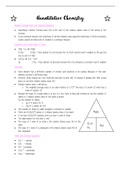
• There are 6.02x10²³ atoms in 1 relative atomic mass of an atom. Mass
• If we have 6.02x10²³ particles, then we have 1 mole of them.
• The abbreviation for the mole is ‘mol’.
• The mass of 1 mole of an atom is the relative atomic mass (Aᵣ) of the
atom.
Aᵣ or
Mol
• The mass of 1 mole of a compound is the relative atomic mass (Mᵣ) of Mᵣ
the compound.
Moles and Chemical Equations:
• SO₄ ²⁻ = sulfate
• NO₃ ⁻ = nitrate
• OH⁻ = hydroxide
• CO₃ ²⁻ = carbonate
• NH₄ ⁺ = ammonium
Relative Formula Mass and Chemical Reactions:
• Something’s relative formula mass (Mᵣ) is the sum of the relative atomic mass of the atoms in the
formula.
• In any chemical reaction, the total mass of all the products must equal the total mass of all the reactants.
Atoms cannot be destroyed or created in a chemical reaction.
Equations and Conservation of Mass:
• 2Mg + 0₂ à 2MgO
0.23g 0.33g – Mass appears to rise because the O₂ that reacted wasn’t weighed as the gas but
was as part of MgO.
• CuCO₃ à CO₂ + Cu0
1g 0.7g – Mass appears to decrease because the CO₂ released as a product wasn’t weighed.
The Mole:
• Each element has a different number of protons and neutrons in its nucleus. Because of this each
element will have a different mass.
• However, these masses are very small and awkward to deal with. So instead of dealing with their actual
mass we use their relative atomic mass. (Aᵣ).
• Relative atomic mass is defined as:
o The weighted average mass of an atom relative to 1/12th the mass of carbon-12 which has a
mass of exactly 12.
• Because the mass of a single atom is so tiny it is very hard to deal with. Instead we use the number of
atoms in 1 relative atomic mass of the atom in grams.
E.g. the number of atoms:
o 1g of H atoms (Aᵣ=1)
o 12g of C atoms (Aᵣ=12)
• This number of atoms is called Avogadro’s constant or number.
• There are 6.02x10²³ atoms in 1 relative atomic mass of an atom. Mass
• If we have 6.02x10²³ particles, then we have 1 mole of them.
• The abbreviation for the mole is ‘mol’.
• The mass of 1 mole of an atom is the relative atomic mass (Aᵣ) of the
atom.
Aᵣ or
Mol
• The mass of 1 mole of a compound is the relative atomic mass (Mᵣ) of Mᵣ
the compound.
Moles and Chemical Equations:
• SO₄ ²⁻ = sulfate
• NO₃ ⁻ = nitrate
• OH⁻ = hydroxide
• CO₃ ²⁻ = carbonate
• NH₄ ⁺ = ammonium