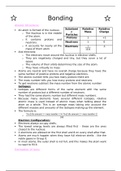
Bonding
Atomic Structure:
An atom is formed of the nucleus: Subatomi Relative Relative
c Mass Charge
o The Nucleus is in the middle
Particles
of the atom.
Protons 1 +1
o It contains protons and
neutrons. Neutrons 1 0
o It accounts for nearly all the Electrons 1 -1
mass of them atom 1836
And electrons:
o The electrons move around the nucleus in electron shells.
o They are negatively charged and tiny, but they cover a lot of
space.
o The volume of their orbits determines the size of the atom.
o They have virtually no mass
Atoms are neutral and have no overall charge because they have the
same number of positive protons and negative electrons.
The atomic number tells you how many protons there are.
The mass number tells you how many protons and neutrons.
To get neutrons subtract the mass number from the atomic number
Isotopes:
Isotopes are different forms of the same element with the same
number of protons but a different number of neutrons.
They had the same atomic number but different mass numbers.
Because many elements have several different isotopes, relative
atomic mass is used instead of atomic mass when talking about the
atom as a whole. This is an average mass taking into account the
different masses and amounts of the isotopes making up the element.
The formula is:
( % of the amount 1× mass number 1 ) +(% of the amount 2× mass number 2)
o
100
Electron Configuration:
Electrons always occupy shells.
The lowest energy levels are always filled first – these are the ones
closest to the nucleus.
2 electrons are allowed on the first shell and 8 on every shell after that.
Atoms are much happier when they have full electron shells – like the
noble gases in Group 0.
In most atoms, the outer shell is not full, and this makes the atom want
to react to fill it.
Formation of Ions:
, Ions are charged particles – they can be single atoms or groups of
atoms.
When atoms lose or gain electrons to form ions, they’re trying to get a
full outer shell. Atoms with full outer shells are very stable.
When metals form ions, they lose electrons in their outer shell to form
positive ions.
When non-metals form ions, they gain electrons into their outer shell to
form negative ions.
The number of electrons lost or gained is the same as the charge on
the ion. E.g. If 2 electrons are lost the charge is 2+. If 3 electrons are
gained the charge is 3-.
Ionic Bonding:
When a metal and a non-metal react together, the metal atom loses
electrons to form a positively charged ions and the non-metal gains
these electrons to form a negatively charged ion. These oppositely
charged ions are strongly attracted to one another by electrostatic
forces. This attraction is called an ionic bond.
Ionic bonds are strong, they take a lot of energy to break.
Ionic compounds therefore have high melting and boiling points.
Ionic compounds conduct electricity when molten of aqueous
(dissolved in water). This is because the ions are free to move.
Dot and Cross Diagrams:
+ -
N Cl C
a N
a l
Ionic compounds have a structure called a giant ionic lattice.
Each positive ion is surrounded by 6 negative ions and each negative
ion is surrounded by 6 positive ions.
The ions form a closely packed regular lattice arrangement and there
are very strong electrostatic forces of attraction in all directions in the
lattice.
Covalent Bonding:
When non-metal atoms bond together, they share pairs of electrons to
make covalent bonds.
The positively charged nuclei of the bonded atoms are attracted to the
shared pair of electrons by electrostatic forces, making
covalent bonds very strong.
Atoms can only share electrons in their outer shells
(highest energy levels). H O H
Atomic Structure:
An atom is formed of the nucleus: Subatomi Relative Relative
c Mass Charge
o The Nucleus is in the middle
Particles
of the atom.
Protons 1 +1
o It contains protons and
neutrons. Neutrons 1 0
o It accounts for nearly all the Electrons 1 -1
mass of them atom 1836
And electrons:
o The electrons move around the nucleus in electron shells.
o They are negatively charged and tiny, but they cover a lot of
space.
o The volume of their orbits determines the size of the atom.
o They have virtually no mass
Atoms are neutral and have no overall charge because they have the
same number of positive protons and negative electrons.
The atomic number tells you how many protons there are.
The mass number tells you how many protons and neutrons.
To get neutrons subtract the mass number from the atomic number
Isotopes:
Isotopes are different forms of the same element with the same
number of protons but a different number of neutrons.
They had the same atomic number but different mass numbers.
Because many elements have several different isotopes, relative
atomic mass is used instead of atomic mass when talking about the
atom as a whole. This is an average mass taking into account the
different masses and amounts of the isotopes making up the element.
The formula is:
( % of the amount 1× mass number 1 ) +(% of the amount 2× mass number 2)
o
100
Electron Configuration:
Electrons always occupy shells.
The lowest energy levels are always filled first – these are the ones
closest to the nucleus.
2 electrons are allowed on the first shell and 8 on every shell after that.
Atoms are much happier when they have full electron shells – like the
noble gases in Group 0.
In most atoms, the outer shell is not full, and this makes the atom want
to react to fill it.
Formation of Ions:
, Ions are charged particles – they can be single atoms or groups of
atoms.
When atoms lose or gain electrons to form ions, they’re trying to get a
full outer shell. Atoms with full outer shells are very stable.
When metals form ions, they lose electrons in their outer shell to form
positive ions.
When non-metals form ions, they gain electrons into their outer shell to
form negative ions.
The number of electrons lost or gained is the same as the charge on
the ion. E.g. If 2 electrons are lost the charge is 2+. If 3 electrons are
gained the charge is 3-.
Ionic Bonding:
When a metal and a non-metal react together, the metal atom loses
electrons to form a positively charged ions and the non-metal gains
these electrons to form a negatively charged ion. These oppositely
charged ions are strongly attracted to one another by electrostatic
forces. This attraction is called an ionic bond.
Ionic bonds are strong, they take a lot of energy to break.
Ionic compounds therefore have high melting and boiling points.
Ionic compounds conduct electricity when molten of aqueous
(dissolved in water). This is because the ions are free to move.
Dot and Cross Diagrams:
+ -
N Cl C
a N
a l
Ionic compounds have a structure called a giant ionic lattice.
Each positive ion is surrounded by 6 negative ions and each negative
ion is surrounded by 6 positive ions.
The ions form a closely packed regular lattice arrangement and there
are very strong electrostatic forces of attraction in all directions in the
lattice.
Covalent Bonding:
When non-metal atoms bond together, they share pairs of electrons to
make covalent bonds.
The positively charged nuclei of the bonded atoms are attracted to the
shared pair of electrons by electrostatic forces, making
covalent bonds very strong.
Atoms can only share electrons in their outer shells
(highest energy levels). H O H