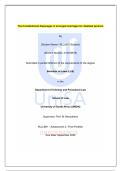
The Constitutional disparages in arranged marriages for disabled persons
By
[Student Name / RLLLB81 Student]
(Student Number: 012345678)
Submitted in partial fulfilment of the requirements for the degree
Bachelor of Laws (LLB)
in the
Department of Criminal and Procedural Law
School of Law
University of South Africa (UNISA)
Supervisor: Prof. M. Monyakane
RLLLB81 – Assessment 2 / Final Portfolio
Due Date: September 2025
, Abstract
Arranged marriages, while culturally significant in many societies, present unique
constitutional and legal challenges when involving persons with disabilities. This
study explores the constitutional disparities that arise in the context of arranged
marriages for disabled individuals in South Africa, focusing on issues of equality,
dignity, autonomy, and legal capacity. It examines how traditional practices intersect
with constitutional protections, highlighting potential conflicts between cultural
norms and human rights obligations.
The research identifies that persons with disabilities are often vulnerable to coercion,
limited autonomy, and unequal treatment in marital arrangements, raising questions
about the adequacy of existing legal frameworks. Through a doctrinal and
comparative approach, the study analyses statutory provisions, constitutional
mandates, and judicial interpretations to evaluate the effectiveness of legal
protections. International perspectives provide a broader understanding of how other
jurisdictions address the tension between cultural practices and the rights of disabled
persons.
The findings underscore the need for judicial vigilance, legislative clarity, and
policy interventions to ensure that arranged marriages respect the autonomy,
consent, and dignity of disabled persons. By critically evaluating existing disparities,
this study contributes to the discourse on disability rights, marriage law, and
constitutional equality, offering recommendations to harmonise cultural practices with
legal safeguards.
Keywords
• Arranged Marriages
• Disability Rights
• Constitutional Law
• Autonomy and Consent
• Equality and Non-Discrimination
By
[Student Name / RLLLB81 Student]
(Student Number: 012345678)
Submitted in partial fulfilment of the requirements for the degree
Bachelor of Laws (LLB)
in the
Department of Criminal and Procedural Law
School of Law
University of South Africa (UNISA)
Supervisor: Prof. M. Monyakane
RLLLB81 – Assessment 2 / Final Portfolio
Due Date: September 2025
, Abstract
Arranged marriages, while culturally significant in many societies, present unique
constitutional and legal challenges when involving persons with disabilities. This
study explores the constitutional disparities that arise in the context of arranged
marriages for disabled individuals in South Africa, focusing on issues of equality,
dignity, autonomy, and legal capacity. It examines how traditional practices intersect
with constitutional protections, highlighting potential conflicts between cultural
norms and human rights obligations.
The research identifies that persons with disabilities are often vulnerable to coercion,
limited autonomy, and unequal treatment in marital arrangements, raising questions
about the adequacy of existing legal frameworks. Through a doctrinal and
comparative approach, the study analyses statutory provisions, constitutional
mandates, and judicial interpretations to evaluate the effectiveness of legal
protections. International perspectives provide a broader understanding of how other
jurisdictions address the tension between cultural practices and the rights of disabled
persons.
The findings underscore the need for judicial vigilance, legislative clarity, and
policy interventions to ensure that arranged marriages respect the autonomy,
consent, and dignity of disabled persons. By critically evaluating existing disparities,
this study contributes to the discourse on disability rights, marriage law, and
constitutional equality, offering recommendations to harmonise cultural practices with
legal safeguards.
Keywords
• Arranged Marriages
• Disability Rights
• Constitutional Law
• Autonomy and Consent
• Equality and Non-Discrimination