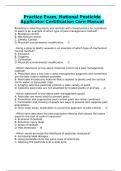
Pesticide Applicators Practice Exam |75 Questions
and Answers
Lowering the humidity of stored grains and other food products to reduce damage from
mold is an example of which type of pest management method? - -a.
Physical/environmental modification (correct)
b. Biological.
c. Mechanical.
d. Regulatory pest control.
-Which statement is true about cultural control practices? - -a. Sanitation is not considered
a cultural practice.
b. Cultural controls involve the release of parasites and predators found in foreign
countries.
c. Trapping is an important cultural control practice.
d. Cultural practices alter the environment, the condition of the host, or the behavior of the
pest to prevent or suppress an infestation. (correct)
-Which statement is true about pest management strategies in IPM? - -a. Eradication is
never the goal of an IPM program.
b. The goal is often to maintain pest damage at economically acceptable levels. (correct)
c. Pesticides are not included in an IPM strategy.
d. Non-chemical methods usually provide only short-term control of a pest.
-Using barriers to prevent pests from getting into an area is an example of which type of
pest management method? - -a. Genetic control.
b. Mechanical control. (correct)
c. Biological control
d. Chemical control
-Sealing cracks and crevices and small openings in buildings is an example of which type of
mechanical control method? - -a. Exclusion. (correct)
b. Mulching.
c. Cultivation.
d. Trapping.
, -Which statement is true about biological control methods? - -a. If pesticides are part of a
biological control program to control an exotic pest, it is better to apply them at the
strongest label rate and to choose the more toxic pesticides.
b. Biological control involves the importation of exotic pests to control natural enemies.
c. Using several cultural practices and a wide variety of pesticides works best in biological
control.
d. Modifying the environment to enhance natural enemies is a recommended practice in
biological control. (correct)
-Under the federal Endangered Species Protection Program, what must be on pesticide
products that might adversely affect an endangered species? - -a. A label statement
advising applicators to consult a county bulletin to determine if they must take any special
precautionary measures when using the product. (correct)
b. A label statement prohibiting them from applying pesticides in all areas where
endangered species might be harmed.
c. A label statement advising them to consult a local conservation officer for a permit to
apply the pesticide.
d. A label statement that lists the endangered species that might be harmed by the pesticide
and how to prevent it.
-Which statement about the requirements of the FQPA is true? - -a. The FQPA does not
consider additional safety standards to account for exposure risks to infants and children.
b. The FQPA does not require review of older pesticides with established residue
tolerances on food.
c. For setting new standards, the FQPA considers aggregate exposures to pesticides but not
cumulative exposures.
d. Testing of pesticides for endocrine disruption potential is required under the FQPA.
(correct)
-Which federal law requires that all pesticides meet new safety standards? - -a. Food
Quality Protection Act (FQPA). (correct)
b. Federal Insecticide, Fungicide, and Rodenticide Act (FIFRA).
c. Worker Protection Standard (WPS).
d. Federal Food, Drug, and Cosmetic Act (FFDCA).
-Both civil and criminal penalties can be assessed for FIFRA violations. - -a. True (correct)
b. False
and Answers
Lowering the humidity of stored grains and other food products to reduce damage from
mold is an example of which type of pest management method? - -a.
Physical/environmental modification (correct)
b. Biological.
c. Mechanical.
d. Regulatory pest control.
-Which statement is true about cultural control practices? - -a. Sanitation is not considered
a cultural practice.
b. Cultural controls involve the release of parasites and predators found in foreign
countries.
c. Trapping is an important cultural control practice.
d. Cultural practices alter the environment, the condition of the host, or the behavior of the
pest to prevent or suppress an infestation. (correct)
-Which statement is true about pest management strategies in IPM? - -a. Eradication is
never the goal of an IPM program.
b. The goal is often to maintain pest damage at economically acceptable levels. (correct)
c. Pesticides are not included in an IPM strategy.
d. Non-chemical methods usually provide only short-term control of a pest.
-Using barriers to prevent pests from getting into an area is an example of which type of
pest management method? - -a. Genetic control.
b. Mechanical control. (correct)
c. Biological control
d. Chemical control
-Sealing cracks and crevices and small openings in buildings is an example of which type of
mechanical control method? - -a. Exclusion. (correct)
b. Mulching.
c. Cultivation.
d. Trapping.
, -Which statement is true about biological control methods? - -a. If pesticides are part of a
biological control program to control an exotic pest, it is better to apply them at the
strongest label rate and to choose the more toxic pesticides.
b. Biological control involves the importation of exotic pests to control natural enemies.
c. Using several cultural practices and a wide variety of pesticides works best in biological
control.
d. Modifying the environment to enhance natural enemies is a recommended practice in
biological control. (correct)
-Under the federal Endangered Species Protection Program, what must be on pesticide
products that might adversely affect an endangered species? - -a. A label statement
advising applicators to consult a county bulletin to determine if they must take any special
precautionary measures when using the product. (correct)
b. A label statement prohibiting them from applying pesticides in all areas where
endangered species might be harmed.
c. A label statement advising them to consult a local conservation officer for a permit to
apply the pesticide.
d. A label statement that lists the endangered species that might be harmed by the pesticide
and how to prevent it.
-Which statement about the requirements of the FQPA is true? - -a. The FQPA does not
consider additional safety standards to account for exposure risks to infants and children.
b. The FQPA does not require review of older pesticides with established residue
tolerances on food.
c. For setting new standards, the FQPA considers aggregate exposures to pesticides but not
cumulative exposures.
d. Testing of pesticides for endocrine disruption potential is required under the FQPA.
(correct)
-Which federal law requires that all pesticides meet new safety standards? - -a. Food
Quality Protection Act (FQPA). (correct)
b. Federal Insecticide, Fungicide, and Rodenticide Act (FIFRA).
c. Worker Protection Standard (WPS).
d. Federal Food, Drug, and Cosmetic Act (FFDCA).
-Both civil and criminal penalties can be assessed for FIFRA violations. - -a. True (correct)
b. False