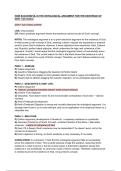
HOW SUCCESSFUL IS THE ONTOLOGICAL ARGUMENT FOR THE EXISTENCE OF
GOD ? (25 marks)
(pink = out of spec content)
LOA: Unsuccessful
CR: Kant’s predicate argument shows that existence cannot be part of God’s concept.
INTRO: The ontological argument is an a priori deductive argument for the existence of God.
It relies purely on the concept of God, meaning it doesn’t require any experience or external
proof to prove God’s existence. However, it faces objections from empiricists, Kant, Caterus
and Guanilo’s perfect island objection, which undermine the logic and coherence of the
argument. Overall, I would argue that the ontological argument does not successfully prove
the existence of God. The crucial reason for this is that Kant shows that existence is not a
predicate, so cannot be a part of God's concept. Therefore, we can’t deduce existence only
from God’s concept.
PARA 1 - ANSELM:
P) Outline Argument
A) Guanilo’s Objections: Begging the Question & Perfect Island
C) Anselm: Onto only applies to God (greatest island concept is vague and subjective)
E) Anselm fails to address begging the question objection, so his ontological argument fails
PARA 2 - DESCARTES & KANT (CR):
P) Outline Argument
A) Caterus: conceptual necessity doesn’t entail actual existence
A) Hume's’ Fork Objection
C) Descartes: ‘God doesn’t exist’ IS and inconceivable contradiction (‘God exist’ = rational
intuition)
A) Kant’s Predicate Development
E) Kant’s Predicate Objection is strong and crucially disproves the ontological argument. It is
stronger than Hume’s, as is more relevant, and not an application of an empiricist theory to a
rationalist one.
PARA 3 - MALCOLM:
P) Outline Argument (development of Anselm’s) + necessary existence is a predicate
A) Assumes Coherence of God’s Concept, consider Paradox of the Stone > Mavrodes
response + Leibniz on coherence of God
C) Kant: P5 is flawed (God’s existence may be impossible IF he doesn’t exist, not bc the
concept is incoherent)
E) Kant’s objection is strong, so God’s existence is only necessary IF he exists
CONCLUSION: In conclusion, I think that the ontological argument fails to successfully
prove the existence of God. This is partly because it begs the question, assuming God’s
existence in order to prove it, but the crucial reason is that Kant’s objection shows that
existence is not a predicate, so cannot be a part of God’s concept. Therefore, external proof
is needed to prove the existence of God, not just God’s concept.
GOD ? (25 marks)
(pink = out of spec content)
LOA: Unsuccessful
CR: Kant’s predicate argument shows that existence cannot be part of God’s concept.
INTRO: The ontological argument is an a priori deductive argument for the existence of God.
It relies purely on the concept of God, meaning it doesn’t require any experience or external
proof to prove God’s existence. However, it faces objections from empiricists, Kant, Caterus
and Guanilo’s perfect island objection, which undermine the logic and coherence of the
argument. Overall, I would argue that the ontological argument does not successfully prove
the existence of God. The crucial reason for this is that Kant shows that existence is not a
predicate, so cannot be a part of God's concept. Therefore, we can’t deduce existence only
from God’s concept.
PARA 1 - ANSELM:
P) Outline Argument
A) Guanilo’s Objections: Begging the Question & Perfect Island
C) Anselm: Onto only applies to God (greatest island concept is vague and subjective)
E) Anselm fails to address begging the question objection, so his ontological argument fails
PARA 2 - DESCARTES & KANT (CR):
P) Outline Argument
A) Caterus: conceptual necessity doesn’t entail actual existence
A) Hume's’ Fork Objection
C) Descartes: ‘God doesn’t exist’ IS and inconceivable contradiction (‘God exist’ = rational
intuition)
A) Kant’s Predicate Development
E) Kant’s Predicate Objection is strong and crucially disproves the ontological argument. It is
stronger than Hume’s, as is more relevant, and not an application of an empiricist theory to a
rationalist one.
PARA 3 - MALCOLM:
P) Outline Argument (development of Anselm’s) + necessary existence is a predicate
A) Assumes Coherence of God’s Concept, consider Paradox of the Stone > Mavrodes
response + Leibniz on coherence of God
C) Kant: P5 is flawed (God’s existence may be impossible IF he doesn’t exist, not bc the
concept is incoherent)
E) Kant’s objection is strong, so God’s existence is only necessary IF he exists
CONCLUSION: In conclusion, I think that the ontological argument fails to successfully
prove the existence of God. This is partly because it begs the question, assuming God’s
existence in order to prove it, but the crucial reason is that Kant’s objection shows that
existence is not a predicate, so cannot be a part of God’s concept. Therefore, external proof
is needed to prove the existence of God, not just God’s concept.