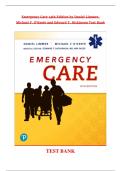
Emergency Care 14th Edition by Daniel Limmer,
Michael F. O'Keefe and Edward T. Dickinson Test Bank
TEST BANK
,Emergency Care 14th Edition – Daniel Limmer, Michael
F. O’Keefe & Edward T. Dickinson | Test Bank with
Verified Answers (2025/2026)
,INTRODUCTION:
This document contains the complete test bank for Emergency Care,
14th Edition by Daniel Limmer, Michael F. O’Keefe, and Edward T.
Dickinson. It includes multiple-choice questions with verified
correct answers and detailed explanations, covering essential EMS
topics such as patient assessment, airway management, medical
and trauma emergencies, EMS systems, safety, stress management,
and quality improvement. Designed to support exam preparation,
this resource is aligned with the latest curriculum and professional
standards for 2025/2026.
SUMMARY Q & A s:
1: What is the primary goal of the initial assessment in emergency
care? --- correct answer ---
The primary goal of the initial assessment is to identify and manage
life-threatening conditions.
2: What does the acronym SAMPLE stand for in patient assessment?
--- correct answer --- SAMPLE stands for Signs/Symptoms,
Allergies, Medications, Past medical history, Last oral intake, and
Events leading to the present illness or injury.
3: In the context of airway management, what is the purpose of the
head-tilt, chin-lift maneuver? --- correct answer ---
The head-tilt, chin-lift maneuver is used to open the airway in a
patient who does not have a suspected spinal injury.
, 4: What is the most common cause of airway obstruction in
unconscious patients? --- correct answer ---
The most common cause of airway obstruction in unconscious
patients is the tongue.
5: How often should vital signs be reassessed in a stable patient? ---
correct answer ---
In a stable patient, vital signs should be reassessed every 15
minutes.
6: What is the recommended compression-to-ventilation ratio for
adult CPR? --- correct answer --- The recommended compression-
to-ventilation ratio for adult CPR is 30:2.
7: What is the first step in the management of a patient
experiencing anaphylaxis? --- correct answer ---
The first step in managing a patient experiencing anaphylaxis is to
administer epinephrine.
8: What is the Glasgow Coma Scale used for? --- correct answer ---
The Glasgow Coma Scale is used to assess a patient? --- correct
answer ---s level of consciousness.
9: Which type of shock is characterized by widespread vasodilation
and decreased blood pressure? --- correct answer ---
Distributive shock is characterized by widespread vasodilation and
Michael F. O'Keefe and Edward T. Dickinson Test Bank
TEST BANK
,Emergency Care 14th Edition – Daniel Limmer, Michael
F. O’Keefe & Edward T. Dickinson | Test Bank with
Verified Answers (2025/2026)
,INTRODUCTION:
This document contains the complete test bank for Emergency Care,
14th Edition by Daniel Limmer, Michael F. O’Keefe, and Edward T.
Dickinson. It includes multiple-choice questions with verified
correct answers and detailed explanations, covering essential EMS
topics such as patient assessment, airway management, medical
and trauma emergencies, EMS systems, safety, stress management,
and quality improvement. Designed to support exam preparation,
this resource is aligned with the latest curriculum and professional
standards for 2025/2026.
SUMMARY Q & A s:
1: What is the primary goal of the initial assessment in emergency
care? --- correct answer ---
The primary goal of the initial assessment is to identify and manage
life-threatening conditions.
2: What does the acronym SAMPLE stand for in patient assessment?
--- correct answer --- SAMPLE stands for Signs/Symptoms,
Allergies, Medications, Past medical history, Last oral intake, and
Events leading to the present illness or injury.
3: In the context of airway management, what is the purpose of the
head-tilt, chin-lift maneuver? --- correct answer ---
The head-tilt, chin-lift maneuver is used to open the airway in a
patient who does not have a suspected spinal injury.
, 4: What is the most common cause of airway obstruction in
unconscious patients? --- correct answer ---
The most common cause of airway obstruction in unconscious
patients is the tongue.
5: How often should vital signs be reassessed in a stable patient? ---
correct answer ---
In a stable patient, vital signs should be reassessed every 15
minutes.
6: What is the recommended compression-to-ventilation ratio for
adult CPR? --- correct answer --- The recommended compression-
to-ventilation ratio for adult CPR is 30:2.
7: What is the first step in the management of a patient
experiencing anaphylaxis? --- correct answer ---
The first step in managing a patient experiencing anaphylaxis is to
administer epinephrine.
8: What is the Glasgow Coma Scale used for? --- correct answer ---
The Glasgow Coma Scale is used to assess a patient? --- correct
answer ---s level of consciousness.
9: Which type of shock is characterized by widespread vasodilation
and decreased blood pressure? --- correct answer ---
Distributive shock is characterized by widespread vasodilation and