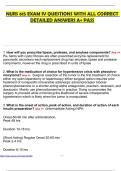
NURS 615 EXAM IV QUESTIONS WITH ALL CORRECT
DETAILED ANSWERS A+ PASS
1. How will you prescribe lipase, protease, and amylase components? Ans >>
Pa- tients with cystic fibrosis are often prescribed enzyme replacement for
pancreatic secretions each replacement drug has amylase, lipase and protease
components, however the drug is prescribed in units of lipase
2. What is the medication of choice for hypertensive crisis with pheochro-
mocytoma? Ans >> Surgical resection of the tumor is the first treatment of choice
either my open laparotomy or laparoscopy either surgical option requires prior
treatment of nonspecific irreversible adrenergic adraonoreceptor blocker
phenoxybenzamine or a shorter acting alpha antagonists, prazosin, terazosin, and
doxazosin. Mainly use phenozibenamine in practice. Doing so promotes the
surgery to proceed while minimizing the likelihood of severe intraoperative
hypertension which is likely when the tumor is manipulated.
3. What is the onset of action, peak of action, and duration of action of each
insulin preparation? Ans >> (Intermediate Acting) NPH
Onset-60-90 min after administration,
Peak 48 hrs
Duration 10-18 hrs.
(Short Acting) Regular Onset 30-60 min
Peak 2-4 hrs
Duration 6-10 hrs
https://www.stuvia.com/user/mboffin
, (Long Acting) Aspart, Lispro, Glulisine
Onset less than 15 min
Peak 1-2 hrs
Duration 3-6 hrs
(Long Acting) Glargine, Detemir
Onset 1-2 hrs
Peak NO PEAK
Duration 24 hrs
4. Identify the symptoms of hypoglycemia, hyperglycemia, and ketoacidosis.-
Ans >>Hypoglycemia- dizziness, confusion, diaphoresis, tachycardia
Hyperglycemia- polyphagia, polydipsia, polyuria, blurred vision, and fatigue
Ketoacidosis- hallmark symptoms include acetone breath like nail polish remover or
fruity breath. Also abdominal pain, nausea, vomiting and sob.
5. When changing from NPH to glargine insulin, how will you adjust the
patient's dose? Ans >> The initial dose of glargine is reduced by 20% to prevent
hypo- glycemia.
https://www.stuvia.com/user/mboffin
, 6. How does metformin work? Ans >> Decreases hyperglycemia by decreasing
hepatic glucose production called hepatic gluconeogenesis. The average person
with type 2 diabetes has three times the rate of gluconeogenesis, metformin
treatment reduces this by over 1/3rd. The molecular mechanism of metformin isn't
completely under- stood. In addition to suppressing hepatic glucose production,
metformin increases insulin sensitivity, enhances peripheral glucose uptake by
inducing the phosphoril- ization of glu4 enhancer factor, decreases insulin induced
suppression of fatty acid oxidation, and decreases absorption of glucose from the
GI tract. Also of note** Metformin helps reduce LDL cholesterol and triglyceride
levels and is not associated with weight gain, in some people it helps promote
weight loss**
7. What diagnostic testing is required before and throughout therapy with
metformin? Ans >> Metformin is not metabolized, it is cleared from the body by
tubular secretion and is secreted unchanged in the urine. Metformin is undetectable
in blood plasma within 24 hrs of a single oral dose the average elimination half-life in
plasma is 6.2 hrs as it is secreted in the urine you should check a serum crt to
assess renal function.
8. What is the action of gliptin? Ans >> The mechanism of DDP-4 inhibitors is to
increase incretin levels incretin are GLP1 and GIP which inhibit glucagon release
in which in turn increases insulin secretion, decreases gastric emptying, and
decreases blood glucose levels
9. How do GLP agonists work? Ans >> They bind directly to a receptor in the
pancreatic beta cell. These agents work in the same pathway as the DPP-4
inhibitors as mentioned above but are generally considered more potent.
10. When should exenatide be administered? Ans >> 60 minutes prior to the
morning and evening meal
11. How will you assess for granulocytopenia? Ans >> Signs of a Cold or flu
including fever and sore throat
https://www.stuvia.com/user/mboffin
DETAILED ANSWERS A+ PASS
1. How will you prescribe lipase, protease, and amylase components? Ans >>
Pa- tients with cystic fibrosis are often prescribed enzyme replacement for
pancreatic secretions each replacement drug has amylase, lipase and protease
components, however the drug is prescribed in units of lipase
2. What is the medication of choice for hypertensive crisis with pheochro-
mocytoma? Ans >> Surgical resection of the tumor is the first treatment of choice
either my open laparotomy or laparoscopy either surgical option requires prior
treatment of nonspecific irreversible adrenergic adraonoreceptor blocker
phenoxybenzamine or a shorter acting alpha antagonists, prazosin, terazosin, and
doxazosin. Mainly use phenozibenamine in practice. Doing so promotes the
surgery to proceed while minimizing the likelihood of severe intraoperative
hypertension which is likely when the tumor is manipulated.
3. What is the onset of action, peak of action, and duration of action of each
insulin preparation? Ans >> (Intermediate Acting) NPH
Onset-60-90 min after administration,
Peak 48 hrs
Duration 10-18 hrs.
(Short Acting) Regular Onset 30-60 min
Peak 2-4 hrs
Duration 6-10 hrs
https://www.stuvia.com/user/mboffin
, (Long Acting) Aspart, Lispro, Glulisine
Onset less than 15 min
Peak 1-2 hrs
Duration 3-6 hrs
(Long Acting) Glargine, Detemir
Onset 1-2 hrs
Peak NO PEAK
Duration 24 hrs
4. Identify the symptoms of hypoglycemia, hyperglycemia, and ketoacidosis.-
Ans >>Hypoglycemia- dizziness, confusion, diaphoresis, tachycardia
Hyperglycemia- polyphagia, polydipsia, polyuria, blurred vision, and fatigue
Ketoacidosis- hallmark symptoms include acetone breath like nail polish remover or
fruity breath. Also abdominal pain, nausea, vomiting and sob.
5. When changing from NPH to glargine insulin, how will you adjust the
patient's dose? Ans >> The initial dose of glargine is reduced by 20% to prevent
hypo- glycemia.
https://www.stuvia.com/user/mboffin
, 6. How does metformin work? Ans >> Decreases hyperglycemia by decreasing
hepatic glucose production called hepatic gluconeogenesis. The average person
with type 2 diabetes has three times the rate of gluconeogenesis, metformin
treatment reduces this by over 1/3rd. The molecular mechanism of metformin isn't
completely under- stood. In addition to suppressing hepatic glucose production,
metformin increases insulin sensitivity, enhances peripheral glucose uptake by
inducing the phosphoril- ization of glu4 enhancer factor, decreases insulin induced
suppression of fatty acid oxidation, and decreases absorption of glucose from the
GI tract. Also of note** Metformin helps reduce LDL cholesterol and triglyceride
levels and is not associated with weight gain, in some people it helps promote
weight loss**
7. What diagnostic testing is required before and throughout therapy with
metformin? Ans >> Metformin is not metabolized, it is cleared from the body by
tubular secretion and is secreted unchanged in the urine. Metformin is undetectable
in blood plasma within 24 hrs of a single oral dose the average elimination half-life in
plasma is 6.2 hrs as it is secreted in the urine you should check a serum crt to
assess renal function.
8. What is the action of gliptin? Ans >> The mechanism of DDP-4 inhibitors is to
increase incretin levels incretin are GLP1 and GIP which inhibit glucagon release
in which in turn increases insulin secretion, decreases gastric emptying, and
decreases blood glucose levels
9. How do GLP agonists work? Ans >> They bind directly to a receptor in the
pancreatic beta cell. These agents work in the same pathway as the DPP-4
inhibitors as mentioned above but are generally considered more potent.
10. When should exenatide be administered? Ans >> 60 minutes prior to the
morning and evening meal
11. How will you assess for granulocytopenia? Ans >> Signs of a Cold or flu
including fever and sore throat
https://www.stuvia.com/user/mboffin