

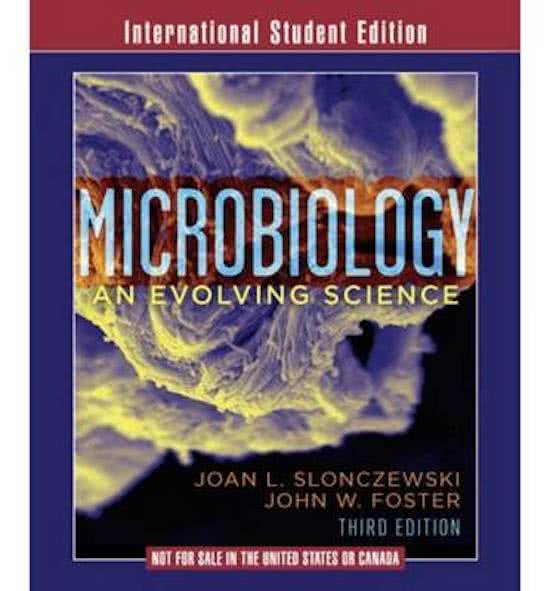
Test bank microbiology an evolving science 3rd edition
by joan L. slonczewski and john Foster All Chapters 1-28
Covered
,TABLE OF CONTENT q q
1. Microbial Life: Origin & Discovery
q q q q q q
2. Observing the Microbial Cell
q q q q q
3. Cell Structure and Function
q q q q q
4. Bacterial Culture, Growth, and Development
q q q q q q
5. Environmental Influences and Control of Microbial Growth
q q q q q q q
6. Viruses
q q
7. Genomes and Chromosomes
q q q
8. Transcription, Translation, and Protein Processing
q q q q
9. Genetic Change and Genome Evolution
q q q q q
10. Molecular Regulation
q q q
11. Viral Molecular Biology
q q q q
12. Molecular Complexity and Synthetic Biology
q q q q q q
13. Energetics and Catabolism
q q q
14. Electron Flow in Organotrophy, Lithotrophy, and Phototrophy
q q q q q q q q
15. Biosynthesis
q
16. Food and Industrial Microbiology
q q q q q
17. Origins and Evolution
q q q
18. Bacterial Diversity
q q
19. Archaeal Diversity
q q q
20. Eukaryotic Diversity
q q q
21. Microbial Ecology
q q
22. Element Cycles and Environmental Microbiology
q q q q q
23. The Human Microbiome and Innate Immunity
q q q q q q
24. The Adaptive Immune Response
q q q q
25. Pathogenesis
q
26. Microbial Disease
q q
27. Antimicrobial Therapy and Discovery
q q q q q
28. Clinical Microbiology and Epidemiology
q q q q
,Microbiology An Evolving Science, 3rd Edition, John Foster & Joan Slonczewski Chapter
q q q q q q q q q q q q
1-28
CHAPTER 1: Microbial Life: Origin and Discovery
q q q q q q
MULTIPLE CHOICE
q
1. Viruses are: q
a. infectious agents that infect multi-cellular organisms q q q q q
b. noncellular particles that take over the metabolism of a cell to generate more
q q q q q q q q q q q q
virus particles
q q
c. pathogens that replicate in complex growth media q q q q q q
d. cellular particles that belong to the archaea domain
q q q q q q q
e. microbes that consist of lipid membrane enclosed genomes
q q q q q q q
Answer: B DIF: q Easy REF: q q 1.1 TOP: q I.A | I.Bq q
MSC: Remembering
q
2. Analysis of DNA sequences reveals:
q q q q
a. the ancient convergence of two cell types, i.e., prokaryotes and
q q q q q q q q q
eukaryotes
q
b. prokaryotes and eukaryotes evolved from a common ancestral cell q q q q q q q q
c. that bacteria share common ancestor with archaea, but not with eukarya
q q q q q q q q q q
d. prokaryotes are cells with a nucleus q q q q q
e. the genome of Haemophilus influenzae has about 2 billion base pairs
q q q q q q q q q q
Answer: B DIF: q Easy REF: q q 1.1 TOP: q I.A | I.Bq q
MSC: Remembering
q
3. Which of these groups are considered to be microbes but NOT considered to be cells?
q q q q q q q q q q q q q q
a. viruses d. protists
b. bacteria e. filamentous fungi q
c. archaea
Answer: A DIF: q Easy REF: q q 1.1 TOP: q I.A.i
MSC: Remembering
q
4. A microbe is commonly defined as:
q q q q q
a. a virus that requires a microscope to be seen
q q q q q q q q
b. a bacterium that requires a microscope to be seen
q q q q q q q q
c. a single-cellular prokaryote that requires a microscope to be
q q q q q q q q
seen
q
d. a multicellular eukaryote that requires a microscope to be seen
q q q q q q q q q
e. a living organism that requires a microscope to be seen
q q q q q q q q q
Answer: E DIF: q Easy REF: q q 1.1 TOP: q I.A.i | I.A.ii
q q
MSC: Remembering
q
5. Which one of the following statements regarding microbial cells is NOT true?
q q q q q q q q q q q
a. Microbial cells acquire food, gain energy to build themselves, and respond
q q q q q q q q q q
to q
, environmental change. q
b. Most single-celled organisms require a microscope to render them visible, but
q q q q q q q q q q
some
q
bacterial cells are large enough to be seen with naked eyes.
q q q q q q q q q q
c. Microbes function as individual entities.
q q q q
d. Many microbes form complex multicellular assemblages.
q q q q q
e. Viruses are not considered as microbial cells.
q q q q q q
Answer: C DIF: q Easy REF: q q 1.1 TOP: q I.A.i | I.A.ii
q q
MSC: Remembering
q
6. Which of the following statements is FALSE?
q q q q q q
a. A genome is the total genetic information contained in an organism’s chromosomal
q q q q q q q q q q q
DNA.
q
b. If a microbe’s genome includes genes for nitrogenase, that microbe probably can fix
q q q q q q q q q q q q
nitrogen.
q
c. By comparing DNA sequences of different organisms, we can figure out how closely
q q q q q q q q q q q q
related they are. q q
d. Fred Sanger developed the first applicable DNA sequencing method.
q q q q q q q q
e. Fred Sanger completed the sequences of Haemophilus influenzae.
q q q q q q q
Answer: E DIF: q Easy REF: q q 1.1 TOP: q I.B
MSC: Remembering
q
7. The first cellular genomes to be sequenced were those of:
q q q q q q q q q
a. humans d. prions
b. bacteria e. fungi
c. viruses
Answer: B DIF: q Easy REF: q q 1.1 TOP: q I.B.i
MSC: Remembering
q
8. The environment of early Earth may have contained all of the following EXCEPT:
q q q q q q q q q q q q
a. ferrous iron q d. oxygen
b. methane e. hydrogen gas q
c. ammonia
Answer: D q DIF: Easy REF: q Special Topic 1.1 q q
TOP: II.D
q q MSC: Remembering q
9. The development of the theory of the ―RNA world‖ resulted from the discovery of:
q q q q q q q q q q q q q
a. archaea d. ribozymes
b. prions e. endosymbionts
c. bacteria
Answer: D q DIF: Medium REF: q Special Topic 1.1 q q
TOP: II.D
q q MSC: Remembering q
10. Which microbes may resemble those of the earliest life forms?
q q q q q q q q q
a. archaea d. cyanobacteria
b. photosynthetic algae e. protists q
c. viruses
Answer: A q DIF: Medium REF: q Special Topic 1.1 q q
TOP: II.D
q q MSC: Remembering q
by joan L. slonczewski and john Foster All Chapters 1-28
Covered
,TABLE OF CONTENT q q
1. Microbial Life: Origin & Discovery
q q q q q q
2. Observing the Microbial Cell
q q q q q
3. Cell Structure and Function
q q q q q
4. Bacterial Culture, Growth, and Development
q q q q q q
5. Environmental Influences and Control of Microbial Growth
q q q q q q q
6. Viruses
q q
7. Genomes and Chromosomes
q q q
8. Transcription, Translation, and Protein Processing
q q q q
9. Genetic Change and Genome Evolution
q q q q q
10. Molecular Regulation
q q q
11. Viral Molecular Biology
q q q q
12. Molecular Complexity and Synthetic Biology
q q q q q q
13. Energetics and Catabolism
q q q
14. Electron Flow in Organotrophy, Lithotrophy, and Phototrophy
q q q q q q q q
15. Biosynthesis
q
16. Food and Industrial Microbiology
q q q q q
17. Origins and Evolution
q q q
18. Bacterial Diversity
q q
19. Archaeal Diversity
q q q
20. Eukaryotic Diversity
q q q
21. Microbial Ecology
q q
22. Element Cycles and Environmental Microbiology
q q q q q
23. The Human Microbiome and Innate Immunity
q q q q q q
24. The Adaptive Immune Response
q q q q
25. Pathogenesis
q
26. Microbial Disease
q q
27. Antimicrobial Therapy and Discovery
q q q q q
28. Clinical Microbiology and Epidemiology
q q q q
,Microbiology An Evolving Science, 3rd Edition, John Foster & Joan Slonczewski Chapter
q q q q q q q q q q q q
1-28
CHAPTER 1: Microbial Life: Origin and Discovery
q q q q q q
MULTIPLE CHOICE
q
1. Viruses are: q
a. infectious agents that infect multi-cellular organisms q q q q q
b. noncellular particles that take over the metabolism of a cell to generate more
q q q q q q q q q q q q
virus particles
q q
c. pathogens that replicate in complex growth media q q q q q q
d. cellular particles that belong to the archaea domain
q q q q q q q
e. microbes that consist of lipid membrane enclosed genomes
q q q q q q q
Answer: B DIF: q Easy REF: q q 1.1 TOP: q I.A | I.Bq q
MSC: Remembering
q
2. Analysis of DNA sequences reveals:
q q q q
a. the ancient convergence of two cell types, i.e., prokaryotes and
q q q q q q q q q
eukaryotes
q
b. prokaryotes and eukaryotes evolved from a common ancestral cell q q q q q q q q
c. that bacteria share common ancestor with archaea, but not with eukarya
q q q q q q q q q q
d. prokaryotes are cells with a nucleus q q q q q
e. the genome of Haemophilus influenzae has about 2 billion base pairs
q q q q q q q q q q
Answer: B DIF: q Easy REF: q q 1.1 TOP: q I.A | I.Bq q
MSC: Remembering
q
3. Which of these groups are considered to be microbes but NOT considered to be cells?
q q q q q q q q q q q q q q
a. viruses d. protists
b. bacteria e. filamentous fungi q
c. archaea
Answer: A DIF: q Easy REF: q q 1.1 TOP: q I.A.i
MSC: Remembering
q
4. A microbe is commonly defined as:
q q q q q
a. a virus that requires a microscope to be seen
q q q q q q q q
b. a bacterium that requires a microscope to be seen
q q q q q q q q
c. a single-cellular prokaryote that requires a microscope to be
q q q q q q q q
seen
q
d. a multicellular eukaryote that requires a microscope to be seen
q q q q q q q q q
e. a living organism that requires a microscope to be seen
q q q q q q q q q
Answer: E DIF: q Easy REF: q q 1.1 TOP: q I.A.i | I.A.ii
q q
MSC: Remembering
q
5. Which one of the following statements regarding microbial cells is NOT true?
q q q q q q q q q q q
a. Microbial cells acquire food, gain energy to build themselves, and respond
q q q q q q q q q q
to q
, environmental change. q
b. Most single-celled organisms require a microscope to render them visible, but
q q q q q q q q q q
some
q
bacterial cells are large enough to be seen with naked eyes.
q q q q q q q q q q
c. Microbes function as individual entities.
q q q q
d. Many microbes form complex multicellular assemblages.
q q q q q
e. Viruses are not considered as microbial cells.
q q q q q q
Answer: C DIF: q Easy REF: q q 1.1 TOP: q I.A.i | I.A.ii
q q
MSC: Remembering
q
6. Which of the following statements is FALSE?
q q q q q q
a. A genome is the total genetic information contained in an organism’s chromosomal
q q q q q q q q q q q
DNA.
q
b. If a microbe’s genome includes genes for nitrogenase, that microbe probably can fix
q q q q q q q q q q q q
nitrogen.
q
c. By comparing DNA sequences of different organisms, we can figure out how closely
q q q q q q q q q q q q
related they are. q q
d. Fred Sanger developed the first applicable DNA sequencing method.
q q q q q q q q
e. Fred Sanger completed the sequences of Haemophilus influenzae.
q q q q q q q
Answer: E DIF: q Easy REF: q q 1.1 TOP: q I.B
MSC: Remembering
q
7. The first cellular genomes to be sequenced were those of:
q q q q q q q q q
a. humans d. prions
b. bacteria e. fungi
c. viruses
Answer: B DIF: q Easy REF: q q 1.1 TOP: q I.B.i
MSC: Remembering
q
8. The environment of early Earth may have contained all of the following EXCEPT:
q q q q q q q q q q q q
a. ferrous iron q d. oxygen
b. methane e. hydrogen gas q
c. ammonia
Answer: D q DIF: Easy REF: q Special Topic 1.1 q q
TOP: II.D
q q MSC: Remembering q
9. The development of the theory of the ―RNA world‖ resulted from the discovery of:
q q q q q q q q q q q q q
a. archaea d. ribozymes
b. prions e. endosymbionts
c. bacteria
Answer: D q DIF: Medium REF: q Special Topic 1.1 q q
TOP: II.D
q q MSC: Remembering q
10. Which microbes may resemble those of the earliest life forms?
q q q q q q q q q
a. archaea d. cyanobacteria
b. photosynthetic algae e. protists q
c. viruses
Answer: A q DIF: Medium REF: q Special Topic 1.1 q q
TOP: II.D
q q MSC: Remembering q

