100% tevredenheidsgarantie Direct beschikbaar na je betaling Lees online óf als PDF Geen vaste maandelijkse kosten 4,6 TrustPilot
logo-home
Tentamen (uitwerkingen)

Basic EKG Patterns Practice Exam With Correct Answers 100% Verified.

Beoordeling
-
Verkocht
-
Pagina's
16
Cijfer
A+
Geüpload op
02-09-2025
Geschreven in
2025/2026

Asystole - Which rhythm is this? Atrial fibrillation - Which rhythm is this? Normal sinus rhythm with multifocal PVCs - Which rhythm is this? Normal sinus rhythm with unifocal PVCs - Which rhythm is this? Sinus Tachycardia rhthym - Which rhythm is this? Supraventricular tachycardia - Which rhythm is this? Asystole - Which rhythm is this? bigeminy - Which rhythm is this? Ventricular Fibrillation - Course - Which rhythm is this? Ventricular Fibrillation - Fine - Which rhythm is this? pacemaker rhythm - Which rhythm is this? Sinus bradycardia - Which rhythm is this? Sinus rhythm - Which rhythm is this? Sinus Tachycardia - Which rhythm is this? Atrial fibrillation - Which rhythm is this? Atrial flutter - Which rhythm is this? Paroxysmal tachycardia - Which rhythm is this? don't need to know - Which rhythm is this? PVC (Premature Ventricular Contraction) - Which rhythm is this? Torsades de pointes - Which rhythm is this? Ventricular fibrillation - Which rhythm is this? Ventricular tachycardia - Which rhythm is this? First-degree AV block - Which rhythm is this? Third-degree AV block - Which rhythm is this? Type I second-degree AV block - 1,2,3 drop - Which rhythm is this? 3:1 Type II second-degree AV block - Which rhythm is this? Sinus bradycardia - Which rhythm is this? Supraventricular tachycardia - Which rhythm is this? Unifocal couplet PVCs - Unifocal PVCs - 1. Right Ventricular Hypertrophy Criteria 2. Cause? - RAD - Right Axis Deviation I- AVL + V1 R wave is larger than the S wave V6 S wave is larger than the R wave 2. Pulmonary disease and congenital heart disease 1. Left Ventricular Hypertrophy Criteria - Left axis deviation beyond 15 degrees I + AVL - R wave in V5 or V6 plus S wave V1 or V2 exceeds 35 mm Only really applies to those > 35 yo as chest wall is otherwise too thin Ways to Calculate Rate 1. Rule of 300 (Good for Regular Rhythms) 2. Count the boxes (Good for Fast Rhythms) 3. Rhythm Strip (Good for Irreg Rhythms ) - 1. 300 / Number of Large Squares (0.2 sec) btw R waves 2. - 6-50 7-42 3. Count # of complex on rhythm strip x 6 (gives an average over 10 sec period) 1.When SA nodes stops - what happens 2. Atrial pacemaker rate 3. Junctional pacemaker rate - MOST COMMON 4. Ventricular pacemaker rate - 1. Escape beats - all myocardial cells have ability to behave as pacemakers 2. 60 -75 bpm 3. located near av node - 40-60 4. 30-45 Junctional Escape - often no p waves rate 40-60 bpm Ventricular Escape Beat - wide bizarre QRS / no P wave / Rate about 33 bpm Usually associated with unconsciousness after accelerated fib. PAC - Premature Atrial Contraction what do they look like cause? PJC - Premature Junction Contraction what do they look like? cause? - PAC - normal sinus beat ( p wave - narrow qrs)thrown in but has diff wave morphology suggesting different pacemaker. Re-entrant loop / Increased automaticity - DIGITALIS TOXICITY PJC - No P wave (or retrograde) with narrow QRS ( suggesting ventricles are depolarizing normally - no slowly /wide qrs as with ventricular origin). PSVT 1. Characteristics 2. How to stop it - 1. Absolutely regular rhythm P Waves often lost in qrs or retrograde Qrs usually narrow 2. Carotid Massage slows conduction through av node. Makes body think BP is rising and interrupt Rentrant loop. - gently apply pressure 10-15 sec - ONE SIDE ONLY Atrial Flutter 1 What happens? 2. Cause ? 3. What causes AV Block? 4. What happens with Carotid Massage - 1. atrial depol happens a such a rapid rate - discrete P waves are not seen. Get FLUTTER WAVES (back to back Ps) between QRS --> Sawtooth pattern. 2. Usually single reentrant loop!! 3 Av node can't handle all the impulses - not all pass through. 2:1 block - 2 Ps pass though to every 1 QRS (only 1 P started ventricular depol) 3:1 Block - 3 P waves pass through for every 1 QRS 4 Increases degrees of block (i.e. 2:1 to 4:1 ) - can see saw tooth pattern easier. Atrial Fibrillation 1. What happens? 2. Cause 3. What's EKG look like with regard to P Waves? 4. Why is it IRREGULARLY IRREGULAR?? 5. Most common cause? - 1. Atrial CHAOS!! - av node can be bombarded with >500 atrial impulses/min. 2. Usually due to MULTIPLE RE_ENTRANT LOOPS 3. No true P waves - often undulating base or waves line, sometimes flat. 4. AV node only lets occasional impulse through resulting in irregular QRS rate. IRREG IRREGULAR. 5. Long standing HTN MAT - Multi Focal Atrial Tachycardia 1. cause (cardiac wise) 2. Rhythm? Rate? 3. P waves? 4. Effect of Carotid Massage. - 1. Random firing of several diff atrial foci 2. Irregular Rhythm, usually 100-220 bpm (or less) 3. P waves present for each qrs (at least 3 diff morphologies -represent diff foci firing) 4. Carotid massage has no effect. Rarely requires treatment. Paroxysmal Atrial Tachycardia (PAT) 1. Cardiac causes? 2. What does EKG look like?? 3. How can your discern from PSVT - 1. Enhanced automaticity of ectopic foci (digitalis Toxicity) OR reentrant circuit 2. REGULAR rhythm with rate of 100-200 bpm - may be hard to see P waves 3. Carotid Massage has no effect, may be warm up or cool down period. PreVentricular Contractions (PVC)s 1. what does it look lik

Meer zien Lees minder
Instelling
EKG.
Vak
EKG.


Oeps! We kunnen je document nu niet laden. Probeer het nog eens of neem contact op met support.

Geschreven voor

Instelling
EKG.
Vak
EKG.

Documentinformatie

Geüpload op
2 september 2025
Aantal pagina's
16
Geschreven in
2025/2026
Type
Tentamen (uitwerkingen)
Bevat
Vragen en antwoorden

Onderwerpen

Voorbeeld van de inhoud

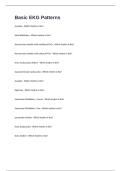
Basic EKG Patterns
Asystole - Which rhythm is this?


Atrial fibrillation - Which rhythm is this?


Normal sinus rhythm with multifocal PVCs - Which rhythm is this?


Normal sinus rhythm with unifocal PVCs - Which rhythm is this?


Sinus Tachycardia rhthym - Which rhythm is this?


Supraventricular tachycardia - Which rhythm is this?


Asystole - Which rhythm is this?


bigeminy - Which rhythm is this?


Ventricular Fibrillation - Course - Which rhythm is this?


Ventricular Fibrillation - Fine - Which rhythm is this?


pacemaker rhythm - Which rhythm is this?


Sinus bradycardia - Which rhythm is this?


Sinus rhythm - Which rhythm is this?

,Sinus Tachycardia - Which rhythm is this?


Atrial fibrillation - Which rhythm is this?


Atrial flutter - Which rhythm is this?


Paroxysmal tachycardia - Which rhythm is this?


don't need to know - Which rhythm is this?


PVC (Premature Ventricular Contraction) - Which rhythm is this?


Torsades de pointes - Which rhythm is this?


Ventricular fibrillation - Which rhythm is this?


Ventricular tachycardia - Which rhythm is this?


First-degree AV block - Which rhythm is this?


Third-degree AV block - Which rhythm is this?


Type I second-degree AV block - 1,2,3 drop - Which rhythm is this?


3:1 Type II second-degree AV block - Which rhythm is this?


Sinus bradycardia - Which rhythm is this?


Supraventricular tachycardia - Which rhythm is this?

, Unifocal couplet PVCs -


Unifocal PVCs -


1. Right Ventricular Hypertrophy Criteria

2. Cause? - RAD - Right Axis Deviation I- AVL +


V1 R wave is larger than the S wave

V6 S wave is larger than the R wave


2. Pulmonary disease and congenital heart disease


1. Left Ventricular Hypertrophy Criteria - Left axis deviation beyond 15 degrees I + AVL -


R wave in V5 or V6 plus S wave V1 or V2 exceeds 35 mm


Only really applies to those > 35 yo as chest wall is otherwise too thin


Ways to Calculate Rate

1. Rule of 300 (Good for Regular Rhythms)

2. Count the boxes (Good for Fast Rhythms)

3. Rhythm Strip (Good for Irreg Rhythms ) - 1. 300 / Number of Large Squares (0.2 sec) btw R waves

2. 1-300 2-150 3-100 4- 75 5-60 6-50 7-42

3. Count # of complex on rhythm strip x 6 (gives an average over 10 sec period)


1.When SA nodes stops - what happens

2. Atrial pacemaker rate

3. Junctional pacemaker rate - MOST COMMON
Maak kennis met de verkoper

Seller avatar
De reputatie van een verkoper is gebaseerd op het aantal documenten dat iemand tegen betaling verkocht heeft en de beoordelingen die voor die items ontvangen zijn. Er zijn drie niveau’s te onderscheiden: brons, zilver en goud. Hoe beter de reputatie, hoe meer de kwaliteit van zijn of haar werk te vertrouwen is.
Rechga Nursing
Bekijk profiel
Volgen Je moet ingelogd zijn om studenten of vakken te kunnen volgen
Verkocht
15
Lid sinds
1 jaar
Aantal volgers
2
Documenten
2232
Laatst verkocht
2 weken geleden

5.0

10 beoordelingen

5
10
4
0
3
0
2
0
1
0

Recent door jou bekeken

Waarom studenten kiezen voor Stuvia

Gemaakt door medestudenten, geverifieerd door reviews

Kwaliteit die je kunt vertrouwen: geschreven door studenten die slaagden en beoordeeld door anderen die dit document gebruikten.

Niet tevreden? Kies een ander document

Geen zorgen! Je kunt voor hetzelfde geld direct een ander document kiezen dat beter past bij wat je zoekt.

Betaal zoals je wilt, start meteen met leren

Geen abonnement, geen verplichtingen. Betaal zoals je gewend bent via iDeal of creditcard en download je PDF-document meteen.

Student with book image

“Gekocht, gedownload en geslaagd. Zo makkelijk kan het dus zijn.”

Alisha Student

Veelgestelde vragen