THE PARK MODEL.
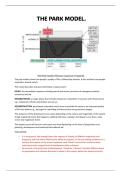
The park model shows how people’s quality of life is affected by hazards. It also outlines how people
respond to hazard events.
The model describes 3 phases that follow a hazard event:
RELIEF: the immediate response including search and rescue, provision of emergency medical
assistance and aid.
REHABILITATION: a longer phase that includes temporary restora"on of services and infrastructure
e.g., temporary schools and shelters are set up.
RECONSTRUCTION: permanent restora"on which aims to provide the same or an improved quality
of life than before e.g., through the rebuilding of infrastructure using aseismic designs.
The steepness of the downward curve varies depending on the nature and magnitude of the hazard.
A high magnitude event that happens suddenly will have a steeper and deeper curve than a slow
onset, low magnitude event.
The upward curve will vary for each event and area depending on the level of prepara"on and
planning, development and na"onal/interna"onal aid.
EVALUATION:
o It is too general. Not enough about the impacts of hazards of different magnitude and
frequency and how these influence the ability to respond. Or the pre-exi"ng condi"ons in a
country, the impacts or the actual responses used. Doesn’t account for countries never
returning to their original level of development a/er a disaster.
o No account of varying levels of development. Therefore, it doesn’t consider different levels
of prepara"on and schemes that were in place in the country before the hazard occurred.
The park model shows how people’s quality of life is affected by hazards. It also outlines how people
respond to hazard events.
The model describes 3 phases that follow a hazard event:
RELIEF: the immediate response including search and rescue, provision of emergency medical
assistance and aid.
REHABILITATION: a longer phase that includes temporary restora"on of services and infrastructure
e.g., temporary schools and shelters are set up.
RECONSTRUCTION: permanent restora"on which aims to provide the same or an improved quality
of life than before e.g., through the rebuilding of infrastructure using aseismic designs.
The steepness of the downward curve varies depending on the nature and magnitude of the hazard.
A high magnitude event that happens suddenly will have a steeper and deeper curve than a slow
onset, low magnitude event.
The upward curve will vary for each event and area depending on the level of prepara"on and
planning, development and na"onal/interna"onal aid.
EVALUATION:
o It is too general. Not enough about the impacts of hazards of different magnitude and
frequency and how these influence the ability to respond. Or the pre-exi"ng condi"ons in a
country, the impacts or the actual responses used. Doesn’t account for countries never
returning to their original level of development a/er a disaster.
o No account of varying levels of development. Therefore, it doesn’t consider different levels
of prepara"on and schemes that were in place in the country before the hazard occurred.