
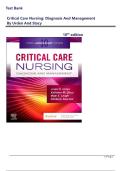
Test Bank
Critical Care Nursing: Diagnosis And Management
By Urden And Stacy
10th edition
1|Page
,Table of contents
Unit i foundations of critical care nursing
1. Critical care nursing practice
2. Ethical and legal issues
3. Genetic issues
4. Facilitating care transitions
5. Psychosocial and spiritual considerations
6. Nutrition alterations and management
7. Pain and pain management
8. Sedation, agitation, and delirium management
9. Palliative and end-of-life care
unit ii cardiovascular alterations
10. Cardiovascular anatomy and physiology
11. Cardiovascular clinical assessment
12. Cardiovascular diagnostic procedures
13. Cardiovascular disorders
14. Cardiovascular therapeutic management
unit iii pulmonary alterations
15. Pulmonary anatomy and physiology
16. Pulmonary clinical assessment
17. Pulmonary diagnostic procedures
18. Pulmonary disorders
19. Pulmonary therapeutic management
unit iv neurologic alterations
20. Neurologic anatomy and physiology
21. Neurologic clinical assessment and diagnostic procedures
22. Neurologic disorders and therapeutic management
unit v kidney alterations
23. Kidney anatomy and physiology
24. Kidney clinical assessment and diagnostic procedures
2|Page
,25. Kidney disorders and therapeutic management
unit vi gastrointestinal alterations
26. Gastrointestinal anatomy and physiology
27. Gastrointestinal clinical assessment and diagnostic procedures
28. Gastrointestinal disorders and therapeutic management
unit vii endocrine alterations
29. Endocrine anatomy and physiology
30. Endocrine clinical assessment and diagnostic procedures
31. Endocrine disorders and therapeutic management
unit viii multisystem alterations
32. Trauma
33. Sepsis, shock, and multiple organ dysfunction syndrome
34. Burns
35. Organ donation and transplantation
36. Hematologic and oncologic emergencies
unit ix special populations
37. The obstetric patient
38. The pediatric patient
39. The older adult patient
3|Page
, Chapter 01: critical care nursing practice urden:
critical care nursing, 10th edition
Multiple choice
1. During world war ii, what types of wards were developed to care for critically injured
patients?
a. Intensive care
b. Triage
c. Shock
d. Postoperative
ANS: c
During world war ii, shock wards were established to care for critically injured patients.
Triage wards establish the order in which a patient is seen or treated upon arrival to a
hospital. Postoperative wards were developed in 1900 and later evolved into intensive care
units.
Pts: 1 dif: cognitive level: remembering ref: p. 2
obj: nursing process step: n/a top: critical care nursing practice
msc: nclex: safe and effective care environment
2. What type of practitioner has a broad depth of specialty knowledge and expertise and
manages complex clinical and system issues?
a. Registered nurses
b. Advanced practice nurses
c. Clinical nurse leaders
d. Intensivists
ANS: b
Advanced practice nurses (apns) have a broad depth of knowledge and expertise in their
specialty area and manage complex clinical and systems issues. Intensivists are medical
practitioners who manage the critical ill patient. Registered nurses (rns) are generally direct
care providers. Clinical nurse leaders (cnls) generally do not manage system issues.
Pts: 1 dif: cognitive level: remembering ref: p. 5
obj: nursing process step: n/a top: critical care nursing practice
msc: nclex: safe and effective care environment
3. What type of practitioner is instrumental in ensuring care that is evidence based and that
safety programs are in place?
a. Clinical nurse specialist
b. Advanced practice nurse
c. Registered nurses
d. Nurse practitioners
ANS: a
4|Page
Critical Care Nursing: Diagnosis And Management
By Urden And Stacy
10th edition
1|Page
,Table of contents
Unit i foundations of critical care nursing
1. Critical care nursing practice
2. Ethical and legal issues
3. Genetic issues
4. Facilitating care transitions
5. Psychosocial and spiritual considerations
6. Nutrition alterations and management
7. Pain and pain management
8. Sedation, agitation, and delirium management
9. Palliative and end-of-life care
unit ii cardiovascular alterations
10. Cardiovascular anatomy and physiology
11. Cardiovascular clinical assessment
12. Cardiovascular diagnostic procedures
13. Cardiovascular disorders
14. Cardiovascular therapeutic management
unit iii pulmonary alterations
15. Pulmonary anatomy and physiology
16. Pulmonary clinical assessment
17. Pulmonary diagnostic procedures
18. Pulmonary disorders
19. Pulmonary therapeutic management
unit iv neurologic alterations
20. Neurologic anatomy and physiology
21. Neurologic clinical assessment and diagnostic procedures
22. Neurologic disorders and therapeutic management
unit v kidney alterations
23. Kidney anatomy and physiology
24. Kidney clinical assessment and diagnostic procedures
2|Page
,25. Kidney disorders and therapeutic management
unit vi gastrointestinal alterations
26. Gastrointestinal anatomy and physiology
27. Gastrointestinal clinical assessment and diagnostic procedures
28. Gastrointestinal disorders and therapeutic management
unit vii endocrine alterations
29. Endocrine anatomy and physiology
30. Endocrine clinical assessment and diagnostic procedures
31. Endocrine disorders and therapeutic management
unit viii multisystem alterations
32. Trauma
33. Sepsis, shock, and multiple organ dysfunction syndrome
34. Burns
35. Organ donation and transplantation
36. Hematologic and oncologic emergencies
unit ix special populations
37. The obstetric patient
38. The pediatric patient
39. The older adult patient
3|Page
, Chapter 01: critical care nursing practice urden:
critical care nursing, 10th edition
Multiple choice
1. During world war ii, what types of wards were developed to care for critically injured
patients?
a. Intensive care
b. Triage
c. Shock
d. Postoperative
ANS: c
During world war ii, shock wards were established to care for critically injured patients.
Triage wards establish the order in which a patient is seen or treated upon arrival to a
hospital. Postoperative wards were developed in 1900 and later evolved into intensive care
units.
Pts: 1 dif: cognitive level: remembering ref: p. 2
obj: nursing process step: n/a top: critical care nursing practice
msc: nclex: safe and effective care environment
2. What type of practitioner has a broad depth of specialty knowledge and expertise and
manages complex clinical and system issues?
a. Registered nurses
b. Advanced practice nurses
c. Clinical nurse leaders
d. Intensivists
ANS: b
Advanced practice nurses (apns) have a broad depth of knowledge and expertise in their
specialty area and manage complex clinical and systems issues. Intensivists are medical
practitioners who manage the critical ill patient. Registered nurses (rns) are generally direct
care providers. Clinical nurse leaders (cnls) generally do not manage system issues.
Pts: 1 dif: cognitive level: remembering ref: p. 5
obj: nursing process step: n/a top: critical care nursing practice
msc: nclex: safe and effective care environment
3. What type of practitioner is instrumental in ensuring care that is evidence based and that
safety programs are in place?
a. Clinical nurse specialist
b. Advanced practice nurse
c. Registered nurses
d. Nurse practitioners
ANS: a
4|Page


