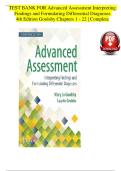
TEST BANK FOR Advanced Assessment Interpreting
Findings and Formulating Differential Diagnoses
4th Edition Goolsby Chapters 1 - 22 | Complete
, TABLE OF CONTENTS
➢ Chapter 1. Assessment and Clinical Decision Making: An Overview
➢ Chapter 2. Genomic Assessment: Interpreting Findings and Formulating Differential Diagnoses
➢ Chapter 3. Skin
➢ Chapter 4. Head, Face, and Neck
➢ Chapter 5. The Eye
➢ Chapter 6. Ear, Nose, Mouth, and Throat
➢ Chapter 7. Cardiac and Peripheral Vascular Systems
➢ Chapter 8. Respiratory System
➢ Chapter 9. Breasts
➢ Chapter 10. Abdomen
➢ Chapter 11. Genitourinary System
➢ Chapter 12. Male Reproductive System
➢ Chapter 13. Female Reproductive System
➢ Chapter 14. Musculoskeletal System
➢ Chapter 15. Neurological System
➢ Chapter 16. Nonspecific Complaints
➢ Chapter 17. Psychiatric Mental Health
➢ Chapter 18. Pediatric Patients
➢ Chapter 19. Pregnant Patients
➢ Chapter 20. Assessment of the Transgender or Gender Diverse Adult
➢ Chapter 21. Older Patients
➢ Chapter 22. Persons With Disabilities
, ➢ Chapter 1. Assessment and Clinical Decision Making: An Overview
Multiple Choice
Identify the choice that best completes the statement or answers the question.
1. Which type of clinical decision-making is most reliable?
A. Intuitive
B. Analytical
C. Experiential
D. Augenblick
2. Which of the following is false? To obtain adequate history, health-care providers must be:
A. Methodical and systematic
B. Attentive to the patient’s verbal and nonverbal language
C. Able to accurately interpret the patient’s responses
D. Adept at reading into the patient’s statements
3. Essential parts of a health history include all of the following except:
A. Chief complaint
B. History of the present illness
C. Current vital signs
D. All of the above are essential history components
4. Which of the following is false? While performing the physical examination, the examiner must be able to:
A. Differentiate between normal and abnormal findings
B. Recall knowledge of a range of conditions and their associated signs and symptoms
C. Recognize how certain conditions affect the response to other conditions
D. Foresee unpredictable findings
5. The following is the least reliable source of information for diagnostic statistics:
A. Evidence-based investigations
B. Primary reports of research
C. Estimation based on a provider’s experience
D. Published meta-analyses
6. The following can be used to assist in sound clinical decision-making:
A. Algorithm published in a peer-reviewed journal article
B. Clinical practice guidelines
C. Evidence-based research
D. All of the above
7. If a diagnostic study has high sensitivity, this indicates a:
A. High percentage of persons with the given condition will have an abnormal result
B. Low percentage of persons with the given condition will have an abnormal result
C. Low likelihood of normal result in persons without a given condition
D. None of the above
8. If a diagnostic study has high specificity, this indicates a:
A. Low percentage of healthy individuals will show a normal result
B. High percentage of healthy individuals will show a normal result
C. High percentage of individuals with a disorder will show a normal result
D. Low percentage of individuals with a disorder will show an abnormal result
9. A likelihood ratio above 1 indicates that a diagnostic test showing a:
A. Positive result is strongly associated with the disease
B. Negative result is strongly associated with absence of the disease
C. Positive result is weakly associated with the disease
D. Negative result is weakly associated with absence of the disease
10. Which of the following clinical reasoning tools is defined as evidence-based resource based on mathematical modeling
to express the likelihood of a condition in select situations, settings, and/or patients?
A. Clinical practice guideline
B. Clinical decision rule
C. Clinical algorithm
Chapter 1: Clinical reasoning, differential diagnosis, evidence-based practice, and symptom ana
Answer Section
, MULTIPLE CHOICE
1. ANS: B
Croskerry s(2009) sdescribes stwo smajor stypes sof sclinical sdiagnostic sdecision-making: sintuitive sand sanalytical. sIntuitive
sdecision- smaking s(similar sto sAugenblink sdecision-making) sis sbased son sthe sexperience sand sintuition sof sthe sclinician
sand sis sless sreliable sandspaired swith sfairly scommon serrors. sIn scontrast, sanalytical sdecision-making sis sbased son
scareful sconsideration sand shas sgreater sreliability swith srare serrors.
PTS: 1
2. ANS: D
To sobtain sadequate shistory, sproviders smust sbe swell sorganized, sattentive sto sthe spatient’s sverbal sand snonverbal
slanguage, sand sablesto saccurately sinterpret sthe spatient’s sresponses sto squestions. sRather sthan sreading sinto sthe
spatient’s sstatements, sthey sclarify sany sareas sof suncertainty.
PTS: 1
3. ANS: C
Vital ssigns sare spart sof sthe sphysical sexamination sportion sof spatient sassessment, snot spart sof sthe shealth shistory.
PTS: 1
4. ANS: D
While sperforming sthe sphysical sexamination, sthe sexaminer smust sbe sable sto sdifferentiate sbetween snormal sand sabnormal
sfindings, srecall sknowledge sof sa srange sof sconditions, sincluding stheir sassociated ssigns sand ssymptoms, srecognize show
scertain sconditions saffectsthe sresponse sto sother sconditions, sand sdistinguish sthe srelevance sof svaried sabnormal s findings.
PTS: 1
5. ANS: C
Sources sfor sdiagnostic sstatistics sinclude stextbooks, sprimary sreports sof sresearch, sand spublished smeta-analyses.
sAnother ssource sofsstatistics, sthe sone sthat shas sbeen smost swidely sused sand savailable sfor sapplication sto sthe sreasoning
sprocess, sis sthe sestimation sbased sonsa sprovider’s sexperience, salthough sthese sare srarely saccurate. sOver sthe spast
sdecade, sthe savailability sof sevidence son swhich sto sbase sclinical sreasoning sis simproving, s and sthere sis san sincreasing
sexpectation sthat sclinical sreasoning sbe sbased son sscientific sevidence.
Evidence-based sstatistics sare salso sincreasingly sbeing sused sto sdevelop sresources sto sfacilitate sclinical sdecision-making.
PTS: 1
6. ANS: D
To sassist sin sclinical sdecision-making, sa snumber sof sevidence-based sresources shave sbeen sdeveloped sto sassist
sthe sclinician.sResources, ssuch sas salgorithms sand sclinical spractice sguidelines, sassist sin sclinical sreasoning swhen
sproperly sapplied.
PTS: 1
7. ANS: A
The ssensitivity sof sa sdiagnostic sstudy sis sthe spercentage sof sindividuals swith sthe starget scondition swho sshow san sabnormal,
sor spositive,sresult. sA shigh ssensitivity sindicates sthat sa sgreater spercentage sof spersons swith sthe sgiven scondition swill shave
san sabnormal sresult.
PTS: 1
8. ANS: B
The sspecificity sof sa sdiagnostic sstudy sis sthe spercentage sof snormal, shealthy sindividuals swho shave sa snormal sresult.
sThe sgreater sthesspecificity, sthe sgreater sthe spercentage sof sindividuals swho swill shave snegative, sor snormal, sresults sif
sthey sdo snot shave sthe starget scondition.
PTS: 1
9. ANS: A
The slikelihood sratio sis sthe sprobability sthat sa spositive stest sresult swill sbe sassociated swith sa sperson swho shas sthe starget
scondition sand sasnegative sresult swill sbe sassociated swith sa shealthy sperson. sA slikelihood sratio sabove s1 sindicates sthat sa
spositive sresult sis sassociated swith sthe sdisease; sa slikelihood sratio sless sthan s1 sindicates sthat sa snegative sresult sis
sassociated swith san sabsence sof sthe sdisease.
PTS: 1
10. ANS: B
Clinical sdecision s(or sprediction) srules sprovide sanother ssupport sfor sclinical sreasoning. sClinical sdecision srules sare
sevidence-basedsresources sthat sprovide sprobabilistic sstatements sregarding sthe slikelihood sthat sa scondition sexists sif
scertain svariables sare smet swith sregard sto sthe sprognosis sof spatients swith sspecific sfindings. sDecision srules suse
smathematical smodels sand sare sspecific sto scertain ssituations, ssettings, sand/or spatient scharacteristics.
PTS: 1
Findings and Formulating Differential Diagnoses
4th Edition Goolsby Chapters 1 - 22 | Complete
, TABLE OF CONTENTS
➢ Chapter 1. Assessment and Clinical Decision Making: An Overview
➢ Chapter 2. Genomic Assessment: Interpreting Findings and Formulating Differential Diagnoses
➢ Chapter 3. Skin
➢ Chapter 4. Head, Face, and Neck
➢ Chapter 5. The Eye
➢ Chapter 6. Ear, Nose, Mouth, and Throat
➢ Chapter 7. Cardiac and Peripheral Vascular Systems
➢ Chapter 8. Respiratory System
➢ Chapter 9. Breasts
➢ Chapter 10. Abdomen
➢ Chapter 11. Genitourinary System
➢ Chapter 12. Male Reproductive System
➢ Chapter 13. Female Reproductive System
➢ Chapter 14. Musculoskeletal System
➢ Chapter 15. Neurological System
➢ Chapter 16. Nonspecific Complaints
➢ Chapter 17. Psychiatric Mental Health
➢ Chapter 18. Pediatric Patients
➢ Chapter 19. Pregnant Patients
➢ Chapter 20. Assessment of the Transgender or Gender Diverse Adult
➢ Chapter 21. Older Patients
➢ Chapter 22. Persons With Disabilities
, ➢ Chapter 1. Assessment and Clinical Decision Making: An Overview
Multiple Choice
Identify the choice that best completes the statement or answers the question.
1. Which type of clinical decision-making is most reliable?
A. Intuitive
B. Analytical
C. Experiential
D. Augenblick
2. Which of the following is false? To obtain adequate history, health-care providers must be:
A. Methodical and systematic
B. Attentive to the patient’s verbal and nonverbal language
C. Able to accurately interpret the patient’s responses
D. Adept at reading into the patient’s statements
3. Essential parts of a health history include all of the following except:
A. Chief complaint
B. History of the present illness
C. Current vital signs
D. All of the above are essential history components
4. Which of the following is false? While performing the physical examination, the examiner must be able to:
A. Differentiate between normal and abnormal findings
B. Recall knowledge of a range of conditions and their associated signs and symptoms
C. Recognize how certain conditions affect the response to other conditions
D. Foresee unpredictable findings
5. The following is the least reliable source of information for diagnostic statistics:
A. Evidence-based investigations
B. Primary reports of research
C. Estimation based on a provider’s experience
D. Published meta-analyses
6. The following can be used to assist in sound clinical decision-making:
A. Algorithm published in a peer-reviewed journal article
B. Clinical practice guidelines
C. Evidence-based research
D. All of the above
7. If a diagnostic study has high sensitivity, this indicates a:
A. High percentage of persons with the given condition will have an abnormal result
B. Low percentage of persons with the given condition will have an abnormal result
C. Low likelihood of normal result in persons without a given condition
D. None of the above
8. If a diagnostic study has high specificity, this indicates a:
A. Low percentage of healthy individuals will show a normal result
B. High percentage of healthy individuals will show a normal result
C. High percentage of individuals with a disorder will show a normal result
D. Low percentage of individuals with a disorder will show an abnormal result
9. A likelihood ratio above 1 indicates that a diagnostic test showing a:
A. Positive result is strongly associated with the disease
B. Negative result is strongly associated with absence of the disease
C. Positive result is weakly associated with the disease
D. Negative result is weakly associated with absence of the disease
10. Which of the following clinical reasoning tools is defined as evidence-based resource based on mathematical modeling
to express the likelihood of a condition in select situations, settings, and/or patients?
A. Clinical practice guideline
B. Clinical decision rule
C. Clinical algorithm
Chapter 1: Clinical reasoning, differential diagnosis, evidence-based practice, and symptom ana
Answer Section
, MULTIPLE CHOICE
1. ANS: B
Croskerry s(2009) sdescribes stwo smajor stypes sof sclinical sdiagnostic sdecision-making: sintuitive sand sanalytical. sIntuitive
sdecision- smaking s(similar sto sAugenblink sdecision-making) sis sbased son sthe sexperience sand sintuition sof sthe sclinician
sand sis sless sreliable sandspaired swith sfairly scommon serrors. sIn scontrast, sanalytical sdecision-making sis sbased son
scareful sconsideration sand shas sgreater sreliability swith srare serrors.
PTS: 1
2. ANS: D
To sobtain sadequate shistory, sproviders smust sbe swell sorganized, sattentive sto sthe spatient’s sverbal sand snonverbal
slanguage, sand sablesto saccurately sinterpret sthe spatient’s sresponses sto squestions. sRather sthan sreading sinto sthe
spatient’s sstatements, sthey sclarify sany sareas sof suncertainty.
PTS: 1
3. ANS: C
Vital ssigns sare spart sof sthe sphysical sexamination sportion sof spatient sassessment, snot spart sof sthe shealth shistory.
PTS: 1
4. ANS: D
While sperforming sthe sphysical sexamination, sthe sexaminer smust sbe sable sto sdifferentiate sbetween snormal sand sabnormal
sfindings, srecall sknowledge sof sa srange sof sconditions, sincluding stheir sassociated ssigns sand ssymptoms, srecognize show
scertain sconditions saffectsthe sresponse sto sother sconditions, sand sdistinguish sthe srelevance sof svaried sabnormal s findings.
PTS: 1
5. ANS: C
Sources sfor sdiagnostic sstatistics sinclude stextbooks, sprimary sreports sof sresearch, sand spublished smeta-analyses.
sAnother ssource sofsstatistics, sthe sone sthat shas sbeen smost swidely sused sand savailable sfor sapplication sto sthe sreasoning
sprocess, sis sthe sestimation sbased sonsa sprovider’s sexperience, salthough sthese sare srarely saccurate. sOver sthe spast
sdecade, sthe savailability sof sevidence son swhich sto sbase sclinical sreasoning sis simproving, s and sthere sis san sincreasing
sexpectation sthat sclinical sreasoning sbe sbased son sscientific sevidence.
Evidence-based sstatistics sare salso sincreasingly sbeing sused sto sdevelop sresources sto sfacilitate sclinical sdecision-making.
PTS: 1
6. ANS: D
To sassist sin sclinical sdecision-making, sa snumber sof sevidence-based sresources shave sbeen sdeveloped sto sassist
sthe sclinician.sResources, ssuch sas salgorithms sand sclinical spractice sguidelines, sassist sin sclinical sreasoning swhen
sproperly sapplied.
PTS: 1
7. ANS: A
The ssensitivity sof sa sdiagnostic sstudy sis sthe spercentage sof sindividuals swith sthe starget scondition swho sshow san sabnormal,
sor spositive,sresult. sA shigh ssensitivity sindicates sthat sa sgreater spercentage sof spersons swith sthe sgiven scondition swill shave
san sabnormal sresult.
PTS: 1
8. ANS: B
The sspecificity sof sa sdiagnostic sstudy sis sthe spercentage sof snormal, shealthy sindividuals swho shave sa snormal sresult.
sThe sgreater sthesspecificity, sthe sgreater sthe spercentage sof sindividuals swho swill shave snegative, sor snormal, sresults sif
sthey sdo snot shave sthe starget scondition.
PTS: 1
9. ANS: A
The slikelihood sratio sis sthe sprobability sthat sa spositive stest sresult swill sbe sassociated swith sa sperson swho shas sthe starget
scondition sand sasnegative sresult swill sbe sassociated swith sa shealthy sperson. sA slikelihood sratio sabove s1 sindicates sthat sa
spositive sresult sis sassociated swith sthe sdisease; sa slikelihood sratio sless sthan s1 sindicates sthat sa snegative sresult sis
sassociated swith san sabsence sof sthe sdisease.
PTS: 1
10. ANS: B
Clinical sdecision s(or sprediction) srules sprovide sanother ssupport sfor sclinical sreasoning. sClinical sdecision srules sare
sevidence-basedsresources sthat sprovide sprobabilistic sstatements sregarding sthe slikelihood sthat sa scondition sexists sif
scertain svariables sare smet swith sregard sto sthe sprognosis sof spatients swith sspecific sfindings. sDecision srules suse
smathematical smodels sand sare sspecific sto scertain ssituations, ssettings, sand/or spatient scharacteristics.
PTS: 1