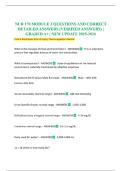
NUR 170 EXAM 2 STUDY GUIDE QUESTIONS AND
CORRECT DETAILED ANSWERS (VERIFIED
ANSWERS) | ALREADY GRADED A+ | NEW 2025-2026
UPDATE
Demonstrate knowledge of the normal ranges for temperature, heart rate,
respiratory rate, blood pressure and pulse oximetry. - ANSWER Temperature
(T): Oral 37.0 C (98.6 F)
Blood Pressure (BP): 120/80
Heart Rate (HR):
60 to 100 (80 average) beats/minute
Respiratory Rate (R): 12-20 breaths/minute
Pulse Oximetry:
95% to 100%
Discuss the technique used in obtaining temperature, heart rate, respiratory rate,
blood pressure and pulse oximetry. - ANSWER Temperature:
- Oral (Posterior sublingual pocket)
- Tympanic (Ear)
- Temporal artery (Side of forehead)
- Rectal
- Axillary (Armpit)
Blood Pressure:
Sites: Brachial (most common), Radial, Popliteal (most common)
Electronic or manual
,Heart Rate:
Peripheral (30 sec x 2) and Apical (1 min)
1. Rate
(Normal 60 to 100 beats per min)
2. Rhythm
(Regular or irregular)
3. Amplitude & Quality
(Strong, weak, expected)
Respiratory Rate:
1 respiration consists of breathing in and out
1. Rate (regular or irregular)
2. Depth (Deep, shallow, normal)
3. Rhythm
Pulse Oximetry:
Noninvasive technique that measures the ratio, expressed as a percentage,
between the actual oxygen content of the hemoglobin and the potential
maximum oxygen-carrying capacity of the hemoglobin (clip-on finger, ear, or toe)
Compare and contrast factors that increase or decrease body temperature, heart
rate, respiratory rate, blood pressure and pulse oximetry findings. - ANSWER
Temperature:
- Age
- Gender
- Physical activity
- State of health
, - Environmental temperatures
- Circadian Rhythm
Time of day
(Lowest in the early morning; Highest in the late afternoon)
Blood Pressure:
increase:
decrease:
Heart Rate:
increase:
decrease:
Respiratory Rate:
increase:
decrease:
Pulse Oximetry:
increase:
decrease:
Discuss the importance of vital sign documentation - ANSWER it provides
medical professionals with concrete information that they use to assess your
health and form a correct diagnosis.
T/F: The normal pulse rate for adolescents and adults ranges from 60 to 100
beats/min.
A. True
B. False - ANSWER A. True
CORRECT DETAILED ANSWERS (VERIFIED
ANSWERS) | ALREADY GRADED A+ | NEW 2025-2026
UPDATE
Demonstrate knowledge of the normal ranges for temperature, heart rate,
respiratory rate, blood pressure and pulse oximetry. - ANSWER Temperature
(T): Oral 37.0 C (98.6 F)
Blood Pressure (BP): 120/80
Heart Rate (HR):
60 to 100 (80 average) beats/minute
Respiratory Rate (R): 12-20 breaths/minute
Pulse Oximetry:
95% to 100%
Discuss the technique used in obtaining temperature, heart rate, respiratory rate,
blood pressure and pulse oximetry. - ANSWER Temperature:
- Oral (Posterior sublingual pocket)
- Tympanic (Ear)
- Temporal artery (Side of forehead)
- Rectal
- Axillary (Armpit)
Blood Pressure:
Sites: Brachial (most common), Radial, Popliteal (most common)
Electronic or manual
,Heart Rate:
Peripheral (30 sec x 2) and Apical (1 min)
1. Rate
(Normal 60 to 100 beats per min)
2. Rhythm
(Regular or irregular)
3. Amplitude & Quality
(Strong, weak, expected)
Respiratory Rate:
1 respiration consists of breathing in and out
1. Rate (regular or irregular)
2. Depth (Deep, shallow, normal)
3. Rhythm
Pulse Oximetry:
Noninvasive technique that measures the ratio, expressed as a percentage,
between the actual oxygen content of the hemoglobin and the potential
maximum oxygen-carrying capacity of the hemoglobin (clip-on finger, ear, or toe)
Compare and contrast factors that increase or decrease body temperature, heart
rate, respiratory rate, blood pressure and pulse oximetry findings. - ANSWER
Temperature:
- Age
- Gender
- Physical activity
- State of health
, - Environmental temperatures
- Circadian Rhythm
Time of day
(Lowest in the early morning; Highest in the late afternoon)
Blood Pressure:
increase:
decrease:
Heart Rate:
increase:
decrease:
Respiratory Rate:
increase:
decrease:
Pulse Oximetry:
increase:
decrease:
Discuss the importance of vital sign documentation - ANSWER it provides
medical professionals with concrete information that they use to assess your
health and form a correct diagnosis.
T/F: The normal pulse rate for adolescents and adults ranges from 60 to 100
beats/min.
A. True
B. False - ANSWER A. True