COMM 108 unit test part 2 Le 1
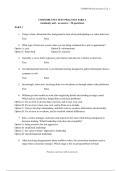
COMM108 UNIT TEST PRACTICE PART 2
(randomly unit - no answer - 30 questions)
PART 3
1. Using a clean, distraction-free background is best when participating in a video interview.
True False
2. What type of interview occurs when you are being evaluated for a job or opportunity?
Option A: case Option B: informational
Option C: behavioral Option D: selection
3. Typically, a cover letter expresses your interest and asks for a chance to interview.
True False
4. An informational interview is an informal meeting designed to gather information about a
company or role.
True False
5. Increasingly, interviews are being done over the phone or through online video platforms.
True False
6. William got into trouble at work after neglecting details and sending an angry email.
Which advice would have helped him avoid these problems?
Option A: It's an error to do less than your best, and to lose your cool.
Option B: It's an error to lose your cool, and to fixate on a mistake.
Option C: Always develop camaraderie, and don't convey sensitive information electronically.
Option D: It's an error to overshare, and to overlook cultural differences.
7. Kim, a senior manager, motivates and empowers her team while being transparent in
decision-making. Which leadership style does she exemplify?
Option A: being assertive but not aggressive
Option B: situational leadership
Option C: the “great woman” approach to leadership
Option D: transformational leadership
8. After resolving disagreements about mailbox colors, the association members reach a
stage where consensus emerges. Which stage is this in group problem-solving?
Practice exercises with no answers
, COMM 108 unit test part 2 Le 2
Option A: The orientation stage. Option B: The conflict stage.
Option C: The emergence stage. Option D: The reinforcement stage.
9. A small group consists of a few people who interact over time to accomplish shared
objectives.
Option A: forum Option B: chain network
Option C: focus group Option D: small group
10.Once group members are familiar with each other and the problem, which stage do they
enter next?
Option A: orientation stage Option B: conflict stage
Option C: emergence stage Option D: reinforcement stage
———————————————————————————————————————
PART 4
1. Which type of speech element may restate earlier points, preview upcoming points, or do
both?
Option A: conclusion Option B: transition
Option C: thesis Option D: summary
2. What reflects whether an audience tends to react positively or negatively to a speaker or
topic?
Option A: attitudes Option B: values
Option C: demographics Option D: group membership
3. What is the term for accurately identifying and crediting a source in a speech or paper?
Option A: outline Option B: citation
Option C: narration Option D: testimony
4. A single sentence that clearly states what a speaker intends to achieve is called
__________.
Option A: a purpose statement Option B: an introduction
Option C: a motivated sequence Option D: a hypothetical example
5. Which method uses a standard format and symbols to organize the ideas in a speech?
Practice exercises with no answers
COMM108 UNIT TEST PRACTICE PART 2
(randomly unit - no answer - 30 questions)
PART 3
1. Using a clean, distraction-free background is best when participating in a video interview.
True False
2. What type of interview occurs when you are being evaluated for a job or opportunity?
Option A: case Option B: informational
Option C: behavioral Option D: selection
3. Typically, a cover letter expresses your interest and asks for a chance to interview.
True False
4. An informational interview is an informal meeting designed to gather information about a
company or role.
True False
5. Increasingly, interviews are being done over the phone or through online video platforms.
True False
6. William got into trouble at work after neglecting details and sending an angry email.
Which advice would have helped him avoid these problems?
Option A: It's an error to do less than your best, and to lose your cool.
Option B: It's an error to lose your cool, and to fixate on a mistake.
Option C: Always develop camaraderie, and don't convey sensitive information electronically.
Option D: It's an error to overshare, and to overlook cultural differences.
7. Kim, a senior manager, motivates and empowers her team while being transparent in
decision-making. Which leadership style does she exemplify?
Option A: being assertive but not aggressive
Option B: situational leadership
Option C: the “great woman” approach to leadership
Option D: transformational leadership
8. After resolving disagreements about mailbox colors, the association members reach a
stage where consensus emerges. Which stage is this in group problem-solving?
Practice exercises with no answers
, COMM 108 unit test part 2 Le 2
Option A: The orientation stage. Option B: The conflict stage.
Option C: The emergence stage. Option D: The reinforcement stage.
9. A small group consists of a few people who interact over time to accomplish shared
objectives.
Option A: forum Option B: chain network
Option C: focus group Option D: small group
10.Once group members are familiar with each other and the problem, which stage do they
enter next?
Option A: orientation stage Option B: conflict stage
Option C: emergence stage Option D: reinforcement stage
———————————————————————————————————————
PART 4
1. Which type of speech element may restate earlier points, preview upcoming points, or do
both?
Option A: conclusion Option B: transition
Option C: thesis Option D: summary
2. What reflects whether an audience tends to react positively or negatively to a speaker or
topic?
Option A: attitudes Option B: values
Option C: demographics Option D: group membership
3. What is the term for accurately identifying and crediting a source in a speech or paper?
Option A: outline Option B: citation
Option C: narration Option D: testimony
4. A single sentence that clearly states what a speaker intends to achieve is called
__________.
Option A: a purpose statement Option B: an introduction
Option C: a motivated sequence Option D: a hypothetical example
5. Which method uses a standard format and symbols to organize the ideas in a speech?
Practice exercises with no answers