8/24/25, 11:35 PM PNCB Exam Study
PNCB Exam Prep 2025-2026 –Pediatric Nursing
Certification Board Test Bank questions and accurate
detailed answers\latest update
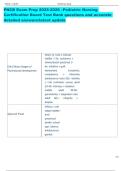
infant-1y: trust v mistrust
toddler 1-3y: autonomy v
shame/doubt preschool 3-
Erik Erikson Stages of 6y: initiative v guilt
Psychosocial development elementary 6-puberty:
competence v inferiority
adolescence teen-20s: identity
v role confusion young adult
20-40: intimacy v isolation
middle adult 40-60:
generativity v stagnation late
adult 60+: integrity v
despair
infancy: oral
stage toddler:
Sigmund Freud anal
preschool:
phallic school
age: latency
adolescence:
genital
1/24
,8/24/25, 11:35 PM PNCB Exam Study
sensorimotor: birth-2
-object performance, object still exsits when outof sight
-recognition of ability to control objects and acts intentionally
preoperational: 2-7
-uses language
-egocentric thinking difficult seeing things from other viewpoints
-classifed objects by single feature: color
Jean Piaget (stages of
concrete operational thinking: 7-12
cognitive
-logical thinking
development) -recognizes conversation by numbers, mass and weight
-objects by features and can place them together
formal operational: 12+
-logical thinking about abstract propositions
-concerned with hypothetical and future
-create hypothese and test
reflexes 0-1mth
primary circular reactions 1-4mths: adaptation of
reflexed to the environment through coordination of
two actions (seeing and grasping)
Jean Piaget
sensorimotor secondary circular 4-8mths: increased awareness of
stage 0-2y objects persons and expected responses
coordination of means and ends 8-12mths: object
infant growth/development permanence emerges with awareness that people and
objects continue to exist when out of sight
tertiary circular 12-18mths: active exploration and trial/error
learning
mental combinations 18-24mths: ability to problem solve
simple situations without trial and error
2/24
, 8/24/25, 11:35 PM PNCB Exam Study
moral reasoning
preconventional
stage 1: pushishment - Obedience, child behaves to avoid
punishment
stage 2: instrumental - exchange, child behaves well
for some gain or reward conventional
stage 3: good boy/good girl, child behaves for approval
Kohlberg's stages of moral stage 4: law and order perspective, child behaves to
development
avoid getting caught postconventional
stage 5: social contract, child/adolescent behaves in
accordance with generally acceptable social norms
stage 6: universal ethical, child/adolescent decides on
moral standards of behavior though indivudal
reflection and reasoning
3/24
PNCB Exam Prep 2025-2026 –Pediatric Nursing
Certification Board Test Bank questions and accurate
detailed answers\latest update
infant-1y: trust v mistrust
toddler 1-3y: autonomy v
shame/doubt preschool 3-
Erik Erikson Stages of 6y: initiative v guilt
Psychosocial development elementary 6-puberty:
competence v inferiority
adolescence teen-20s: identity
v role confusion young adult
20-40: intimacy v isolation
middle adult 40-60:
generativity v stagnation late
adult 60+: integrity v
despair
infancy: oral
stage toddler:
Sigmund Freud anal
preschool:
phallic school
age: latency
adolescence:
genital
1/24
,8/24/25, 11:35 PM PNCB Exam Study
sensorimotor: birth-2
-object performance, object still exsits when outof sight
-recognition of ability to control objects and acts intentionally
preoperational: 2-7
-uses language
-egocentric thinking difficult seeing things from other viewpoints
-classifed objects by single feature: color
Jean Piaget (stages of
concrete operational thinking: 7-12
cognitive
-logical thinking
development) -recognizes conversation by numbers, mass and weight
-objects by features and can place them together
formal operational: 12+
-logical thinking about abstract propositions
-concerned with hypothetical and future
-create hypothese and test
reflexes 0-1mth
primary circular reactions 1-4mths: adaptation of
reflexed to the environment through coordination of
two actions (seeing and grasping)
Jean Piaget
sensorimotor secondary circular 4-8mths: increased awareness of
stage 0-2y objects persons and expected responses
coordination of means and ends 8-12mths: object
infant growth/development permanence emerges with awareness that people and
objects continue to exist when out of sight
tertiary circular 12-18mths: active exploration and trial/error
learning
mental combinations 18-24mths: ability to problem solve
simple situations without trial and error
2/24
, 8/24/25, 11:35 PM PNCB Exam Study
moral reasoning
preconventional
stage 1: pushishment - Obedience, child behaves to avoid
punishment
stage 2: instrumental - exchange, child behaves well
for some gain or reward conventional
stage 3: good boy/good girl, child behaves for approval
Kohlberg's stages of moral stage 4: law and order perspective, child behaves to
development
avoid getting caught postconventional
stage 5: social contract, child/adolescent behaves in
accordance with generally acceptable social norms
stage 6: universal ethical, child/adolescent decides on
moral standards of behavior though indivudal
reflection and reasoning
3/24