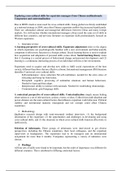
Exploring cross-cultural skills for expatriate managers from Chinese multinationals:
Congruence and contextualization
Rise in MNE's leads to more need for cross-cultural skills. Going global was firmly established
as a national strategy in 2004, since then Chinese expatriate outflow has increased significantly.
There are substantial cultural and managerial differences between China and many foreign
markets. It is still unclear whether international managers always need the same set of skills in
different host countries, and previous literature on expatriate skills predominately focused on
Western expatriates.
1. Literature review
A learning perspective of cross-cultural skills. Expatriate adjustment refers to the degree
to which expatriates are psychologically familiar with a new environment and behaviourally
competent to effectively function in a foreign culture. Social learning theory is used to explain
how acquisition and adaptation of personal skills comes about. Social learning theory states
that (1) learning is a central process of behavioural change and personal development; and (2)
learning is a continuous interacting process of an individual with his or her environment.
Expatriates need to acquire and develop new skills to fulfil social expectations of the host
society, different than those that are effective at home. International management (IM) literature
identifies 4 universal cross-cultural skills:
- Self-maintenance: stress reduction Nd self-confidence, needed for the extra stress of
relocating and being far from home.
- Perceptual: cognitive processing of unfamiliar situations and human behaviours.
Needed to learn and then adapt.
- Interpersonal: ability to interact with nationals. Needed for establishing relationships.
- Communication: good language skills.
A contextual perspective of cross-cultural skills. Contextualization simply means linking
observations to a set of relevant facts, actions, events, or ideas. Collectivism-individualism and
power-distance are the main cultural factors that influence expatriate work behaviour. Political
stability and institutional maturity (transparent and not corrupt) could affect Chinese
expatriates.
2. Methodology
Qualitative research design with semi-structured (online) interviews. (1) the background
information of the expatriate; (2) the opportunities and challenges in developing and using
cross-cultural skills; and (3) the situations in which cross-cultural skills function effectively or
ineffectively.
Selection of informants. Three groups of informants were interviewed to get diverse
perspectives, including the Chinese expatriates, their local colleagues, and the expatriate
supervisors at headquarters. The expatriates had to be managers and on international
assignment for more than 6 months. Companies representing a variety of industries were
chosen.
3. Findings
All four sets of skills were found to be important, but the order of importance was different for
different countries. This is attributed to differing contextual factors.
Congruence and contextualization
Rise in MNE's leads to more need for cross-cultural skills. Going global was firmly established
as a national strategy in 2004, since then Chinese expatriate outflow has increased significantly.
There are substantial cultural and managerial differences between China and many foreign
markets. It is still unclear whether international managers always need the same set of skills in
different host countries, and previous literature on expatriate skills predominately focused on
Western expatriates.
1. Literature review
A learning perspective of cross-cultural skills. Expatriate adjustment refers to the degree
to which expatriates are psychologically familiar with a new environment and behaviourally
competent to effectively function in a foreign culture. Social learning theory is used to explain
how acquisition and adaptation of personal skills comes about. Social learning theory states
that (1) learning is a central process of behavioural change and personal development; and (2)
learning is a continuous interacting process of an individual with his or her environment.
Expatriates need to acquire and develop new skills to fulfil social expectations of the host
society, different than those that are effective at home. International management (IM) literature
identifies 4 universal cross-cultural skills:
- Self-maintenance: stress reduction Nd self-confidence, needed for the extra stress of
relocating and being far from home.
- Perceptual: cognitive processing of unfamiliar situations and human behaviours.
Needed to learn and then adapt.
- Interpersonal: ability to interact with nationals. Needed for establishing relationships.
- Communication: good language skills.
A contextual perspective of cross-cultural skills. Contextualization simply means linking
observations to a set of relevant facts, actions, events, or ideas. Collectivism-individualism and
power-distance are the main cultural factors that influence expatriate work behaviour. Political
stability and institutional maturity (transparent and not corrupt) could affect Chinese
expatriates.
2. Methodology
Qualitative research design with semi-structured (online) interviews. (1) the background
information of the expatriate; (2) the opportunities and challenges in developing and using
cross-cultural skills; and (3) the situations in which cross-cultural skills function effectively or
ineffectively.
Selection of informants. Three groups of informants were interviewed to get diverse
perspectives, including the Chinese expatriates, their local colleagues, and the expatriate
supervisors at headquarters. The expatriates had to be managers and on international
assignment for more than 6 months. Companies representing a variety of industries were
chosen.
3. Findings
All four sets of skills were found to be important, but the order of importance was different for
different countries. This is attributed to differing contextual factors.