
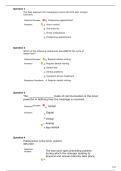
Question 1
The best approach for managing 6 years old child with temper
tantrums.
Selected Answer: D. Postponing appointment
Answers: A. Voice control
B. Tell show do.
C. Three medications
D. Postponing appointment
Question 2
Which of the following statements does NOT fit the cycle of
dental fear?
Selected Answer: A. Regular dental visiting.
Answers: A. Regular dental visiting
B. Dental fear
C. Dental problems
D. Symptom-driven treatment
Response Feedback: A Regular dental visiting.
Question 3
The mode of communication is the most
powerful in defining how the message is received.
Selected Answer: Verbal
b.
Answers:
a.
Digital
b. Verbal
c. Analog
d. Non-Verbal
Question 4
Pubescence is the term used to
describe:
Selected
Answer: The two-year span preceding puberty
during which the changes leading to
physical and sexual maturity take place.
a.
1/18
, Answers
: The two-year span preceding puberty
during which the changes leading to
physical and sexual maturity take place.
a.
The stage when a person learns to read and
b. write, to do sums, to do things on their own.
The stage where the person asks questions and
c. has a thirst for knowledge.
The stage whereby the person asserts.
themselves through direct play and other social
Respons
d. interaction.
e
A. The two-year span preceding puberty during
Feedbac
k: which the changes leading to physical and sexual
maturity take place.
Question 5
Which one of the following is NOT a stage of development according to
Erikson:
Selected
Answer: Intimacy vs Stagnation
c.
Answers: Trust vs Mistrust
a.
b. Initiative vs Guilt
Intimacy vs Stagnation
c.
d. Identity vs Role Confusion
Response Feedback: C. Intimacy vs Stagnation
Question 6
Which questions would be MORE suitable to ask in the patient
satisfaction questionnaire?
Selected
Answer: How satisfied are they with the treatment.
a. received?
How satisfied are they with the treatment.
Answers: received?
a.
b. If they have
eaten? How are
2/18
, t hey feeling?
c.
3/18
The best approach for managing 6 years old child with temper
tantrums.
Selected Answer: D. Postponing appointment
Answers: A. Voice control
B. Tell show do.
C. Three medications
D. Postponing appointment
Question 2
Which of the following statements does NOT fit the cycle of
dental fear?
Selected Answer: A. Regular dental visiting.
Answers: A. Regular dental visiting
B. Dental fear
C. Dental problems
D. Symptom-driven treatment
Response Feedback: A Regular dental visiting.
Question 3
The mode of communication is the most
powerful in defining how the message is received.
Selected Answer: Verbal
b.
Answers:
a.
Digital
b. Verbal
c. Analog
d. Non-Verbal
Question 4
Pubescence is the term used to
describe:
Selected
Answer: The two-year span preceding puberty
during which the changes leading to
physical and sexual maturity take place.
a.
1/18
, Answers
: The two-year span preceding puberty
during which the changes leading to
physical and sexual maturity take place.
a.
The stage when a person learns to read and
b. write, to do sums, to do things on their own.
The stage where the person asks questions and
c. has a thirst for knowledge.
The stage whereby the person asserts.
themselves through direct play and other social
Respons
d. interaction.
e
A. The two-year span preceding puberty during
Feedbac
k: which the changes leading to physical and sexual
maturity take place.
Question 5
Which one of the following is NOT a stage of development according to
Erikson:
Selected
Answer: Intimacy vs Stagnation
c.
Answers: Trust vs Mistrust
a.
b. Initiative vs Guilt
Intimacy vs Stagnation
c.
d. Identity vs Role Confusion
Response Feedback: C. Intimacy vs Stagnation
Question 6
Which questions would be MORE suitable to ask in the patient
satisfaction questionnaire?
Selected
Answer: How satisfied are they with the treatment.
a. received?
How satisfied are they with the treatment.
Answers: received?
a.
b. If they have
eaten? How are
2/18
, t hey feeling?
c.
3/18


