Hoofdstuk 2
A set is a collection of objects which typically share a property. The objects belonging to the
collection are individually referred to as its elements or members. The numbers of objects in a set A
is referred to as its cardinality and written as |A|. If there are not too many elements in the set then
it is described by writing its elements in a list between curly braces. Example:
- {false, true}; Cardinality = 2
- {3, 7, 14}; Cardinality = 3
- {red, blue, yellow}; Cardinality = 3
- {Joel, Felix, Oskar, Amanda}; Cardinality = 4
Listing all the elemens can get guite tedious. For lists with a great amount of elements we use the
following notation:
- {1, 3, 5, … , 99} (The set of 50 odd positive integers below 100);
- {a, b, c, .. , z} (The set of 26 letters of the alfabet);
- {2, 3, 5, 7, 11, 13, 17, …} (The infinite set of prime numbers);
But for example, the next element in the sequence after 17 is 21. Perhaps it’s isn’t even a number.
To avoind these kind of problems sets are typically describe not by explicitly listing the elements
between curly braces, but rather by describing the property that the elements share. In general, we
shall describe sets using the following set-builder notation: {x : x has property P}. This set consist of
exactly those elements x which satisfy the property P. More examples:
1. The collection of all beaches on the Gower Peninsula: {b : b is a beach on the Gower Peninsula}.
2. The collection of all people who climbed Mount Kailash: {p : p has climbed Mount Kailash}.
3. The collection of all prime numbers: {n : n is a prime number}.
4. The collection of all sets of people who have a common grandmother: {A : A is a set of people
who share a common grandmother}.
Note that Ø and { Ø} are different sets:
the set Ø contains no elements while
the set { Ø } contains one element,
namely the set Ø itself, and hence is not
the same as the empty set Ø.
A set with exactly one element is called a singleton:
- {a}
- {true}
- {{Wouter}}
Memberships are denoted by ∈. We can write the following propositions about sets:
- If x is an element of the set A, we write x ∈ A
- If x is not an element of the set A, we write x ∉ A
, A set is solely defined but its members, two sets are equal if, and only if, they have the same
elements. When you list the elements of a set, the order in which you list them, and the number of
times you list each element, doesn’t matter. Example:
- {3, 7, 14} = {7, 14, 3, 7, 3}
- {Joel, Felix, Oskar} ≠ {Joel, Felix, Oskar, Amanda}.
When all the elements of a set A are also elements of a set B, we say that A is a subset of B, written
A ⊆ B. More formally: A ⊆ B holds if and only if, for all x:
- x∈A⇒x∈B
We write A ⊈ B when A is not a subset of B; or more formally, ¬(A ⊆ B). If A and B are not equal, we
write A ≠ B. If A ≠ B and A ⊆ B we write A ⊂ B. Then A is a strict subset of B.
If x is an element of the set A x∈A
If x is not an element of the set A x∉A
If A and B are equal A=B
If A and B are not equal A≠B
If A = B and elements A = elements B (Subnet) A⊆B
If An and B are not a subnet A ⊈ B or ¬(A ⊆ B)
If A ≠ B and A ⊆ B (strict subnet) A⊂B
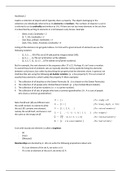
To help visualize a relation between sets, we can draw a Venn
diagram. For example we have the following sets:
1. X = {1, 2, 3, 4, 5}
2. Y = {2, 3, 4}
3. Z= {3, 4, 5, 6}
Here we have set U containing all possible elements (the universe
of discourse) as followed: U = {1, 2, 3, 4, 5, 6, 7, 8, 9,10} which will be the integer from 1 to 10.
The set B is a subset of U (here B drawn in green). The set A
is a subset of B (here A drawn in blue). In this way, we can
refer to the sets corresponding to the different regions of
this diagram, such as:
- the elements of B that are not in A;
- the elements in U that are not in A or B;
A set is a collection of objects which typically share a property. The objects belonging to the
collection are individually referred to as its elements or members. The numbers of objects in a set A
is referred to as its cardinality and written as |A|. If there are not too many elements in the set then
it is described by writing its elements in a list between curly braces. Example:
- {false, true}; Cardinality = 2
- {3, 7, 14}; Cardinality = 3
- {red, blue, yellow}; Cardinality = 3
- {Joel, Felix, Oskar, Amanda}; Cardinality = 4
Listing all the elemens can get guite tedious. For lists with a great amount of elements we use the
following notation:
- {1, 3, 5, … , 99} (The set of 50 odd positive integers below 100);
- {a, b, c, .. , z} (The set of 26 letters of the alfabet);
- {2, 3, 5, 7, 11, 13, 17, …} (The infinite set of prime numbers);
But for example, the next element in the sequence after 17 is 21. Perhaps it’s isn’t even a number.
To avoind these kind of problems sets are typically describe not by explicitly listing the elements
between curly braces, but rather by describing the property that the elements share. In general, we
shall describe sets using the following set-builder notation: {x : x has property P}. This set consist of
exactly those elements x which satisfy the property P. More examples:
1. The collection of all beaches on the Gower Peninsula: {b : b is a beach on the Gower Peninsula}.
2. The collection of all people who climbed Mount Kailash: {p : p has climbed Mount Kailash}.
3. The collection of all prime numbers: {n : n is a prime number}.
4. The collection of all sets of people who have a common grandmother: {A : A is a set of people
who share a common grandmother}.
Note that Ø and { Ø} are different sets:
the set Ø contains no elements while
the set { Ø } contains one element,
namely the set Ø itself, and hence is not
the same as the empty set Ø.
A set with exactly one element is called a singleton:
- {a}
- {true}
- {{Wouter}}
Memberships are denoted by ∈. We can write the following propositions about sets:
- If x is an element of the set A, we write x ∈ A
- If x is not an element of the set A, we write x ∉ A
, A set is solely defined but its members, two sets are equal if, and only if, they have the same
elements. When you list the elements of a set, the order in which you list them, and the number of
times you list each element, doesn’t matter. Example:
- {3, 7, 14} = {7, 14, 3, 7, 3}
- {Joel, Felix, Oskar} ≠ {Joel, Felix, Oskar, Amanda}.
When all the elements of a set A are also elements of a set B, we say that A is a subset of B, written
A ⊆ B. More formally: A ⊆ B holds if and only if, for all x:
- x∈A⇒x∈B
We write A ⊈ B when A is not a subset of B; or more formally, ¬(A ⊆ B). If A and B are not equal, we
write A ≠ B. If A ≠ B and A ⊆ B we write A ⊂ B. Then A is a strict subset of B.
If x is an element of the set A x∈A
If x is not an element of the set A x∉A
If A and B are equal A=B
If A and B are not equal A≠B
If A = B and elements A = elements B (Subnet) A⊆B
If An and B are not a subnet A ⊈ B or ¬(A ⊆ B)
If A ≠ B and A ⊆ B (strict subnet) A⊂B
To help visualize a relation between sets, we can draw a Venn
diagram. For example we have the following sets:
1. X = {1, 2, 3, 4, 5}
2. Y = {2, 3, 4}
3. Z= {3, 4, 5, 6}
Here we have set U containing all possible elements (the universe
of discourse) as followed: U = {1, 2, 3, 4, 5, 6, 7, 8, 9,10} which will be the integer from 1 to 10.
The set B is a subset of U (here B drawn in green). The set A
is a subset of B (here A drawn in blue). In this way, we can
refer to the sets corresponding to the different regions of
this diagram, such as:
- the elements of B that are not in A;
- the elements in U that are not in A or B;