

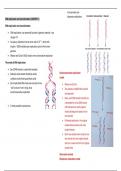
- Conservative and
dispersive replication
DNA replication and recombination I (KCSPX 11)
DNA replication and recombination
• DNA replication is an essential function of genetic material – see
chapter 10
• Accuracy: replication has an error rate of 10−6 , which still
implies 3000 mistakes per replication cycle in the human
genome
• Watson and Crick (1953) model: semi-conservative replication
The mode of DNA replication
• Each DNA strand is a potential template
• Adenylic acids attract thymidylic acids; Semiconservative replication
cytidylic acids attract guanidylic acids model
• Each replicated DNA molecule consists of one • Watson and Crick
“old” and one “new” string, thus • Two strands of dsDNA first unwind
semiconservative replication and separate
• Next, each DNA strand functions as
a template for a new DNA strand,
• 2 other possible mechanisms: with the bases on each original
strand dictating new bases on the
new strands
• Following replication, the original
double helix produces two new
double helices
• Each new double helix contains one
new strand and one original strand,
which is conserved from the original
double helix
Alternative models
Dispersive replication model
, • Replication of a dsDNA molecule results in two dsDNA Meselson-Stahl experiment: proof for semiconservative replication
molecules that are mixtures, or "hybrids" of "old" and "new" DNA
“Old dsDNA”
Sections of “old” and
“new” DNA on the same
strand
“old” + “new” “old” + “new”
Matthew Meselson and Franklin Stahl, 1958
“the most beautiful experiment in biology”
Is DNA replication:
• Dispersive Step 1: producing “generation 0”
• Conservative
• Semi-conservative • E. coli is grown in medium with 15N
(“heavy nitrogen”) for several
generations until all bacterial DNA is
labelled with 15N
• Ultracentrifugation shows that all DNA is
“heavy” (as expected)
All DNA of E. coli contains 15N
Ultracentrifugation – separation method according to density
15N – contains one extra neutron
, Step 4: producing “generation III”
• Generation II is allowed to
replicate for a third time in
medium with 14N (“light nitrogen”)
Ultracentrifugation • Ultracentrifugation shows two
types of DNA: 50% “heavy”/50%
• All DNA molecules are 50%
“light” and 100% light – but not in
“heavy”/50% “light”
the same proportions
Step 2: producing “generation I”
• Generation 0 is allowed to replicate once in medium with 14N Ultracentrifugation
(“light nitrogen”)
• Three quarters of DNA molecules are “light”
• Ultracentrifugation shows that all DNA is 50% “heavy”/50% “light”
• One quarter of DNA molecules are 50%
“heavy”/50% “light”
• The proportion of 14N and 15N/14N
changed
Step 3: producing “generation II”
• Generation I is allowed to
replicate for a second time in
medium with 14N (“light
nitrogen”)
• Ultracentrifugation shows two
types of DNA: 50% “heavy”/50%
“light” and 100% light
All DNA is 50% heavy
and 50% light
Ultracentrifugation
• Half of the DNA molecules are 50% All DNA strands are All dsDNA are There is “light dsDNA
“heavy”/50% “light” DNA labelled with 15N “hybrid”: one There is “hybrid”
• Half of the DNA molecules are 100% “heavy” and one dsDNA
“light” “light” strand
dispersive replication
DNA replication and recombination I (KCSPX 11)
DNA replication and recombination
• DNA replication is an essential function of genetic material – see
chapter 10
• Accuracy: replication has an error rate of 10−6 , which still
implies 3000 mistakes per replication cycle in the human
genome
• Watson and Crick (1953) model: semi-conservative replication
The mode of DNA replication
• Each DNA strand is a potential template
• Adenylic acids attract thymidylic acids; Semiconservative replication
cytidylic acids attract guanidylic acids model
• Each replicated DNA molecule consists of one • Watson and Crick
“old” and one “new” string, thus • Two strands of dsDNA first unwind
semiconservative replication and separate
• Next, each DNA strand functions as
a template for a new DNA strand,
• 2 other possible mechanisms: with the bases on each original
strand dictating new bases on the
new strands
• Following replication, the original
double helix produces two new
double helices
• Each new double helix contains one
new strand and one original strand,
which is conserved from the original
double helix
Alternative models
Dispersive replication model
, • Replication of a dsDNA molecule results in two dsDNA Meselson-Stahl experiment: proof for semiconservative replication
molecules that are mixtures, or "hybrids" of "old" and "new" DNA
“Old dsDNA”
Sections of “old” and
“new” DNA on the same
strand
“old” + “new” “old” + “new”
Matthew Meselson and Franklin Stahl, 1958
“the most beautiful experiment in biology”
Is DNA replication:
• Dispersive Step 1: producing “generation 0”
• Conservative
• Semi-conservative • E. coli is grown in medium with 15N
(“heavy nitrogen”) for several
generations until all bacterial DNA is
labelled with 15N
• Ultracentrifugation shows that all DNA is
“heavy” (as expected)
All DNA of E. coli contains 15N
Ultracentrifugation – separation method according to density
15N – contains one extra neutron
, Step 4: producing “generation III”
• Generation II is allowed to
replicate for a third time in
medium with 14N (“light nitrogen”)
Ultracentrifugation • Ultracentrifugation shows two
types of DNA: 50% “heavy”/50%
• All DNA molecules are 50%
“light” and 100% light – but not in
“heavy”/50% “light”
the same proportions
Step 2: producing “generation I”
• Generation 0 is allowed to replicate once in medium with 14N Ultracentrifugation
(“light nitrogen”)
• Three quarters of DNA molecules are “light”
• Ultracentrifugation shows that all DNA is 50% “heavy”/50% “light”
• One quarter of DNA molecules are 50%
“heavy”/50% “light”
• The proportion of 14N and 15N/14N
changed
Step 3: producing “generation II”
• Generation I is allowed to
replicate for a second time in
medium with 14N (“light
nitrogen”)
• Ultracentrifugation shows two
types of DNA: 50% “heavy”/50%
“light” and 100% light
All DNA is 50% heavy
and 50% light
Ultracentrifugation
• Half of the DNA molecules are 50% All DNA strands are All dsDNA are There is “light dsDNA
“heavy”/50% “light” DNA labelled with 15N “hybrid”: one There is “hybrid”
• Half of the DNA molecules are 100% “heavy” and one dsDNA
“light” “light” strand


