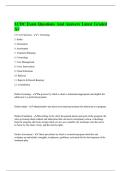
CSE 230 midterm 1 UPDATED ACTUAL
Exam Questions and CORRECT Answers
An assembly language programmer's view of the microprocessor - CORRECT ANSWER -
instruction set architecture
Assembly language instructions that can be executed by the processor - CORRECT
ANSWER - instruction set
Storage within the processor - CORRECT ANSWER - register
Addresses where data comes from and where it goes when it is executed - CORRECT
ANSWER - addressing mode
Binary encoding of instructions and data - CORRECT ANSWER - machine language
The representation of symbols in a source alphabet by strings of binary digits - CORRECT
ANSWER - binary encoding
What translates symbolic assembly language code into binary machine language code? -
CORRECT ANSWER - assembler
When using a HLL, does a programmer need an understanding of the underlying instruction set
architecture? - CORRECT ANSWER - no
What does using a HLL increase? - CORRECT ANSWER - productivity
The rate at which programmers can develop code - CORRECT ANSWER - productivity
, HLLs are generally hardware-(dependent, independent). - CORRECT ANSWER -
independent
A compiler can be written to generate machine language for (any, only one) target ISA. -
CORRECT ANSWER - any
Programs written in HLLs are (less, more) portable than those written in assembly language. -
CORRECT ANSWER - more
A trait of code that means source code can be modified as required and recompiled to run on a
different machine - CORRECT ANSWER - portability
What is a kilobyte? - CORRECT ANSWER - 10^3
What is a megabyte? - CORRECT ANSWER - 10^6
What is a gigabyte? - CORRECT ANSWER - 10^9
What is a terabyte? - CORRECT ANSWER - 10^12
What is a petabyte? - CORRECT ANSWER - 10^15
What is an exabyte? - CORRECT ANSWER - 10^18
What is a zettabyte? - CORRECT ANSWER - 10^21
What is a yottabyte? - CORRECT ANSWER - 10^24
Exam Questions and CORRECT Answers
An assembly language programmer's view of the microprocessor - CORRECT ANSWER -
instruction set architecture
Assembly language instructions that can be executed by the processor - CORRECT
ANSWER - instruction set
Storage within the processor - CORRECT ANSWER - register
Addresses where data comes from and where it goes when it is executed - CORRECT
ANSWER - addressing mode
Binary encoding of instructions and data - CORRECT ANSWER - machine language
The representation of symbols in a source alphabet by strings of binary digits - CORRECT
ANSWER - binary encoding
What translates symbolic assembly language code into binary machine language code? -
CORRECT ANSWER - assembler
When using a HLL, does a programmer need an understanding of the underlying instruction set
architecture? - CORRECT ANSWER - no
What does using a HLL increase? - CORRECT ANSWER - productivity
The rate at which programmers can develop code - CORRECT ANSWER - productivity
, HLLs are generally hardware-(dependent, independent). - CORRECT ANSWER -
independent
A compiler can be written to generate machine language for (any, only one) target ISA. -
CORRECT ANSWER - any
Programs written in HLLs are (less, more) portable than those written in assembly language. -
CORRECT ANSWER - more
A trait of code that means source code can be modified as required and recompiled to run on a
different machine - CORRECT ANSWER - portability
What is a kilobyte? - CORRECT ANSWER - 10^3
What is a megabyte? - CORRECT ANSWER - 10^6
What is a gigabyte? - CORRECT ANSWER - 10^9
What is a terabyte? - CORRECT ANSWER - 10^12
What is a petabyte? - CORRECT ANSWER - 10^15
What is an exabyte? - CORRECT ANSWER - 10^18
What is a zettabyte? - CORRECT ANSWER - 10^21
What is a yottabyte? - CORRECT ANSWER - 10^24