

Lab 6 Study Guide 1: AMGST Date:29Sep23 Names:
• Monocots and Eudicots :
• Plant Tissues and Leaf Cross Section :
• Tree Growth and Bark :
Watch the video: https://www.youtube.com/watch?v=zHp_voyo7MY (13:36)
Answer the questions from the video or from the additional images. Images from the
Photographic Atlas are also informative.
This is a Word Document; it will expand as you fill it out.
Monocots and Dicots:
What is a
cotyledon?
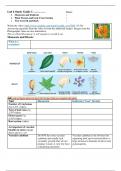
Look at figure above or fig 5.167 in the Atlas to complete the table.
Trait Monocots Eudicots (“true” Dicots)
Number of Cotyledons
Fig 5.167, (video)
Type of leaf veins Fig
5.167(video)
Flower parts Fig
5.167,(video)
Root system (video)
Arrangement of vascular
bundles in stems (image
above and Fig 5.167
Vascular cambium Do NOT have true vascular Vascular cambium is the obvious line
cambium and usually lack separating bark and wood and allows a
secondary growth (they do not large increase in diameter in dicots and
produce wood). A very few have gymnosperms.
a thickening meristem.
, Look at Figure 5.254 in the Atlas. Can you tell which flowers are monocots, and which are dicots? What
additional information do you need?
Plant Structure: Find and be able to name the basic parts of a plant (parts in bold are in the video).
1. Stem
2. Leaf
3. Node
4. Internode
Plant tissues: Complete the table from information in the video (at time 2:32), content below.
Tissue Component What is the function of the components?
Dermal: Epidermis
Protection
and prevent Periderm
water loss
Guard cells surround
the Stomata
Cuticle
Ground: Parenchyma
Metabolism,
storage and Collenchyma
support
Sclerenchyma
Vascular: Xylem
Transport
water and Phloem
sugar
• Monocots and Eudicots :
• Plant Tissues and Leaf Cross Section :
• Tree Growth and Bark :
Watch the video: https://www.youtube.com/watch?v=zHp_voyo7MY (13:36)
Answer the questions from the video or from the additional images. Images from the
Photographic Atlas are also informative.
This is a Word Document; it will expand as you fill it out.
Monocots and Dicots:
What is a
cotyledon?
Look at figure above or fig 5.167 in the Atlas to complete the table.
Trait Monocots Eudicots (“true” Dicots)
Number of Cotyledons
Fig 5.167, (video)
Type of leaf veins Fig
5.167(video)
Flower parts Fig
5.167,(video)
Root system (video)
Arrangement of vascular
bundles in stems (image
above and Fig 5.167
Vascular cambium Do NOT have true vascular Vascular cambium is the obvious line
cambium and usually lack separating bark and wood and allows a
secondary growth (they do not large increase in diameter in dicots and
produce wood). A very few have gymnosperms.
a thickening meristem.
, Look at Figure 5.254 in the Atlas. Can you tell which flowers are monocots, and which are dicots? What
additional information do you need?
Plant Structure: Find and be able to name the basic parts of a plant (parts in bold are in the video).
1. Stem
2. Leaf
3. Node
4. Internode
Plant tissues: Complete the table from information in the video (at time 2:32), content below.
Tissue Component What is the function of the components?
Dermal: Epidermis
Protection
and prevent Periderm
water loss
Guard cells surround
the Stomata
Cuticle
Ground: Parenchyma
Metabolism,
storage and Collenchyma
support
Sclerenchyma
Vascular: Xylem
Transport
water and Phloem
sugar


