, PLEASE USE THIS DOCUMENT AS A GUIDE TO ANSWER YOUR ASSIGNMENT
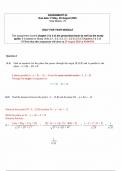
(1.1) Find an equation for the plane that passes through the origin (0, 0, 0) and is parallel to
the plane - x +3y - 2z = 6.
To find the equation of the plane parallel to -:t +3y - 2z = 6, we note that two planes are parallel if they
have the same normal vector. The normal vector of the plane - x +3y - 2z = 6is(-1, 3, - 2).
Since the planewe are looking for passes through the origin, itsequation will have the form:
-x +3y - 2z = 0
(1.2) Find the distance between the point (-1, -2, 0) and the plane 3x - y + 4z = -2.
To fi nd the d is tance from a point ( x 1, y 1 , z 1) to a plane Ax + B y + Gz + D = 0, the formula is:
. + B y1 + Gz1 + D I
= -IAx1
D1stance ------;;= = = =;;;---
✓A 2 + B 2 + c2
For the point (-1, - 2 , 0) and the plane 3x -y + 4z - - 2, we can substitute A - 3, B - -1, G = 4,
D = 2 (since we rearra ng e the equation of the plane as 3x - y + 4z + 2 = 0).
Now, applying the formula:
Distance - 13(-1)-(-2) + 4(0)+ 21 _ l - 3 + 2 + 21 _ J!l __l_
J 32 + (-1) 2 + 42 ✓9 + 1 + 16 56 V26
So, the distance is:
1
Distance = ~ ~ 0.196
v 26
,(2.1) Find the angle between the two vectors v = (-1, 1,0, -1) and w = (1, -1 , 3, -2).
Determine whether both vectors are perpendicular, parallel, or neither.
To find the angle 0 between two vecto rs, we use the formula:
V •W
cos0 = lvllwl
Where:
• v · w is the dot product of the vectors.
• lvl and lwl are the magnitudes of the vectors.
Step 1: Find the dot product v • w
V •W = (- 1)(1) + (1)( - 1) + (0)(3) + (- 1)(- 2) = - 1 - 1 + 0 + 2 = 0
Step 2: Find the magnitudes of v and w
lvl - ✓(- 1) 2 + 12 + 02 + (- 1)2 - v'l + 1 + 0 + 1 - v'3
lwl = ✓1 2 + (- 1) 2 + 32 + (- 2) 2 = v'l + l + 9 + 4 = Vl5
Step 3: Calculate cos 0
0
cos0 = v'3 x v'15 = 0
Since cos 0 = 0, the vectors are perpendicular. This is because the angle between them is 90°.
, (2.2) Find the direction cosines and the direction angles for the vector r = (0, - 1, - 2, ~ ).
The direction cosines are the cosines of the angles that the vector makes with the coordinate axes. The
direction angles a, {3, and I are given by:
't z
cos a =
1"x
j;"j' cos f3
1"y
= Vi' cos, = VI
Where r,, = 0, ry = - 1, and r·z =- 2 (the components of r ).
Step 1: Find the magnitude of the vector r
✓0 + 1 + 4 + -9 - ~
2
lrl - 02 +(-1)2 + (- 2)2, + (3)
- -
4
- +4
-
16
- -ffi
9 - /H3 -
16 16 16 4
Step 2: Find the direction cosines
-1 -4 -2 -8
cos a: - - 0 - 0 cos f3 - ,ff:i - \/13 ' cos,- - - --
v'7:i ' ~ ffi
T 4 4
Step 3: Find the direction angles
The direction angles a , fl, and 'Y can be found by taking the inverse cosine of the direction cosines:
fJ = cos-1 ( v'- 74)
3
1 - cos 1 (-8)
173
(1.1) Find an equation for the plane that passes through the origin (0, 0, 0) and is parallel to
the plane - x +3y - 2z = 6.
To find the equation of the plane parallel to -:t +3y - 2z = 6, we note that two planes are parallel if they
have the same normal vector. The normal vector of the plane - x +3y - 2z = 6is(-1, 3, - 2).
Since the planewe are looking for passes through the origin, itsequation will have the form:
-x +3y - 2z = 0
(1.2) Find the distance between the point (-1, -2, 0) and the plane 3x - y + 4z = -2.
To fi nd the d is tance from a point ( x 1, y 1 , z 1) to a plane Ax + B y + Gz + D = 0, the formula is:
. + B y1 + Gz1 + D I
= -IAx1
D1stance ------;;= = = =;;;---
✓A 2 + B 2 + c2
For the point (-1, - 2 , 0) and the plane 3x -y + 4z - - 2, we can substitute A - 3, B - -1, G = 4,
D = 2 (since we rearra ng e the equation of the plane as 3x - y + 4z + 2 = 0).
Now, applying the formula:
Distance - 13(-1)-(-2) + 4(0)+ 21 _ l - 3 + 2 + 21 _ J!l __l_
J 32 + (-1) 2 + 42 ✓9 + 1 + 16 56 V26
So, the distance is:
1
Distance = ~ ~ 0.196
v 26
,(2.1) Find the angle between the two vectors v = (-1, 1,0, -1) and w = (1, -1 , 3, -2).
Determine whether both vectors are perpendicular, parallel, or neither.
To find the angle 0 between two vecto rs, we use the formula:
V •W
cos0 = lvllwl
Where:
• v · w is the dot product of the vectors.
• lvl and lwl are the magnitudes of the vectors.
Step 1: Find the dot product v • w
V •W = (- 1)(1) + (1)( - 1) + (0)(3) + (- 1)(- 2) = - 1 - 1 + 0 + 2 = 0
Step 2: Find the magnitudes of v and w
lvl - ✓(- 1) 2 + 12 + 02 + (- 1)2 - v'l + 1 + 0 + 1 - v'3
lwl = ✓1 2 + (- 1) 2 + 32 + (- 2) 2 = v'l + l + 9 + 4 = Vl5
Step 3: Calculate cos 0
0
cos0 = v'3 x v'15 = 0
Since cos 0 = 0, the vectors are perpendicular. This is because the angle between them is 90°.
, (2.2) Find the direction cosines and the direction angles for the vector r = (0, - 1, - 2, ~ ).
The direction cosines are the cosines of the angles that the vector makes with the coordinate axes. The
direction angles a, {3, and I are given by:
't z
cos a =
1"x
j;"j' cos f3
1"y
= Vi' cos, = VI
Where r,, = 0, ry = - 1, and r·z =- 2 (the components of r ).
Step 1: Find the magnitude of the vector r
✓0 + 1 + 4 + -9 - ~
2
lrl - 02 +(-1)2 + (- 2)2, + (3)
- -
4
- +4
-
16
- -ffi
9 - /H3 -
16 16 16 4
Step 2: Find the direction cosines
-1 -4 -2 -8
cos a: - - 0 - 0 cos f3 - ,ff:i - \/13 ' cos,- - - --
v'7:i ' ~ ffi
T 4 4
Step 3: Find the direction angles
The direction angles a , fl, and 'Y can be found by taking the inverse cosine of the direction cosines:
fJ = cos-1 ( v'- 74)
3
1 - cos 1 (-8)
173